University of Marburg, Marburg, Germany.
University of Cambridge, Cambridge, UK.
Transl Psychiatry. 2023 May 10;13(1):162. doi: 10.1038/s41398-023-02444-z.
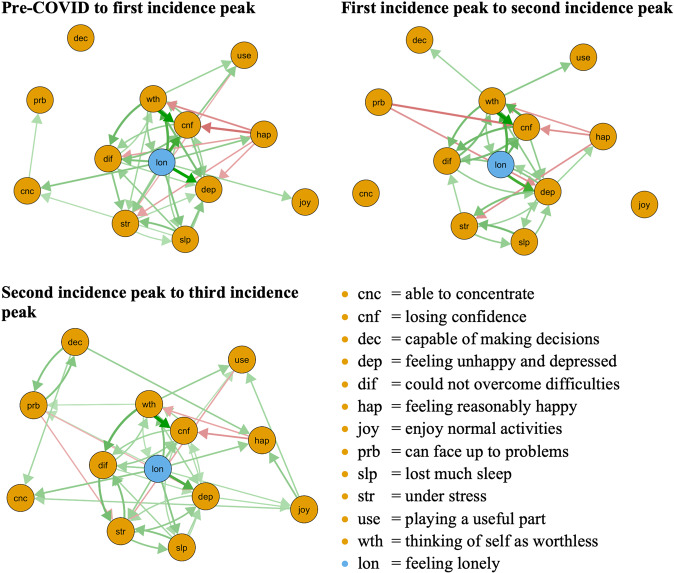
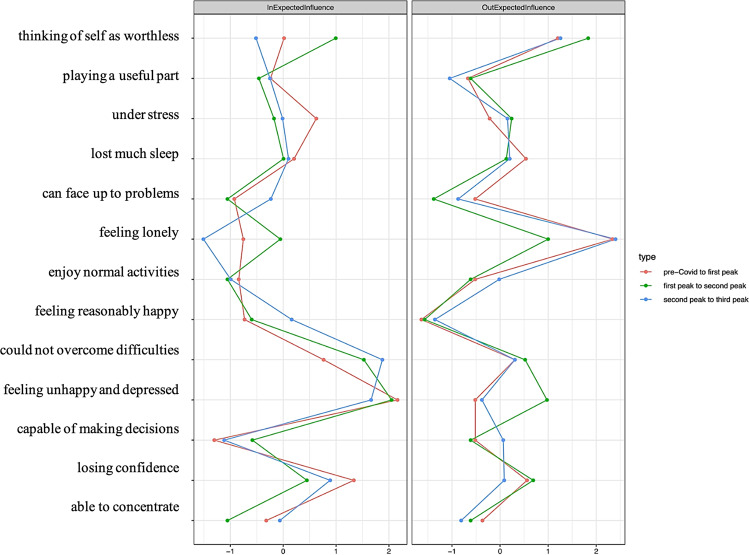
Figuring out which symptoms are central for symptom escalation during the COVID-19 pandemic is important for targeting prevention and intervention. Previous studies have contributed to the understanding of the course of psychological distress during the pandemic, but less is known about key symptoms of psychological distress over time. Going beyond a pathogenetic pathway perspective, we applied the network approach to psychopathology to examine how psychological distress unfolds in a period of maximum stress (pre-pandemic to pandemic onset) and a period of repeated stress (pandemic peak to pandemic peak). We conducted secondary data analyses with the Understanding Society data (N = 17,761), a longitudinal probability study in the UK with data before (2019), at the onset of (April 2020), and during the COVID-19 pandemic (November 2020 & January 2021). Using the General Health Questionnaire and one loneliness item, we computed three temporal cross-lagged panel network models to analyze psychological distress over time. Specifically, we computed (1) a pre-COVID to first incidence peak network, (2) a first incidence peak to second incidence peak network, and (3) a second incidence peak to third incidence peak network. All networks were highly consistent over time. Loneliness and thinking of self as worthless displayed a high influence on other symptoms. Feeling depressed and not overcoming difficulties had many incoming connections, thus constituting an end-product of symptom cascades. Our findings highlight the importance of loneliness and self-worth for psychological distress during COVID-19, which may have important implications in therapy and prevention. Prevention and intervention measures are discussed, as single session interventions are available that specifically target loneliness and worthlessness to alleviate mental health problems.
确定 COVID-19 大流行期间哪些症状是症状恶化的核心,对于有针对性地进行预防和干预至关重要。先前的研究有助于了解大流行期间心理困扰的过程,但对于心理困扰随时间推移的关键症状知之甚少。超越病因学途径的观点,我们应用精神病理学网络方法来检查在最大压力期间(大流行前至大流行开始)和重复压力期间(大流行高峰期至大流行高峰期)心理困扰是如何发展的。我们对英国纵向概率研究 Understanding Society 数据(N = 17761)进行了二次数据分析,该研究在大流行前(2019 年)、大流行开始时(2020 年 4 月)和 COVID-19 大流行期间(2020 年 11 月和 2021 年 1 月)收集数据。使用一般健康问卷和一个孤独项目,我们计算了三个时间交叉滞后面板网络模型来分析随时间推移的心理困扰。具体来说,我们计算了(1)COVID-19 前至第一发病高峰网络,(2)第一发病高峰至第二发病高峰网络,和(3)第二发病高峰至第三发病高峰网络。所有网络在时间上高度一致。孤独感和自我价值感对其他症状有很大影响。感到沮丧和无法克服困难有许多传入连接,因此构成了症状级联的最终产物。我们的研究结果强调了孤独感和自我价值感在 COVID-19 期间对心理困扰的重要性,这可能对治疗和预防具有重要意义。讨论了预防和干预措施,因为有专门针对孤独感和无价值感的单次干预措施,可以缓解心理健康问题。