Philip R. Lee Institute for Health Policy Studies, University of California San Francisco, 490 Illinois St, Box 0936, 95158, San Francisco, CA, USA.
BMC Public Health. 2023 May 11;23(1):864. doi: 10.1186/s12889-023-15762-0.
The Omicron variant of SARS-CoV-2 led to a steep rise in transmissions, and emerging variants continue to influence case rates across the US. As public tolerance for isolation abated, CDC guidance on duration of at-home isolation of COVID-19 cases was shortened to five days if no symptoms, with no laboratory test requirement, despite more cautious approaches advocated by other federal experts.
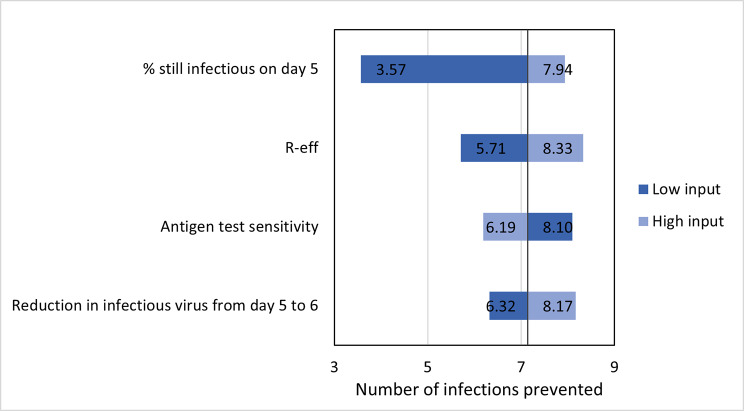
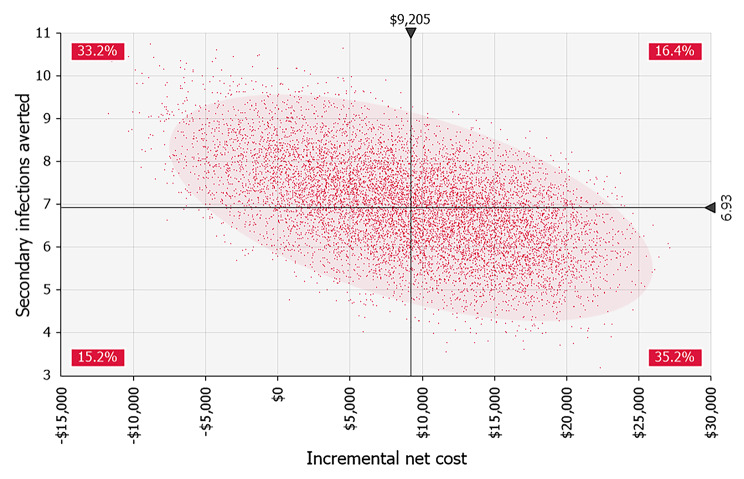
We conducted a decision tree analysis of alternative protocols for ending COVID-19 isolation, estimating net costs (direct and productivity), secondary infections, and incremental cost-effectiveness ratios. Sensitivity analyses assessed the impact of input uncertainty.
Per 100 individuals, five-day isolation had 23 predicted secondary infections and a net cost of $33,000. Symptom check on day five (CDC guidance) yielded a 23% decrease in secondary infections (to 17.8), with a net cost of $45,000. Antigen testing on day six yielded 2.9 secondary infections and $63,000 in net costs. This protocol, compared to the next best protocol of antigen testing on day five of a maximum eight-day isolation, cost an additional $1,300 per secondary infection averted. Antigen or polymerase chain reaction testing on day five were dominated (more expensive and less effective) versus antigen testing on day six. Results were qualitatively robust to uncertainty in key inputs.
A six-day isolation with antigen testing to confirm the absence of contagious virus appears the most effective and cost-effective de-isolation protocol to shorten at-home isolation of individuals with COVID-19.
SARS-CoV-2 的奥密克戎变体导致传播急剧上升,新出现的变体继续影响美国各地的病例率。随着公众对隔离的容忍度降低,CDC 将 COVID-19 病例在家隔离的持续时间从如果没有症状则缩短至五天的指导缩短,无需进行实验室检测,尽管其他联邦专家提倡更为谨慎的方法。
我们对结束 COVID-19 隔离的替代方案进行了决策树分析,估计了净成本(直接和生产力)、二次感染和增量成本效益比。敏感性分析评估了输入不确定性的影响。
每 100 人中有 23 例预测的二次感染和 33,000 美元的净成本。在第五天进行症状检查(CDC 指南)可将二次感染减少 23%(降至 17.8),净成本为 45,000 美元。第六天进行抗原检测可导致 2.9 例二次感染和 63,000 美元的净成本。与下一个最佳方案(最长八天隔离期内第五天进行抗原检测)相比,该方案每避免一次二次感染的额外成本为 1,300 美元。第五天进行抗原或聚合酶链反应检测与第六天进行抗原检测相比,成本更高且效果更差。结果在关键输入存在不确定性的情况下具有定性稳健性。
使用抗原检测确认无传染性病毒的六天隔离似乎是最有效和最具成本效益的解除隔离方案,可以缩短 COVID-19 患者的居家隔离时间。