Department of Population Health Sciences, Spencer Fox Eccles School of Medicine at the University of Utah, Salt Lake City, Utah, USA.
Departments of Psychiatry and Behavioral Sciences and Medical Social Sciences, Northwestern University Feinberg School of Medicine, Chicago, IL, USA.
BMJ Open. 2023 May 15;13(5):e067657. doi: 10.1136/bmjopen-2022-067657.
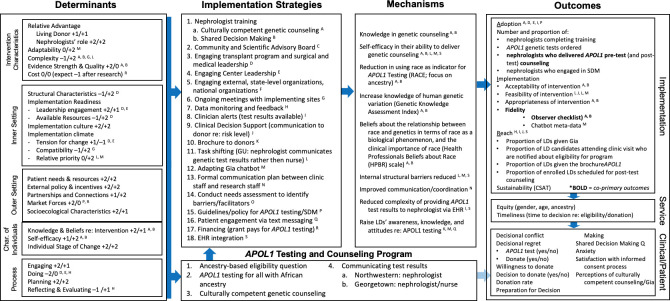
While living donor (LD) kidney transplantation is the optimal treatment for patients with kidney failure, LDs assume a higher risk of future kidney failure themselves. LDs of African ancestry have an even greater risk of kidney failure post-donation than White LDs. Because evidence suggests that Apolipoprotein L1 () risk variants contribute to this greater risk, transplant nephrologists are increasingly using genetic testing to evaluate LD candidates of African ancestry. However, nephrologists do not consistently perform genetic counselling with LD candidates about due to a lack of knowledge and skill in counselling. Without proper counselling, testing will magnify LD candidates' decisional conflict about donating, jeopardising their informed consent. Given cultural concerns about genetic testing among people of African ancestry, protecting LD candidates' safety is essential to improve informed decisions about donating. Clinical 'chatbots', mobile apps that provide genetic information to patients, can improve informed treatment decisions. No chatbot on is available and no nephrologist training programmes are available to provide culturally competent counselling to LDs about . Given the shortage of genetic counsellors, increasing nephrologists' genetic literacy is critical to integrating genetic testing into practice.
Using a non-randomised, pre-post trial design in two transplant centres (Chicago, IL, and Washington, DC), we will evaluate the effectiveness of culturally competent testing, chatbot and counselling on LD candidates' decisional conflict about donating, preparedness for decision-making, willingness to donate and satisfaction with informed consent and longitudinally evaluate the implementation of this intervention into clinical practice using the each, ffectiveness, doption, mplementation and aintenance framework.
This study will create a model for testing of LDs of African ancestry, which can be implemented nationally via implementation science approaches. will serve as a model for integrating culturally competent genetic testing into transplant and other practices to improve informed consent. This study involves human participants and was approved by Northwestern University IRB (STU00214038). Participants gave informed consent to participate in the study before taking part.
ClinicalTrials.gov Identifier: NCT04910867. Registered 8 May 2021, https://register.
gov/prs/app/action/SelectProtocol?sid=S000AWZ6&selectaction=Edit&uid=U0001PPF&ts=7&cx=-8jv7m2 ClinicalTrials.gov Identifier: NCT04999436. Registered 5 November 2021, https://register.
gov/prs/app/action/SelectProtocol?sid=S000AYWW&selectaction=Edit&uid=U0001PPF&ts=11&cx=9tny7v.
虽然活体供肾(LD)移植是治疗肾衰竭患者的最佳方法,但 LD 自身也面临着更高的未来肾衰竭风险。非裔 LD 的捐肾后肾衰竭风险甚至高于白种 LD。由于证据表明载脂蛋白 L1(APOL1)风险变体导致了这种更高的风险,移植肾病学家越来越多地使用基因检测来评估非裔 LD 候选人。然而,由于缺乏基因咨询方面的知识和技能,肾病学家并没有一直向 LD 候选人提供有关的遗传咨询。如果没有适当的咨询,检测将放大 LD 候选人对捐赠的决策冲突,危及他们的知情同意。鉴于非裔人群对基因检测的文化担忧,保护 LD 候选人的安全对于改善有关捐赠的知情决策至关重要。临床“聊天机器人”,即向患者提供遗传信息的移动应用程序,可以改善知情治疗决策。目前没有关于的聊天机器人,也没有肾脏科医生培训计划可以为 LD 候选人提供有关的文化能力咨询。鉴于遗传咨询师的短缺,提高肾病学家的基因素养对于将基因检测纳入实践至关重要。
我们将在两个移植中心(伊利诺伊州芝加哥和华盛顿特区)使用非随机、前后试验设计来评估文化能力基因检测、聊天机器人和咨询对 LD 候选人捐赠决策冲突、决策准备、捐赠意愿和知情同意满意度的影响,并使用每个、效果、采用、实施和维护框架纵向评估该干预措施在临床实践中的实施情况。
这项研究将为非裔 LD 的基因检测建立一个模型,该模型可以通过实施科学方法在全国范围内实施。将为将文化能力基因检测纳入移植和其他实践以改善知情同意提供模型。本研究涉及人类参与者,已获得西北大学 IRB(STU00214038)的批准。参与者在参与研究之前,已同意参与研究。
ClinicalTrials.gov 标识符:NCT04910867。注册于 2021 年 5 月 8 日,https://register.
ClinicalTrials.gov 标识符:NCT04999436。注册于 2021 年 11 月 5 日,https://register.
ClinicalTrials.gov 标识符:NCT04999436。注册于 2021 年 11 月 5 日,https://register.
ClinicalTrials.gov 标识符:NCT04999436。注册于 2021 年 11 月 5 日,https://register.
ClinicalTrials.gov 标识符:NCT04999436。注册于 2021 年 11 月 5 日,https://register.