Sarasati Andari, Syahruddin Muhammad Hidayat, Nuryanti Archadian, Ana Ika Dewi, Barlian Anggraini, Wijaya Christofora Hanny, Ratnadewi Diah, Wungu Triati Dewi Kencana, Takemori Hiroshi
Doctoral Study Program, Faculty of Dentistry, Universitas Gadjah Mada, Yogyakarta 55281, Indonesia.
Department of Dental Biomedical Sciences, Faculty of Dentistry, Universitas Gadjah Mada, Yogyakarta 55281, Indonesia.
Biomedicines. 2023 Mar 29;11(4):1053. doi: 10.3390/biomedicines11041053.
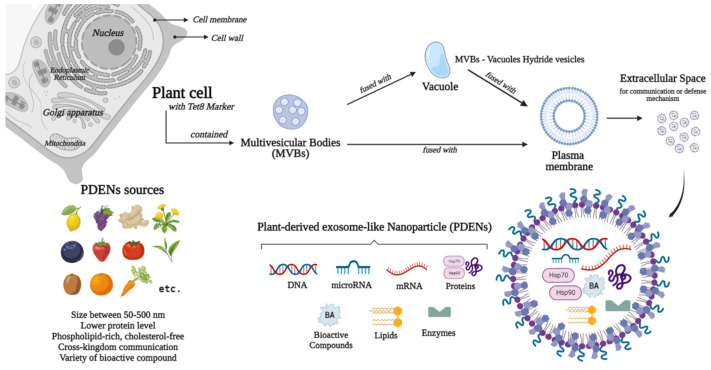
Plant-derived exosome-like nanoparticles (PDENs) comprise various bioactive biomolecules. As an alternative cell-free therapeutic approach, they have the potential to deliver nano-bioactive compounds to the human body, and thus lead to various anti-inflammatory, antioxidant, and anti-tumor benefits. Moreover, it is known that Indonesia is one of the herbal centers of the world, with an abundance of unexplored sources of PDENs. This encouraged further research in biomedical science to develop natural richness in plants as a source for human welfare. This study aims to verify the potential of PDENs for biomedical purposes, especially for regenerative therapy applications, by collecting and analyzing data from the latest relevant research and developments.
植物来源的外泌体样纳米颗粒(PDENs)包含各种生物活性生物分子。作为一种替代性的无细胞治疗方法,它们有潜力将纳米生物活性化合物输送到人体,从而带来各种抗炎、抗氧化和抗肿瘤益处。此外,众所周知,印度尼西亚是世界草药中心之一,拥有大量未被探索的PDENs来源。这鼓励了生物医学科学的进一步研究,以开发植物中的天然资源用于人类福祉。本研究旨在通过收集和分析最新相关研究与进展的数据,验证PDENs在生物医学领域的潜力,特别是在再生治疗应用方面的潜力。