Ruas Juliana Silveira, Silva Felipe Luz Torres, Euzébio Mayara Ferreira, Biazon Tássia Oliveira, Daiggi Camila Maia Martin, Nava Daniel, Franco Mayra Troiani, Cardinalli Izilda Aparecida, Cassone Alejandro Enzo, Pereira Luiz Henrique, Seidinger Ana Luiza, Maschietto Mariana, Jotta Patricia Yoshioka
Research Center, Boldrini Children's Hospital, Campinas 13083-884, SP, Brazil.
Genetics and Molecular Biology, Institute of Biology, State University of Campinas, Campinas 13083-862, SP, Brazil.
Biomedicines. 2023 Apr 3;11(4):1082. doi: 10.3390/biomedicines11041082.
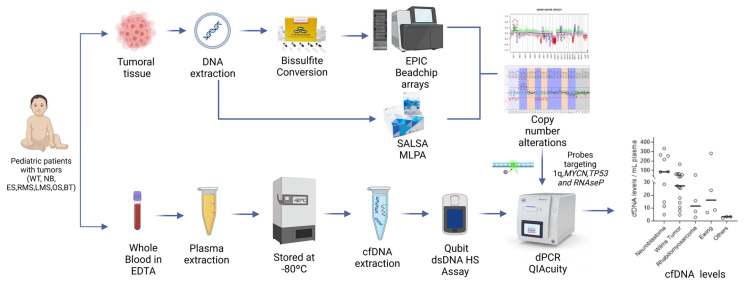
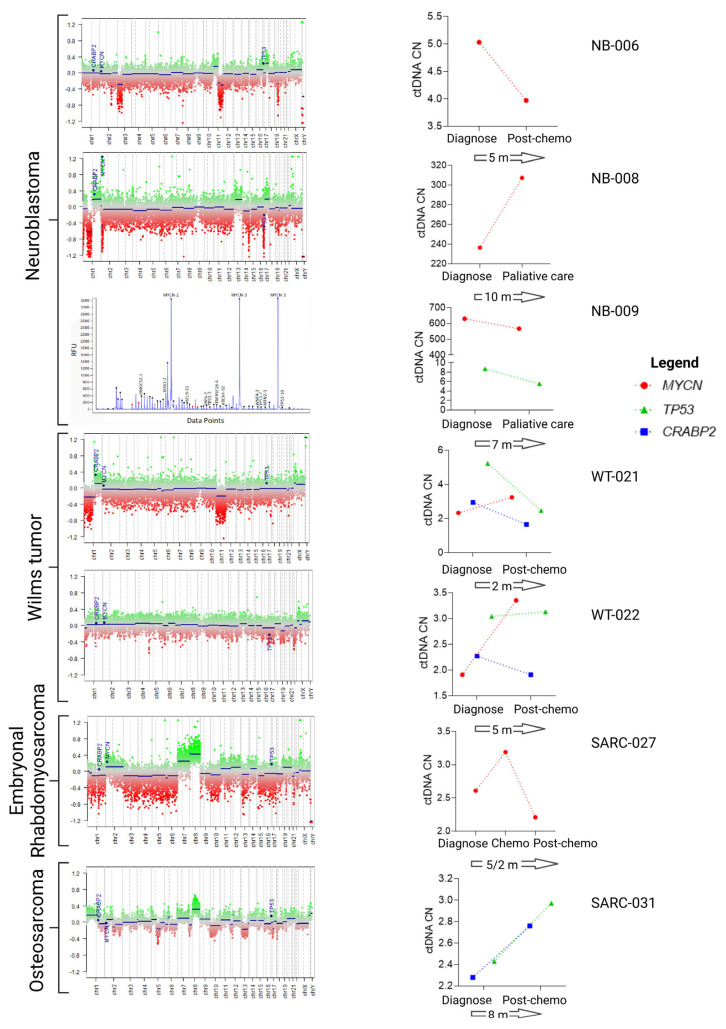
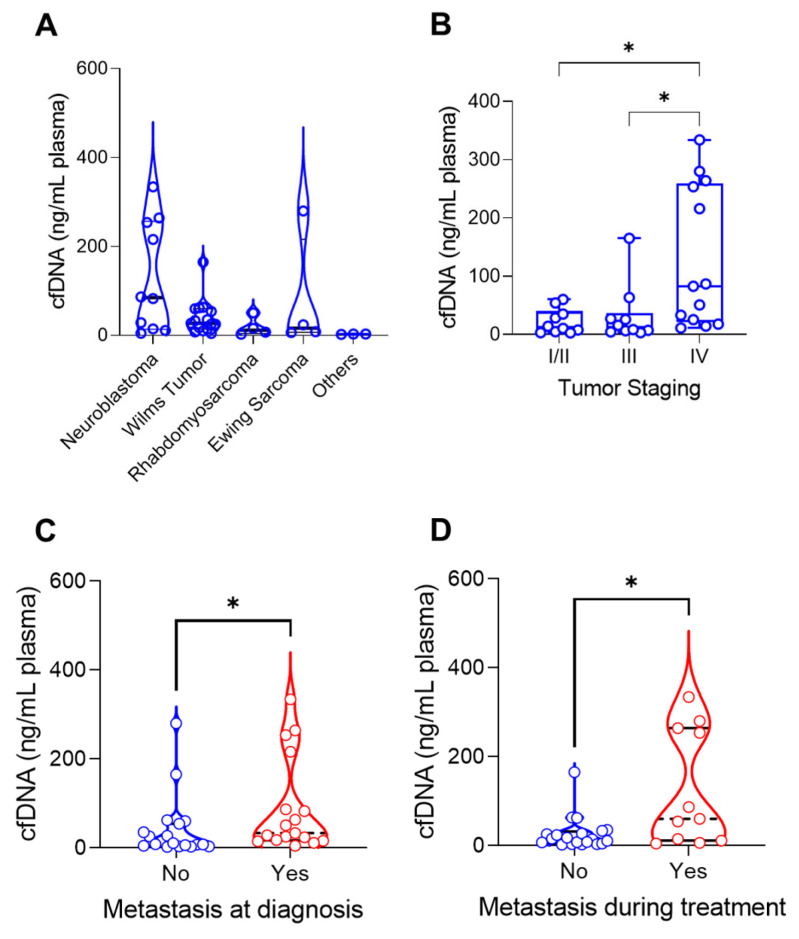
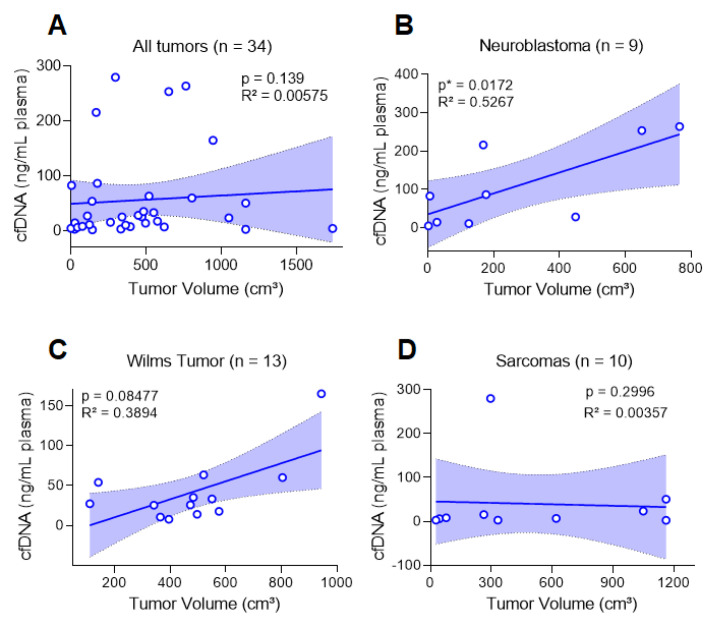
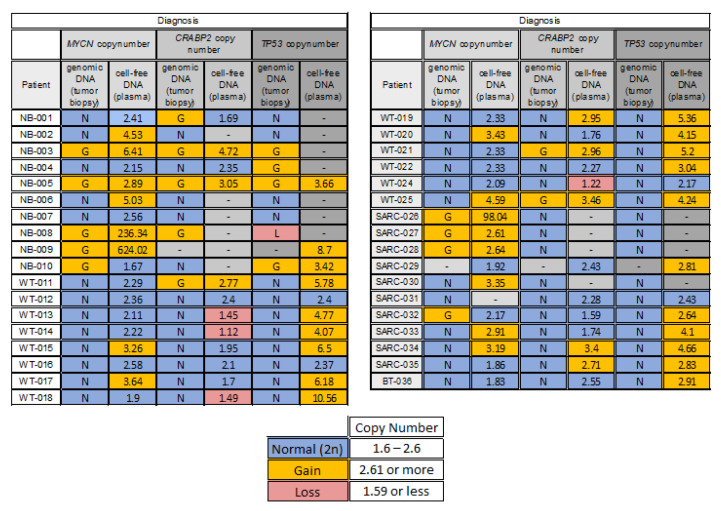
Pediatric tumors share few recurrent mutations and are instead characterized by copy number alterations (CNAs). The cell-free DNA (cfDNA) is a prominent source for the detection of cancer-specific biomarkers in plasma. We profiled CNAs in the tumor tissues for further evaluation of alterations in 1q, and 17p in the circulating tumor DNA (ctDNA) in the peripheral blood at diagnosis and follow-up using digital PCR. We report that among the different kinds of tumors (neuroblastoma, Wilms tumor, Ewing sarcoma, rhabdomyosarcoma, leiomyosarcoma, osteosarcoma and benign teratoma), neuroblastoma presented the greatest amount of cfDNA, in correlation with tumor volume. Considering all tumors, cfDNA levels correlated with tumor stage, metastasis at diagnosis and metastasis developed during therapy. In the tumor tissue, at least one CNA (at , , surrogate markers for 1q and 17p, respectively, and ) was observed in 89% of patients. At diagnosis, CNAs levels were concordant between tumor and ctDNA in 56% of the cases, and for the remaining 44%, 91.4% of the CNAs were present only in cfDNA and 8.6% only in the tumor. Within the cfDNA, we observed that 46% and 23% of the patients had and 1q gain, respectively. The use of specific CNAs as targets for liquid biopsy in pediatric patients with cancer can improve diagnosis and should be considered for monitoring of the disease response.
儿科肿瘤很少有复发性突变,而是以拷贝数改变(CNA)为特征。游离DNA(cfDNA)是检测血浆中癌症特异性生物标志物的重要来源。我们对肿瘤组织中的CNA进行了分析,以进一步评估诊断和随访时外周血中循环肿瘤DNA(ctDNA)中1q和17p的改变情况,采用数字PCR技术。我们报告,在不同类型的肿瘤(神经母细胞瘤、肾母细胞瘤、尤因肉瘤、横纹肌肉瘤、平滑肌肉瘤、骨肉瘤和良性畸胎瘤)中,神经母细胞瘤的cfDNA含量最高,与肿瘤体积相关。综合所有肿瘤来看,cfDNA水平与肿瘤分期、诊断时的转移情况以及治疗期间出现的转移相关。在肿瘤组织中,89%的患者至少观察到一种CNA(分别为1q和17p的替代标志物,以及)。诊断时,56%的病例肿瘤和ctDNA中的CNA水平一致,其余44%中,91.4%的CNA仅存在于cfDNA中,8.6%仅存在于肿瘤中。在cfDNA中,我们观察到分别有46%和23%的患者存在1q增益。将特定的CNA作为儿童癌症患者液体活检的靶点,可改善诊断,应考虑用于监测疾病反应。