Frøjd Lars Aastebøl, Dammen Toril, Munkhaugen John, Weedon-Fekjær Harald, Nordhus Inger Hilde, Papageorgiou Costas, Sverre Elise
Department of Behavioural Medicine, University of Oslo, Oslo, Norway.
Institute of Clinical Medicine, Medical Faculty, University of Oslo, Oslo, Norway.
Sleep Adv. 2022 Apr 7;3(1):zpac007. doi: 10.1093/sleepadvances/zpac007. eCollection 2022.
Insomnia is highly prevalent in patients with coronary heart disease (CHD). However, the potential effect of insomnia on the risk of recurrent major adverse cardiovascular events (MACE) remains uncertain.
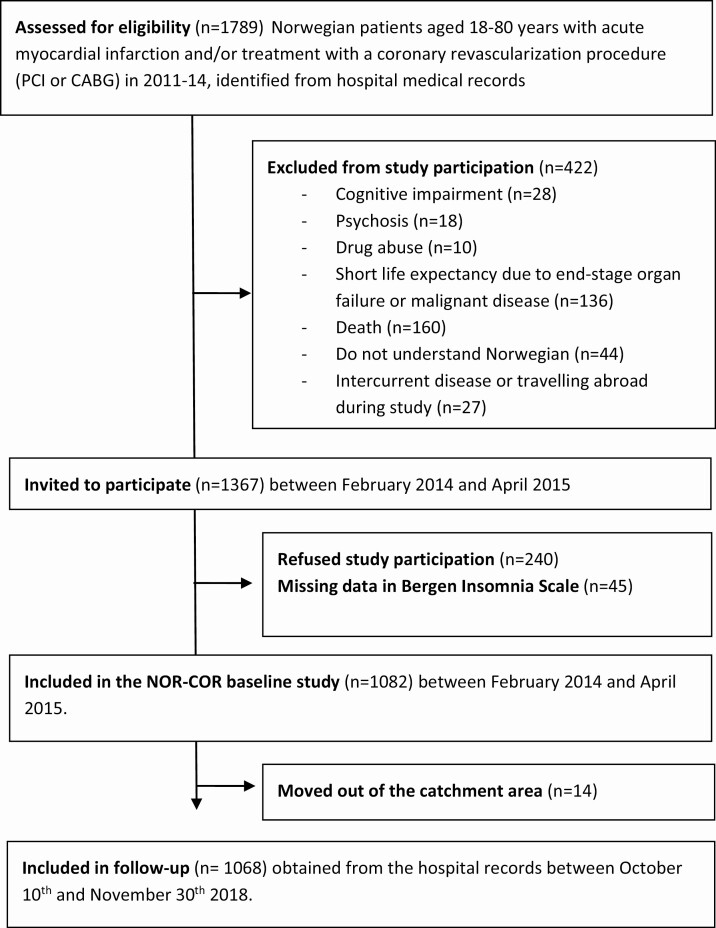
This prospective cohort study included 1082 consecutive patients 2-36 (mean 16) months after myocardial infarction and/or coronary revascularization. Data on clinical insomnia, coronary risk factors, and comorbidity were collected at baseline. Clinical insomnia was assessed using the Bergen Insomnia Scale (BIS). The primary composite endpoint of MACE (cardiovascular death, hospitalization due to myocardial infarction, revascularization, stroke, or heart failure) was assessed with an average follow-up of 4.2 (SD 0.3) years after baseline. Data were analyzed using Cox proportional hazard regression models stratified by prior coronary events before the index event.
At baseline, mean age was 62 years, 21% were females, and 45% reported clinical insomnia. A total of 346 MACE occurred in 225 patients during the follow-up period. For clinical insomnia, the relative risk of recurrent MACE was 1.62 (95% confidence interval [CI]: 1.24-2.11, p < .001) adjusted for age, gender, and previous coronary events. In a multi-adjusted analysis, including coronary risk factors, cardiovascular comorbidity, symptoms of anxiety, and depression, the relative risk was 1.41 (95% CI: 1.05-1.89, p = .023). Clinical insomnia accounted for 16% of the MACE in attributable risk fraction analyses, being third in importance after smoking (27%) and low physical activity (21%).
Clinical insomnia was associated with increased risk of recurrent MACE. These results emphasize the importance of identifying and managing insomnia in CHD outpatients.
失眠在冠心病(CHD)患者中极为普遍。然而,失眠对复发性主要不良心血管事件(MACE)风险的潜在影响仍不确定。
这项前瞻性队列研究纳入了1082例在心肌梗死和/或冠状动脉血运重建术后2至36个月(平均16个月)的连续患者。在基线时收集有关临床失眠、冠状动脉危险因素和合并症的数据。使用卑尔根失眠量表(BIS)评估临床失眠情况。对MACE的主要复合终点(心血管死亡、因心肌梗死住院、血运重建、中风或心力衰竭)进行评估,基线后平均随访4.2(标准差0.3)年。使用Cox比例风险回归模型对数据进行分析,该模型按索引事件前的既往冠状动脉事件进行分层。
在基线时,平均年龄为62岁,21%为女性,45%报告有临床失眠。在随访期间,225例患者共发生346次MACE。对于临床失眠,在调整年龄、性别和既往冠状动脉事件后,复发性MACE的相对风险为1.62(95%置信区间[CI]:1.24 - 2.11,p < 0.001)。在包括冠状动脉危险因素、心血管合并症、焦虑症状和抑郁症状的多因素调整分析中,相对风险为1.41(95% CI:1.05 - 1.89,p = 0.023)。在归因风险分数分析中,临床失眠占MACE的16%,在重要性方面仅次于吸烟(27%)和低体力活动(21%),位列第三。
临床失眠与复发性MACE风险增加相关。这些结果强调了在冠心病门诊患者中识别和管理失眠的重要性。