Taylor Shannon L, Donahue Paula M C, Pridmore Michael D, Garza Maria E, Patel Niral J, Custer Chelsea A, Luo Yu, Aday Aaron W, Beckman Joshua A, Donahue Manus J, Crescenzi Rachelle L
Vanderbilt University, Department of Biomedical Engineering, Nashville, Tennessee, United States.
Vanderbilt University Medical Center, Department of Physical Medicine and Rehabilitation, Nashville, Tennessee, United States.
J Med Imaging (Bellingham). 2023 May;10(3):036001. doi: 10.1117/1.JMI.10.3.036001. Epub 2023 May 15.
Lipedema is a painful subcutaneous adipose tissue (SAT) disease involving disproportionate SAT accumulation in the lower extremities that is frequently misdiagnosed as obesity. We developed a semiautomatic segmentation pipeline to quantify the unique lower-extremity SAT quantity in lipedema from multislice chemical-shift-encoded (CSE) magnetic resonance imaging (MRI).
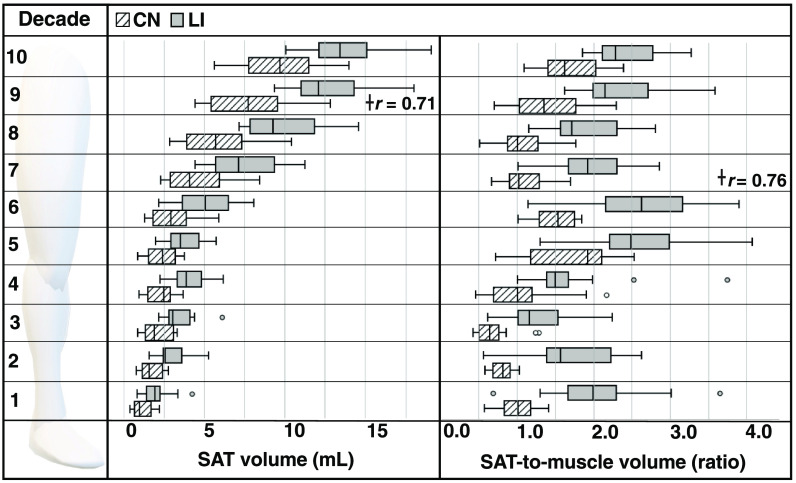
Patients with lipedema () and controls () matched for age and body mass index (BMI) underwent CSE-MRI acquired from the thighs to ankles. Images were segmented to partition SAT and skeletal muscle with a semiautomated algorithm incorporating classical image processing techniques (thresholding, active contours, Boolean operations, and morphological operations). The Dice similarity coefficient (DSC) was computed for SAT and muscle automated versus ground truth segmentations in the calf and thigh. SAT and muscle volumes and the SAT-to-muscle volume ratio were calculated across slices for decades containing 10% of total slices per participant. The effect size was calculated, and Mann-Whitney test applied to compare metrics in each decade between groups (significance: two-sided ).
Mean DSC for SAT segmentations was 0.96 in the calf and 0.98 in the thigh, and for muscle was 0.97 in the calf and 0.97 in the thigh. In all decades, mean SAT volume was significantly elevated in participants with versus without lipedema (), whereas muscle volume did not differ. Mean SAT-to-muscle volume ratio was significantly elevated () in all decades, where the greatest effect size for distinguishing lipedema was in the seventh decade approximately midthigh ().
The semiautomated segmentation of lower-extremity SAT and muscle from CSE-MRI could enable fast multislice analysis of SAT deposition throughout the legs relevant to distinguishing patients with lipedema from females with similar BMI but without SAT disease.
脂肪性水肿是一种疼痛性皮下脂肪组织(SAT)疾病,其特征是下肢SAT不成比例地堆积,常被误诊为肥胖症。我们开发了一种半自动分割流程,用于从多层化学位移编码(CSE)磁共振成像(MRI)中量化脂肪性水肿患者独特的下肢SAT量。
对年龄和体重指数(BMI)相匹配的脂肪性水肿患者()和对照组()进行从大腿到脚踝的CSE-MRI检查。采用结合经典图像处理技术(阈值处理、活动轮廓、布尔运算和形态学运算)的半自动算法对图像进行分割,以区分SAT和骨骼肌。计算小腿和大腿中SAT和肌肉自动分割与真实分割的骰子相似系数(DSC)。为每位参与者计算包含总切片10%的数十个切片的SAT和肌肉体积以及SAT与肌肉体积比。计算效应大小,并应用曼-惠特尼检验比较各组在每个十年中的指标(显著性:双侧)。
SAT分割的平均DSC在小腿为0.96,在大腿为0.98;肌肉分割的平均DSC在小腿为0.97,在大腿为0.97。在所有十年中,有脂肪性水肿的参与者的平均SAT体积显著高于无脂肪性水肿的参与者(),而肌肉体积无差异。所有十年中的平均SAT与肌肉体积比均显著升高(),其中区分脂肪性水肿的最大效应大小在大约大腿中部的第七个十年()。
从CSE-MRI中对下肢SAT和肌肉进行半自动分割,可以实现对整个腿部SAT沉积的快速多层分析,有助于区分脂肪性水肿患者与BMI相似但无SAT疾病的女性。