Pagliaccio David, Wengler Kenneth, Durham Katherine, Fontaine Martine, Rueppel Meryl, Becker Hannah, Bilek Emily, Pieper Sarah, Risdon Caroline, Horga Guillermo, Fitzgerald Kate D, Marsh Rachel
Department of Psychiatry, Columbia University Irving Medical Center, New York, NY, USA.
New York State Psychiatric Institute, New York, NY, USA.
Mol Psychiatry. 2023 Jul;28(7):3075-3082. doi: 10.1038/s41380-023-02105-z. Epub 2023 May 17.
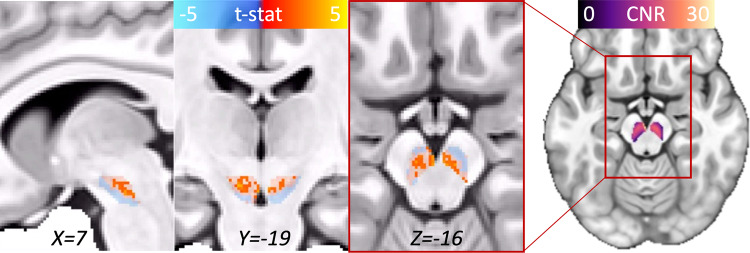
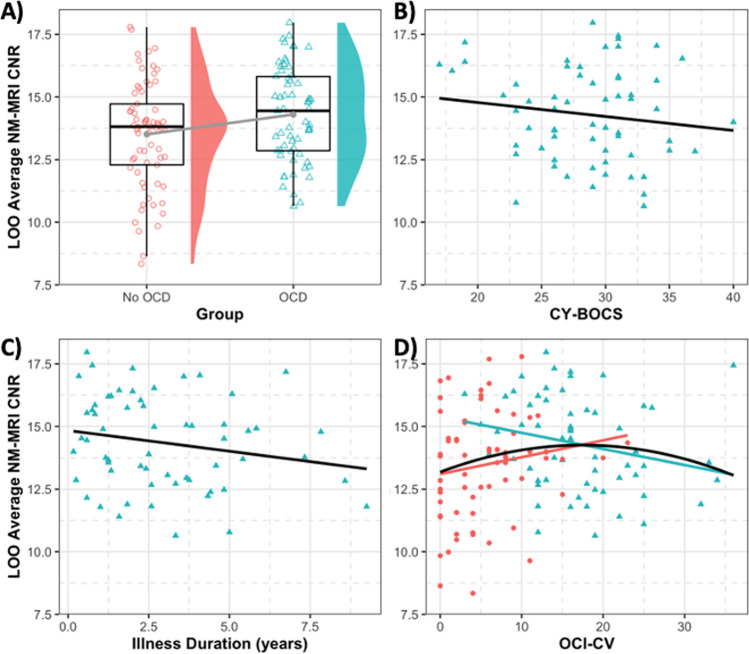
Obsessive-compulsive disorder (OCD) is an impairing psychiatric condition, which often onsets in childhood. Growing research highlights dopaminergic alterations in adult OCD, yet pediatric studies are limited by methodological constraints. This is the first study to utilize neuromelanin-sensitive MRI as a proxy for dopaminergic function among children with OCD. N = 135 youth (6-14-year-olds) completed high-resolution neuromelanin-sensitive MRI across two sites; n = 64 had an OCD diagnosis. N = 47 children with OCD completed a second scan after cognitive-behavioral therapy. Voxel-wise analyses identified that neuromelanin-MRI signal was higher among children with OCD compared to those without (483 voxels, permutation-corrected p = 0.018). Effects were significant within both the substania nigra pars compacta (p = 0.004, Cohen's d = 0.51) and ventral tegmental area (p = 0.006, d = 0.50). Follow-up analyses indicated that more severe lifetime symptoms (t = -2.72, p = 0.009) and longer illness duration (t = -2.22, p = 0.03) related to lower neuromelanin-MRI signal. Despite significant symptom reduction with therapy (p < 0.001, d = 1.44), neither baseline nor change in neuromelanin-MRI signal associated with symptom improvement. Current results provide the first demonstration of the utility of neuromelanin-MRI in pediatric psychiatry, specifically highlighting in vivo evidence for midbrain dopamine alterations in treatment-seeking youth with OCD. Neuromelanin-MRI likely indexes accumulating alterations over time, herein, implicating dopamine hyperactivity in OCD. Given evidence of increased neuromelanin signal in pediatric OCD but negative association with symptom severity, additional work is needed to parse potential longitudinal or compensatory mechanisms. Future studies should explore the utility of neuromelanin-MRI biomarkers to identify early risk prior to onset, parse OCD subtypes or symptom heterogeneity, and explore prediction of pharmacotherapy response.
强迫症(OCD)是一种会造成损害的精神疾病,通常在儿童期发病。越来越多的研究强调了成年强迫症患者多巴胺能的改变,但儿科研究受到方法学限制。这是第一项利用对神经黑素敏感的磁共振成像(MRI)作为强迫症患儿多巴胺能功能替代指标的研究。135名青少年(6至14岁)在两个地点完成了高分辨率对神经黑素敏感的MRI检查;其中64人被诊断患有强迫症。47名患有强迫症的儿童在接受认知行为治疗后完成了第二次扫描。体素分析发现,与未患强迫症的儿童相比,患强迫症儿童的神经黑素MRI信号更高(483个体素,置换校正p = 0.018)。在黑质致密部(p = 0.004,科恩d值 = 0.51)和腹侧被盖区(p = 0.006,d值 = 0.50)内均有显著影响。随访分析表明,更严重的终生症状(t = -2.72,p = 0.009)和更长的病程(t = -2.22,p = 0.03)与较低的神经黑素MRI信号相关。尽管治疗后症状有显著减轻(p < 0.001,d值 = 1.44),但神经黑素MRI信号的基线值或变化均与症状改善无关。目前的结果首次证明了神经黑素MRI在儿童精神病学中的实用性,特别突出了寻求治疗的强迫症青少年中脑多巴胺改变的体内证据。神经黑素MRI可能反映了随着时间积累的变化,在此表明强迫症中多巴胺功能亢进。鉴于儿科强迫症中神经黑素信号增加但与症状严重程度呈负相关的证据,需要进一步研究以剖析潜在的纵向或代偿机制。未来的研究应探索神经黑素MRI生物标志物在发病前识别早期风险、剖析强迫症亚型或症状异质性以及预测药物治疗反应方面的实用性。