Araújo Ana, Duarte Isabel C, Sousa Teresa, Meneses Sofia, Pereira Ana T, Robbins Trevor, Macedo António, Castelo-Branco Miguel
Coimbra Institute for Biomedical Imaging and Translational Research (CIBIT), University of Coimbra, 3000-548 Coimbra, Portugal; Institute for Nuclear Sciences Applied to Health (ICNAS), University of Coimbra, 3000-548 Coimbra, Portugal; Institute of Psychological Medicine, Faculty of Medicine, University of Coimbra, 3004-504 Coimbra, Portugal; Faculty of Medicine, Institute of Physiology, University of Coimbra, 3004-531 Coimbra, Portugal; Department of Psychiatry, Local Health Unit of Coimbra, 3004-561 Coimbra, Portugal.
Coimbra Institute for Biomedical Imaging and Translational Research (CIBIT), University of Coimbra, 3000-548 Coimbra, Portugal; Institute for Nuclear Sciences Applied to Health (ICNAS), University of Coimbra, 3000-548 Coimbra, Portugal.
Neuroimage Clin. 2025;45:103729. doi: 10.1016/j.nicl.2024.103729. Epub 2024 Dec 31.
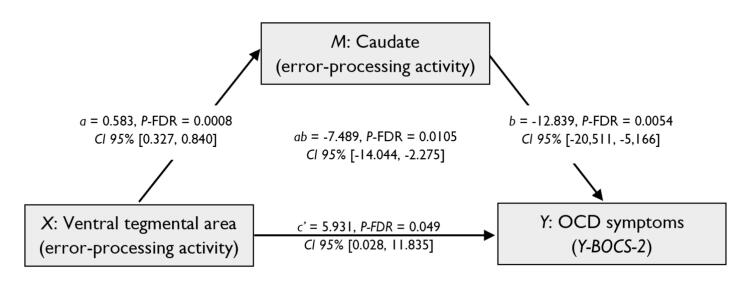
Dysfunctional response inhibition, mediated by the striatum and its connections, is thought to underly the clinical manifestations of obsessive-compulsive disorder (OCD). However, the exact neural mechanisms remain controversial. In this study, we undertook a novel approach by positing that a) inhibition is a dynamic construct inherently susceptible to numerous failures, which require error-processing, and b) the actor-critic framework of reinforcement learning can integrate neural patterns of inhibition and error-processing in OCD with their behavioural correlates. We invited nineteen adults with OCD and 21 age-matched healthy controls to perform an fMRI-adjusted stop-signal task. Then, we extracted brain activation and connectivity values regarding distinct task phases in the "actor" and "critic" regions, here corresponding to the caudate's head and dorsal putamen, and midbrain's nuclei (ventral tegmental area and substantia nigra). During response preparation phases of the inhibitory process, individuals with OCD exhibited decreased functional connectivity between the "critic" structures and frontal regions involved in cognitive and executive control. Activity analysis revealed task-related hyperactivation in the midbrain alongside error-processing-specific hyperactivation in the striatum, which was correlated with excessive behavioural slowness, also found in the clinical group. Finally, we identified a remarkable opponency between activity in the ventral tegmental area and caudate leading to direct increases and indirect decreases in symptom severity. We propose a unique "actor-critic"-based domain- and timing-dependent neural profile in OCD, reflecting "harm-avoidant" styles for response suppression, and influencing symptom severity. The dichotomy of hypoconnectivity and hyperactivation in the "critic" along with the opponent relationship between the "actor" and the "critic" in determining symptom severity suggests the implication of neural adaptation mechanisms in OCD with potential relevance for neurobiologically-driven therapies.
由纹状体及其连接介导的功能失调的反应抑制被认为是强迫症(OCD)临床表现的基础。然而,确切的神经机制仍存在争议。在本研究中,我们采用了一种新方法,假定:a)抑制是一个动态结构,本质上容易出现许多失误,这需要错误处理;b)强化学习的行为者-评判者框架可以将强迫症中抑制和错误处理的神经模式与其行为关联整合起来。我们邀请了19名患有强迫症的成年人和21名年龄匹配的健康对照者进行功能磁共振成像(fMRI)调整后的停止信号任务。然后,我们提取了“行为者”和“评判者”区域(此处对应尾状核头部和背侧壳核以及中脑核团(腹侧被盖区和黑质))中不同任务阶段的脑激活和连接值。在抑制过程的反应准备阶段,强迫症患者在“评判者”结构与参与认知和执行控制的额叶区域之间表现出功能连接减少。活动分析显示,中脑存在与任务相关的过度激活,同时纹状体存在与错误处理相关的过度激活,这与临床组中发现的过度行为迟缓相关。最后,我们确定腹侧被盖区和尾状核活动之间存在显著的对立关系,导致症状严重程度直接增加和间接降低。我们提出了一种独特的基于“行为者-评判者”的、与领域和时间相关的强迫症神经特征,反映了反应抑制的“避免伤害”风格,并影响症状严重程度。“评判者”中的低连接性和过度激活的二分法,以及“行为者”和“评判者”在决定症状严重程度方面的对立关系,表明神经适应机制在强迫症中的作用,这可能与神经生物学驱动的治疗相关。