Emergency Department, Haaglanden Medical Center, P.O. Box 432, 2501 CK, The Hague, The Netherlands.
Department of Psychiatry, Leiden University Medical Center, Leiden, The Netherlands.
BMC Geriatr. 2023 May 18;23(1):309. doi: 10.1186/s12877-023-04021-x.
As unplanned Emergency Department (ED) return visits (URVs) are associated with adverse health outcomes in older adults, many EDs have initiated post-discharge interventions to reduce URVs. Unfortunately, most interventions fail to reduce URVs, including telephone follow-up after ED discharge, investigated in a recent trial. To understand why these interventions were not effective, we analyzed patient and ED visit characteristics and reasons for URVs within 30 days for patients aged ≥ 70 years.
Data was used from a randomized controlled trial, investigating whether telephone follow-up after ED discharge reduced URVs compared to a satisfaction survey call. Only observational data from control group patients were used. Patient and index ED visit characteristics were compared between patients with and without URVs. Two independent researchers determined the reasons for URVs and categorized them into: patient-related, illness-related, new complaints and other reasons. Associations were examined between the number of URVs per patient and the categories of reasons for URVs.
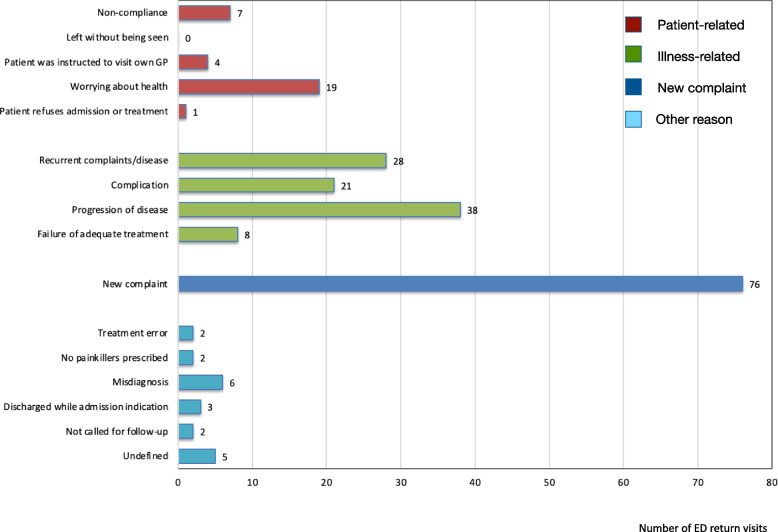
Of the 1659 patients, 222 (13.4%) had at least one URV within 30 days. Male sex, ED visit in the 30 days before the index ED visit, triage category "urgent", longer length of ED stay, urinary tract problems, and dyspnea were associated with URVs. Of the 222 patients with an URV, 31 (14%) returned for patient-related reasons, 95 (43%) for illness-related reasons, 76 (34%) for a new complaint and 20 (9%) for other reasons. URVs of patients who returned ≥ 3 times were mostly illness-related (72%).
As the majority of patients had an URV for illness-related reasons or new complaints, these data fuel the discussion as to whether URVs can or should be prevented.
For this cohort study, we used data from a randomized controlled trial (RCT). This trial was pre-registered in the Netherlands Trial Register with number NTR6815 on the 7 of November 2017.
由于非计划性急诊部(ED)复诊(URV)与老年人的不良健康结果相关,许多 ED 已经启动了出院后干预措施以减少 URV。不幸的是,大多数干预措施未能减少 URV,包括最近一项试验中调查的 ED 出院后电话随访。为了了解为什么这些干预措施无效,我们分析了 70 岁及以上患者在 30 天内 URV 的患者和 ED 就诊特征及 URV 原因。
该研究使用了一项随机对照试验的数据,该试验调查了 ED 出院后电话随访是否与满意度调查电话相比减少了 URV。仅使用对照组患者的观察数据。比较了 URV 患者和无 URV 患者的患者和指数 ED 就诊特征。两位独立的研究人员确定了 URV 的原因,并将其分为:患者相关、疾病相关、新投诉和其他原因。检查了每位患者的 URV 次数与 URV 原因类别之间的关联。
在 1659 名患者中,有 222 名(13.4%)在 30 天内至少有一次 URV。男性、ED 就诊在指数 ED 就诊前 30 天内、分诊类别“紧急”、ED 停留时间较长、泌尿系统问题和呼吸困难与 URV 相关。在有 URV 的 222 名患者中,31 名(14%)因患者相关原因返回,95 名(43%)因疾病相关原因返回,76 名(34%)因新投诉返回,20 名(9%)因其他原因返回。返回≥3 次的患者的 URV 主要与疾病相关(72%)。
由于大多数患者因疾病相关原因或新投诉而进行 URV,这些数据引发了关于是否可以或应该预防 URV 的讨论。
对于这项队列研究,我们使用了一项随机对照试验(RCT)的数据。该试验于 2017 年 11 月 7 日在荷兰试验登记处(NTR6815)进行了预先注册。