Department of Plastic Surgery, the First Hospital of China Medical University, Liaoning, China.
College of Animal Science and Veterinary Medicine, Shandong Agricultural University, Shandong, China.
Aging Dis. 2023 Dec 1;14(6):2167-2176. doi: 10.14336/AD.2023.0321.
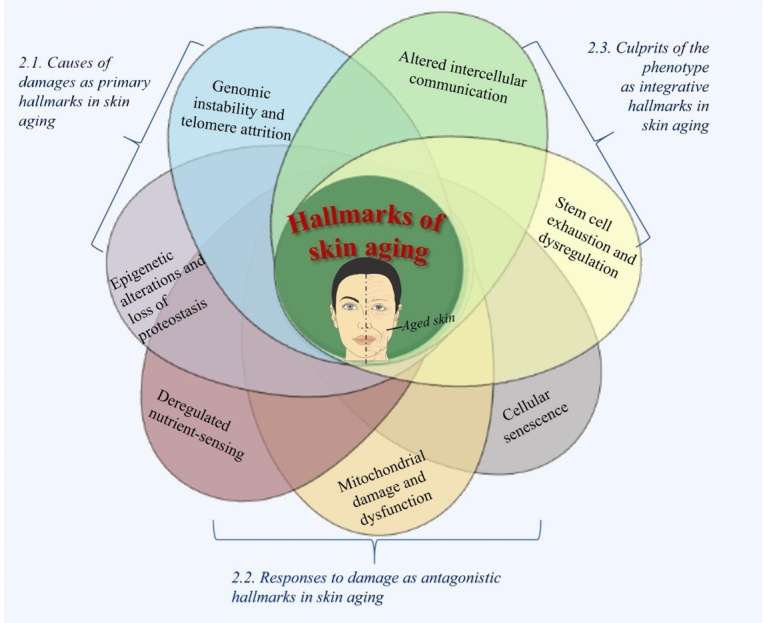
Aging is defined as impaired physiological integrity, decreased function, increased susceptibility to external risk factors and various diseases. Skin, the largest organ in our body, may become more vulnerable to insult as time goes by and behave as aged skin. Here, we systemically reviewed three categories including seven hallmarks of skin aging. These hallmarks including genomic instability and telomere attrition, epigenetic alterations and loss of proteostasis, deregulated nutrient-sensing, mitochondrial damage and dysfunction, cellular senescence, stem cell exhaustion/dysregulation, and altered intercellular communication. These seven hallmarks can generally be divided into three categories including (i) causes of damages as primary hallmarks in skin aging; (ii) responses to damage as antagonistic hallmarks in skin aging; and (iii) culprits of the phenotype as integrative hallmarks in skin aging.
衰老是指生理完整性受损、功能下降、对外界风险因素和各种疾病的易感性增加。皮肤是我们身体最大的器官,随着时间的推移,它可能变得更容易受到伤害,并表现出衰老的皮肤特征。在这里,我们系统地综述了包括皮肤衰老的七个标志性特征在内的三个类别。这些标志性特征包括基因组不稳定性和端粒磨损、表观遗传改变和蛋白质稳定性丧失、营养感应失调、线粒体损伤和功能障碍、细胞衰老、干细胞衰竭/失调以及细胞间通讯改变。这七个标志性特征通常可以分为三类,包括(i)导致皮肤衰老损伤的原因,即主要标志性特征;(ii)作为皮肤衰老拮抗标志性特征的损伤反应;以及(iii)作为皮肤衰老综合标志性特征的表型罪魁祸首。