Institute of Molecular Biology, Biocenter, Medical University Innsbruck, Innsbruck, Austria.
Institute of Pharmacy, Unit of Pharmacognosy, Center for Molecular Biosciences Innsbruck, Austria.
Microbiol Spectr. 2023 Jun 15;11(3):e0049623. doi: 10.1128/spectrum.00496-23. Epub 2023 May 18.
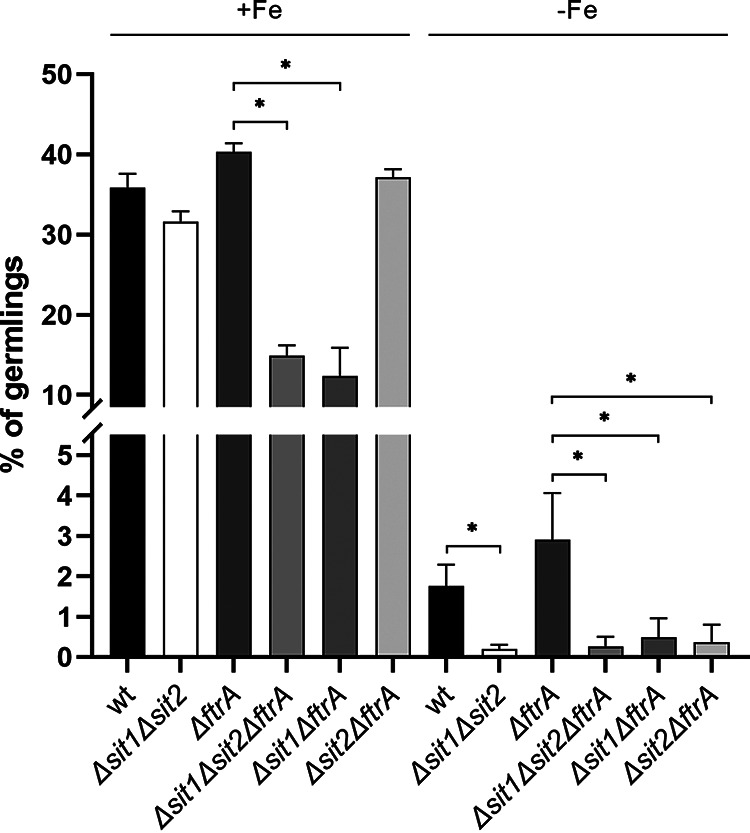
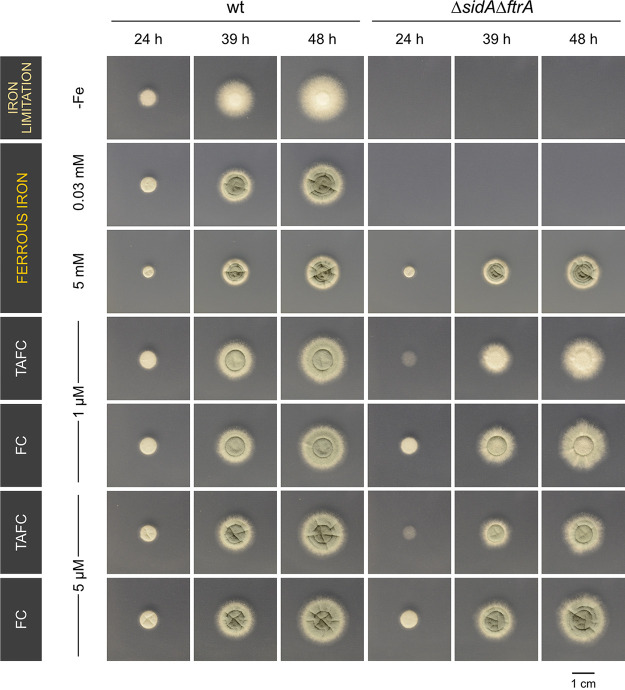
The opportunistic fungal pathogen Aspergillus fumigatus utilizes two high-affinity iron uptake mechanisms, termed reductive iron assimilation (RIA) and siderophore-mediated iron acquisition (SIA). The latter has been shown to be crucial for virulence of this fungus and is a target for development of novel strategies for diagnosis and treatment of fungal infections. So far, research on SIA in this mold focused mainly on the hyphal stage, revealing the importance of extracellular fusarinine-type siderophores in iron acquisition as well as of the siderophore ferricrocin in intracellular iron handling. The current study aimed to characterize iron acquisition during germination. High expression of genes involved in biosynthesis and uptake of ferricrocin in conidia and during germination, independent of iron availability, suggested a role of ferricrocin in iron acquisition during germination. In agreement, (i) bioassays indicated secretion of ferricrocin during growth on solid media during both iron sufficiency and limitation, (ii) ferricrocin was identified in the supernatant of conidia germinating in liquid media during both iron sufficiency and limitation, (iii) in contrast to mutants lacking all siderophores, mutants synthesizing ferricrocin but lacking fusarinine-type siderophores were able to grow under iron limitation in the absence of RIA, and (iv) genetic inactivation of the ferricrocin transporter Sit1 decreased germination in the absence of RIA. Taken together, this study revealed that ferricrocin has not only an intracellular role but also functions as an extracellular siderophore to support iron acquisition. The iron availability-independent ferricrocin secretion and uptake during early germination indicate developmental, rather than iron regulation. Aspergillus fumigatus is one of the most common airborne fungal pathogens for humans. Low-molecular-mass iron chelators, termed siderophores, have been shown to play a central role in iron homeostasis and, consequently, virulence of this mold. Previous studies demonstrated the crucial role of secreted fusarinine-type siderophores, such as triacetylfusarinine C, in iron acquisition, as well as of the ferrichrome-type siderophore ferricrocin in intracellular iron storage and transport. Here, we demonstrate that ferricrocin is also secreted to mediate iron acquisition during germination together with reductive iron assimilation. During early germination, ferricrocin secretion and uptake were not repressed by iron availability, indicating developmental regulation of this iron acquisition system in this growth phase.
机会致病真菌烟曲霉利用两种高亲和力的铁摄取机制,分别称为还原铁同化(RIA)和铁载体介导的铁摄取(SIA)。后者已被证明对该真菌的毒力至关重要,是开发新型真菌感染诊断和治疗策略的靶点。到目前为止,对该真菌中 SIA 的研究主要集中在菌丝阶段,揭示了细胞外呋咱型铁载体在铁摄取以及细胞内铁处理中铁载体三乙酰基麦角隐亭中的重要性。本研究旨在描述萌发过程中的铁获取。在孢子和萌发过程中,与铁可用性无关的铁载体 ferricrocin 的生物合成和摄取相关基因的高表达表明,ferricrocin 在萌发过程中在铁获取中起作用。一致地,(i)生物测定表明,在铁充足和有限的固体培养基上生长时,ferricrocin 被分泌,(ii)在铁充足和有限的液体培养基中,在孢子萌发期间,在培养基上清液中鉴定出 ferricrocin,(iii)与缺乏所有铁载体的突变体相比,合成 ferricrocin 但缺乏呋咱型铁载体的突变体能够在没有 RIA 的情况下在铁限制下生长,以及(iv)铁载体 transporter Sit1 的遗传失活降低了没有 RIA 的情况下的萌发。总的来说,这项研究表明,ferricrocin 不仅具有细胞内作用,而且还作为一种细胞外铁载体发挥作用,以支持铁的获取。在早期萌发过程中,ferricrocin 的分泌和摄取与铁可用性无关,表明这是一种发育而非铁调节的过程。烟曲霉是人类最常见的空气传播真菌病原体之一。低分子量铁螯合剂,称为铁载体,已被证明在铁稳态中起核心作用,因此在这种真菌中起关键作用。先前的研究表明,分泌的呋咱型铁载体(如三乙酰基麦角隐亭 C)在铁获取中的关键作用,以及 ferrichrome 型铁载体 ferricrocin 在细胞内铁储存和运输中的作用。在这里,我们证明 ferricrocin 也被分泌以介导萌发期间的铁获取以及还原铁同化。在早期萌发过程中,ferricrocin 的分泌和摄取不受铁可用性的抑制,表明在该生长阶段该铁获取系统受到发育调控。