State Key Laboratory of Component-based Chinese Medicine, Tianjin University of Traditional Chinese Medicine, Tianjin, China.
Institute of Traditional Chinese Medicine, Tianjin University of Traditional Chinese Medicine, Tianjin, China.
PLoS One. 2023 May 18;18(5):e0285722. doi: 10.1371/journal.pone.0285722. eCollection 2023.
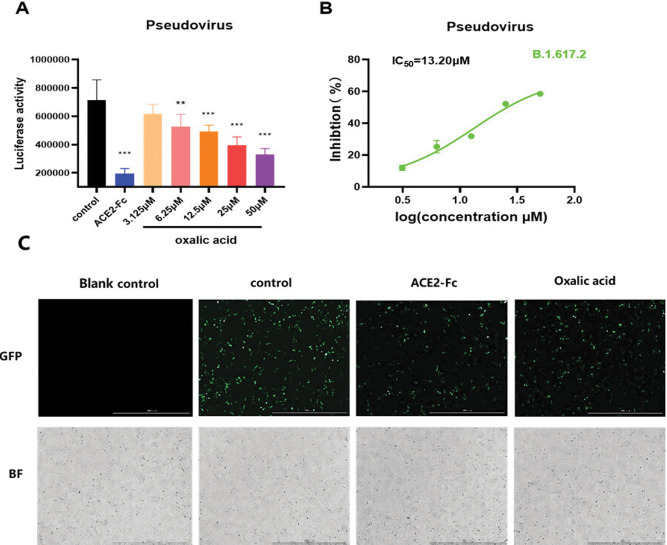
An epidemic of Corona Virus Disease 2019 (COVID-19) caused by severe acute respiratory syndrome coronavirus 2 (SARS-CoV-2) is spreading worldwide. Moreover, the emergence of SARS-CoV-2 variants of concern, such as Delta and Omicron, has seriously challenged the application of current therapeutics including vaccination and drugs. Relying on interaction of spike protein with receptor angiotensin-converting enzymes 2 (ACE2), SARS-CoV-2 successfully invades to the host cells, which indicates a strategy that identification of small-molecular compounds to block the entry is of great significance for COVID-19 prevention. Our study evaluated the potential efficacy of natural compound oxalic acid (OA) as an inhibitory agent against SARS-CoV-2 invasion, particular on the interaction of the receptor binding domain (RBD) of Delta and Omicron variants to ACE2. By employing a competitive binding assay in vitro, OA significantly blocked the binding of RBDs from Delta B.1.617.2 and Omicron B.1.1.529 to ACE2, but has no effect on the wide-type SARS-CoV-2 strain. Furthermore, OA inhibited the entries of Delta and Omicron pseudovirus into ACE2 high expressing-HEK293T cells. By surface plasmon resonance (SPR) assay, the direct bindings of OA to RBD and ACE2 were analyzed and OA had both affinities with RBDs of B.1.617.2 and B.1.1.529 and with ACE2. Molecular docking predicted the binding sites on the RBD-ACE2 complex and it showed similar binding abilities to both complex of variant Delta or Omicron RBD and ACE2. In conclusion, we provided a promising novel small-molecule compound OA as an antiviral candidate by blocking the cellular entries of SARS-CoV-2 variants.
由严重急性呼吸系统综合症冠状病毒 2 型(SARS-CoV-2)引起的 2019 年冠状病毒病(COVID-19)疫情正在全球范围内蔓延。此外,Delta 和奥密克戎等关注的 SARS-CoV-2 变体的出现,严重挑战了当前包括疫苗接种和药物在内的治疗方法的应用。SARS-CoV-2 依靠刺突蛋白与受体血管紧张素转换酶 2(ACE2)的相互作用,成功入侵宿主细胞,这表明识别小分子化合物来阻断入侵的策略对于 COVID-19 的预防具有重要意义。我们的研究评估了天然化合物草酸(OA)作为一种抑制 SARS-CoV-2 入侵的潜在有效药物,特别是对 Delta 和奥密克戎变体的受体结合域(RBD)与 ACE2 的相互作用的抑制效果。通过体外竞争结合测定,OA 显著阻断了 Delta B.1.617.2 和奥密克戎 B.1.1.529 的 RBD 与 ACE2 的结合,但对野生型 SARS-CoV-2 株没有影响。此外,OA 抑制了 Delta 和奥密克戎假病毒进入 ACE2 高表达-HEK293T 细胞。通过表面等离子体共振(SPR)测定,分析了 OA 与 RBD 和 ACE2 的直接结合,OA 与 B.1.617.2 和 B.1.1.529 的 RBD 均具有亲和力,并且与 ACE2 也具有亲和力。分子对接预测了 RBD-ACE2 复合物上的结合位点,结果表明 OA 对 Delta 或奥密克戎 RBD 与 ACE2 复合物均具有相似的结合能力。总之,我们通过阻断 SARS-CoV-2 变体的细胞进入,提供了一种有前景的新型小分子化合物 OA 作为抗病毒候选药物。