Department of Experimental Cardiac Surgery, Anesthesiology and Cardiology, Institute of Cardiology, Jagiellonian University Medical College, Kraków, Poland.
Krakow Centre for Medical Research and Technologies, John Paul II Hospital, Kraków, Poland.
Thromb Haemost. 2023 Sep;123(9):880-891. doi: 10.1055/s-0043-1768712. Epub 2023 May 18.
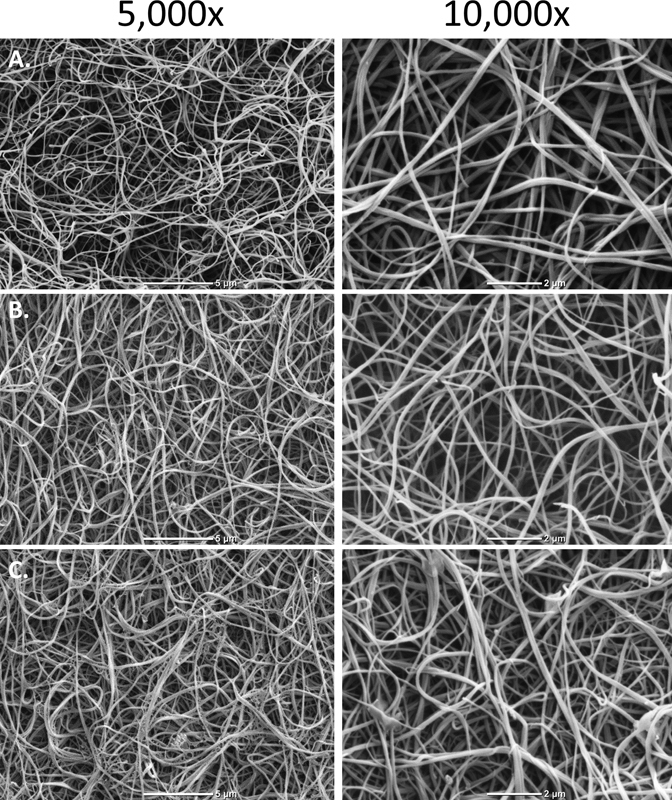
Deficiency of antithrombin increases risk of venous thromboembolism. We hypothesized that antithrombin deficiency affects fibrin clot structure and function.
We evaluated 148 patients (age: 38 [32-50] years; 70% women) with genetically confirmed antithrombin deficiency and 50 healthy controls. Fibrin clot permeability (K) and clot lysis time (CLT) along with thrombin generation capacity were assessed before and after antithrombin activity normalization in vitro.
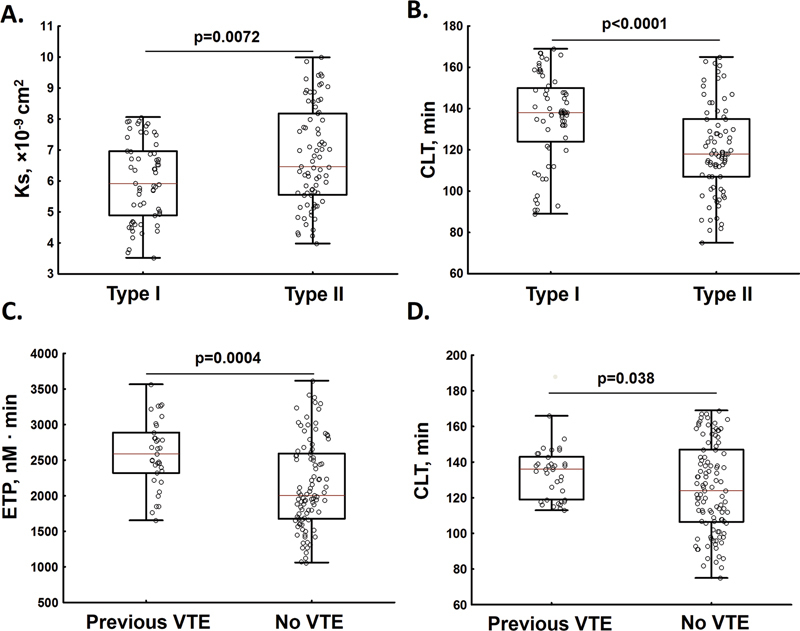
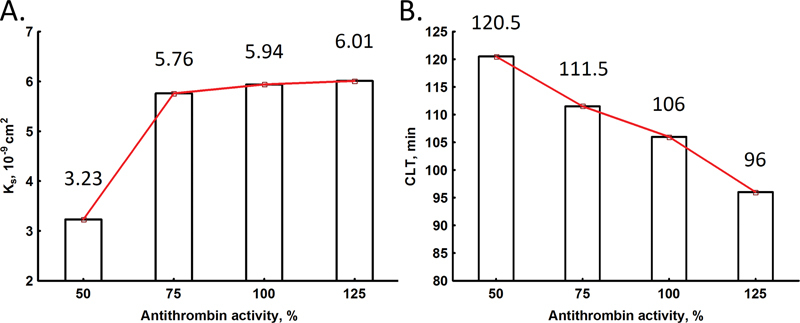
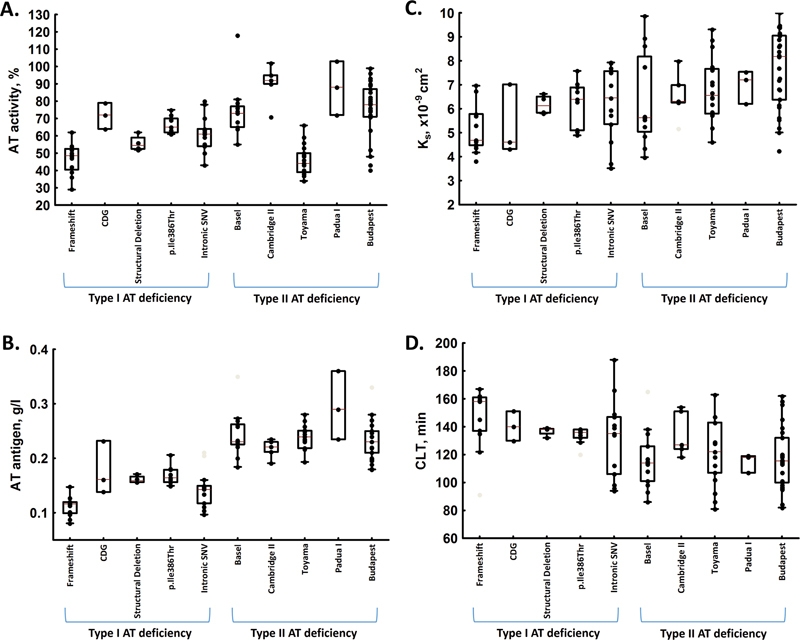
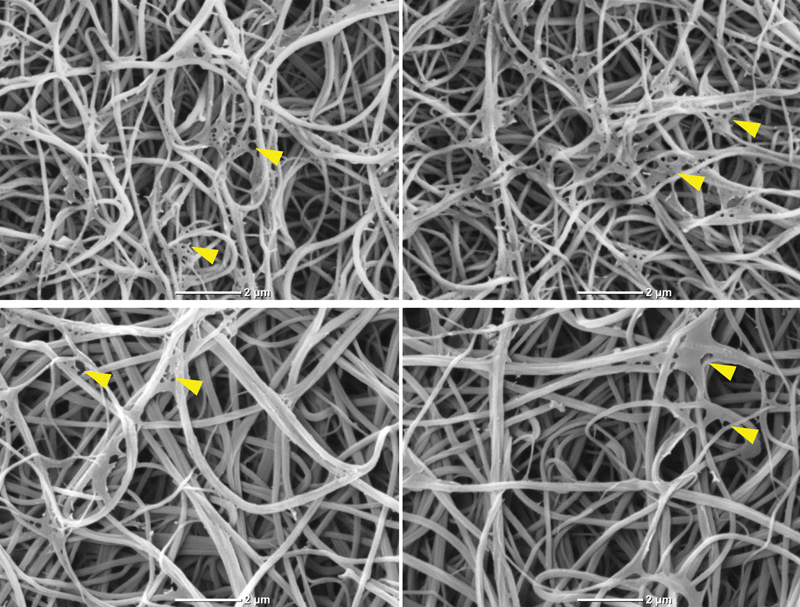
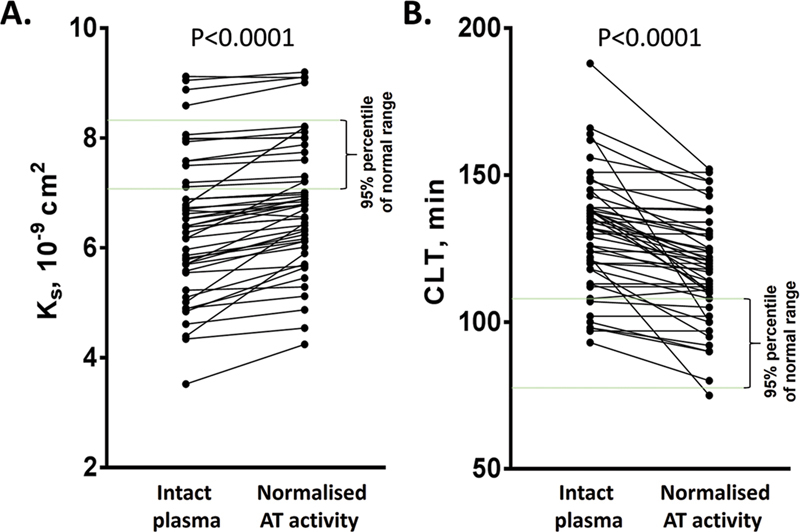
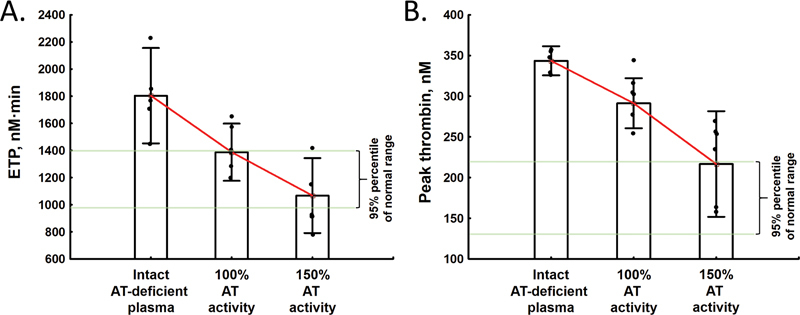
Antithrombin-deficient patients had lower antithrombin activity (-39%) and antigen levels (-23%) compared with controls (both < 0.01). Prothrombin fragment 1 + 2 levels were 26.5% higher in patients with antithrombin deficiency than in controls along with 94% increased endogenous thrombin potential (ETP) and 108% higher peak thrombin (all < 0.01). Antithrombin deficiency was associated with 18% reduced K and 35% prolonged CLT (both < 0.001). Patients with type I ( = 65; 43.9%) compared with type II antithrombin deficiency ( = 83; 56.1%) had 22.5% lower antithrombin activity ( < 0.001) and despite similar fibrinogen levels, 8.4% reduced K, 18% prolonged CLT, and 30% higher ETP (all < 0.01). Reduced K was associated with lower antithrombin antigen level (β = - 6.1, 95% confidence interval [CI]: -1.7 to -10.5), while prolonged CLT was associated with lower antithrombin antigen (β = - 69.6, 95% CI: -9.6 to -129.7), activity (β = - 2.4, 95% CI: -0.3 to -4.5), higher PAI-1 (β = 12.1, 95% CI: 7.7-16.5), and thrombin-activatable fibrinolysis inhibitor levels (β = 3.8, 95% CI: 1.9-5.7). Addition of exogenous antithrombin reduced ETP (-42%) and peak thrombin (-21%), and improved K (+8%) and CLT (-12%; all < 0.01).
Our study suggests that enhanced thrombin generation and prothrombotic plasma fibrin clot phenotype can contribute to increased risk of thrombosis in patients with antithrombin deficiency.
抗凝血酶缺乏会增加静脉血栓栓塞的风险。我们假设抗凝血酶缺乏会影响纤维蛋白凝块的结构和功能。
我们评估了 148 名经基因证实的抗凝血酶缺乏症患者(年龄:38[32-50]岁;70%为女性)和 50 名健康对照者。在体外将抗凝血酶活性正常化前后,评估纤维蛋白凝块的通透性(K)和凝块溶解时间(CLT)以及凝血酶生成能力。
与对照组相比(均 < 0.01),抗凝血酶缺乏症患者的抗凝血酶活性(-39%)和抗原水平(-23%)均较低。与对照组相比,抗凝血酶缺乏症患者的凝血酶原片段 1+2 水平高 26.5%,内源性凝血酶潜能(ETP)高 94%,最大凝血酶高 108%(均 < 0.01)。抗凝血酶缺乏症与 K 降低 18%和 CLT 延长 35%有关(均 < 0.001)。与 II 型抗凝血酶缺乏症(n=83;56.1%)相比,I 型抗凝血酶缺乏症(n=65;43.9%)的抗凝血酶活性降低 22.5%( < 0.001),尽管纤维蛋白原水平相似,但 K 降低 8.4%,CLT 延长 18%,ETP 升高 30%(均 < 0.01)。K 降低与抗凝血酶抗原水平降低相关(β=-6.1,95%置信区间[CI]:-1.7 至-10.5),CLT 延长与抗凝血酶抗原水平降低相关(β=-69.6,95%CI:-9.6 至-129.7),活性降低相关(β=-2.4,95%CI:-0.3 至-4.5),PAI-1 水平升高(β=12.1,95%CI:7.7-16.5)和血栓调节蛋白激活的纤溶抑制剂水平升高(β=3.8,95%CI:1.9-5.7)。添加外源性抗凝血酶可降低 ETP(-42%)和最大凝血酶(-21%),并改善 K(+8%)和 CLT(-12%;均 < 0.01)。
我们的研究表明,增强的凝血酶生成和促血栓形成的血浆纤维蛋白凝块表型可能导致抗凝血酶缺乏症患者的血栓形成风险增加。