HealthPartners Institute, Minneapolis, Minnesota.
Department of Obstetrics and Gynecology, Weill Cornell Medical College, New York, New York.
JAMA Netw Open. 2023 May 1;6(5):e2314350. doi: 10.1001/jamanetworkopen.2023.14350.
Adherence to COVID-19 booster vaccine recommendations has lagged in pregnant and nonpregnant adult populations. One barrier to booster vaccination is uncertainty regarding the safety of booster doses among pregnant people.
To evaluate whether there is an association between COVID-19 booster vaccination during pregnancy and spontaneous abortion.
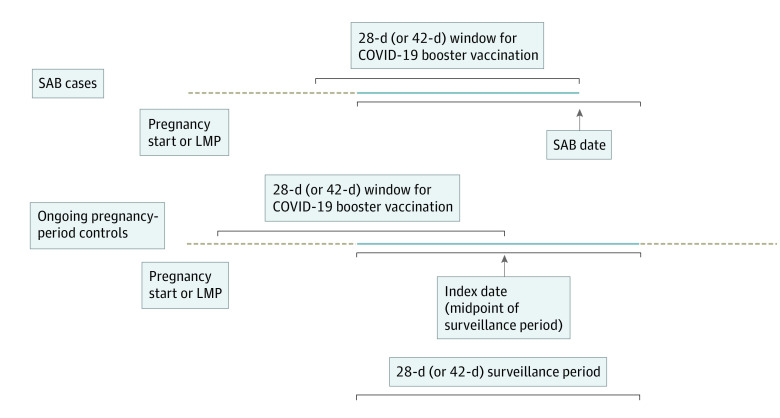
DESIGN, SETTING, AND PARTICIPANTS: This observational, case-control, surveillance study evaluated people aged 16 to 49 years with pregnancies at 6 to 19 weeks' gestation at 8 health systems in the Vaccine Safety Datalink from November 1, 2021, to June 12, 2022. Spontaneous abortion cases and ongoing pregnancy controls were evaluated during consecutive surveillance periods, defined by calendar time.
Primary exposure was receipt of a third messenger RNA (mRNA) COVID-19 vaccine dose within 28 days before spontaneous abortion or index date (midpoint of surveillance period in ongoing pregnancy controls). Secondary exposures were third mRNA vaccine doses in a 42-day window or any COVID-19 booster in 28- and 42-day windows.
Spontaneous abortion cases and ongoing pregnancy controls were identified from electronic health data using a validated algorithm. Cases were assigned to a single surveillance period based on pregnancy outcome date. Eligible ongoing pregnancy time was assigned to 1 or more surveillance periods as an ongoing pregnancy-period control. Generalized estimating equations were used to estimate adjusted odds ratios (AOR) with gestational age, maternal age, antenatal visits, race and ethnicity, site, and surveillance period as covariates and robust variance estimates to account for inclusion of multiple pregnancy periods per unique pregnancy.
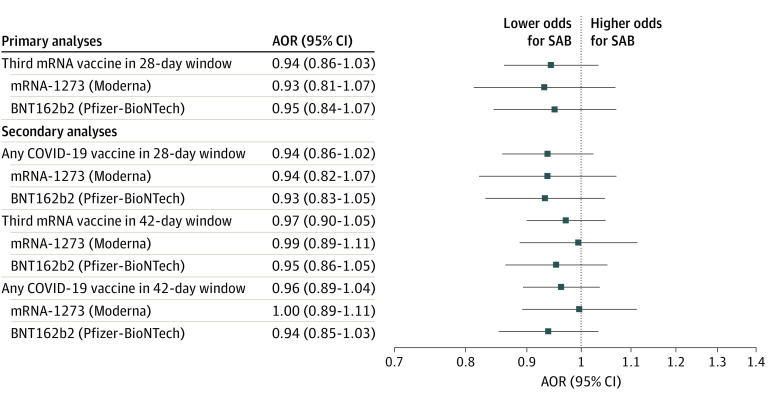
Among 112 718 unique pregnancies included in the study, the mean (SD) maternal age was 30.6 (5.5) years. Pregnant individuals were Asian, non-Hispanic (15.1%); Black, non-Hispanic (7.5%); Hispanic (35.6%); White, non-Hispanic (31.2%); and of other or unknown (10.6%); and 100% were female. Across eight 28-day surveillance periods, among 270 853 ongoing pregnancy-period controls, 11 095 (4.1%) had received a third mRNA COVID-19 vaccine in a 28-day window; among 14 226 cases, 553 (3.9%) had received a third mRNA COVID-19 vaccine within 28 days of the spontaneous abortion. Receipt of a third mRNA COVID-19 vaccine was not associated with spontaneous abortion in a 28-day window (AOR, 0.94; 95% CI, 0.86-1.03). Results were consistent when using a 42-day window (AOR, 0.97; 95% CI, 0.90-1.05) and for any COVID-19 booster in a 28-day (AOR, 0.94; 95% CI, 0.86-1.02) or 42-day (AOR, 0.96; 95% CI, 0.89-1.04) exposure window.
In this case-control surveillance study, COVID-19 booster vaccination in pregnancy was not associated with spontaneous abortion. These findings support the safety of recommendations for COVID-19 booster vaccination, including in pregnant populations.
在孕妇和非孕妇成年人群体中,对 COVID-19 加强疫苗推荐的依从性滞后。加强疫苗接种的一个障碍是人们对孕妇接种加强剂量的安全性存在不确定性。
评估 COVID-19 加强疫苗接种与自然流产之间是否存在关联。
设计、地点和参与者:这项观察性病例对照监测研究评估了在 8 个健康系统中,16 至 49 岁的孕妇,妊娠时间为 6 至 19 周,妊娠时间为 6 至 19 周。在连续的监测期间,通过日历时间评估自然流产病例和持续妊娠对照。
主要暴露是在自然流产或索引日期(持续妊娠对照的监测期中点)前 28 天内接受第三剂信使 RNA(mRNA)COVID-19 疫苗。次要暴露是在 42 天窗口内接受第三剂 mRNA 疫苗或在 28 天和 42 天窗口内接受任何 COVID-19 加强剂。
通过验证算法从电子健康数据中确定自然流产病例和持续妊娠对照。根据妊娠结局日期,将病例分配到单个监测期。合格的持续妊娠时间被分配到 1 个或多个监测期,作为持续妊娠期对照。使用广义估计方程估计调整后的优势比(AOR),以胎龄、母亲年龄、产前检查、种族和民族、地点和监测期为协变量,并使用稳健方差估计来考虑每个独特妊娠的多个妊娠期的纳入。
在这项研究中,纳入了 112718 个独特的妊娠,平均(SD)母亲年龄为 30.6(5.5)岁。孕妇为亚洲,非西班牙裔(15.1%);黑人,非西班牙裔(7.5%);西班牙裔(35.6%);白人,非西班牙裔(31.2%)和其他或未知(10.6%);100%为女性。在 8 个 28 天的监测期内,在 270853 个持续妊娠期对照中,有 11095(4.1%)在 28 天窗口内接受了第三剂 mRNA COVID-19 疫苗;在 14226 例病例中,有 553(3.9%)在自然流产前 28 天内接受了第三剂 mRNA COVID-19 疫苗。在 28 天的窗口期内,接受第三剂 mRNA COVID-19 疫苗与自然流产无关(AOR,0.94;95%CI,0.86-1.03)。当使用 42 天的窗口期(AOR,0.97;95%CI,0.90-1.05)和任何 COVID-19 加强剂的 28 天(AOR,0.94;95%CI,0.86-1.02)或 42 天(AOR,0.96;95%CI,0.89-1.04)暴露窗口时,结果是一致的。
在这项病例对照监测研究中,妊娠期间 COVID-19 加强疫苗接种与自然流产无关。这些发现支持包括孕妇在内的 COVID-19 加强疫苗接种建议的安全性。