Auckland Bioengineering Institute, University of Auckland, 70 Symonds Street, Grafton, Auckland, 1010, New Zealand.
Department of Anatomy and Medical Imaging, University of Auckland, Auckland, New Zealand.
Sci Rep. 2023 May 19;13(1):8118. doi: 10.1038/s41598-023-33968-5.
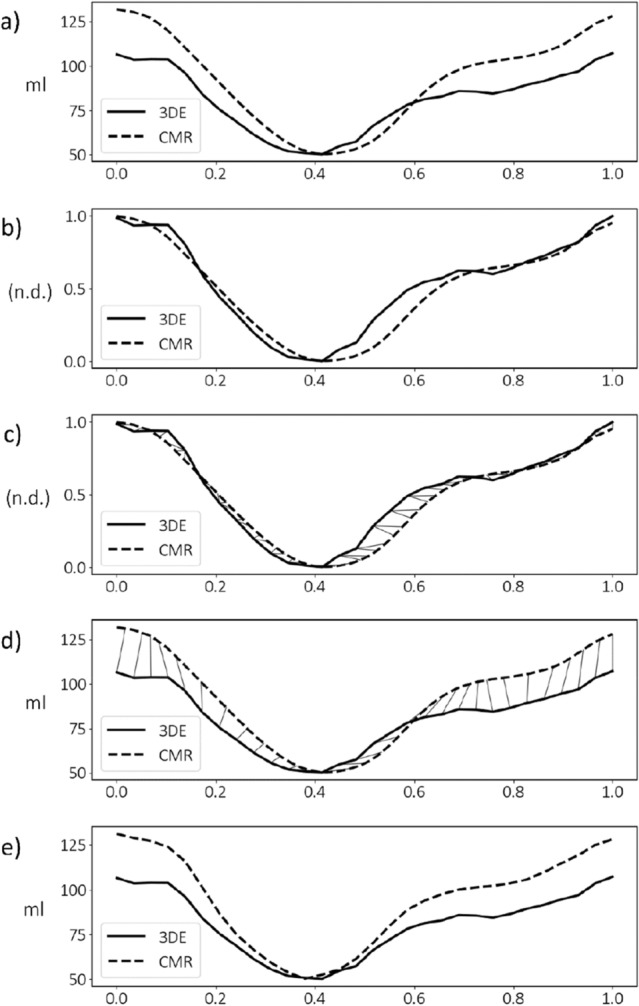
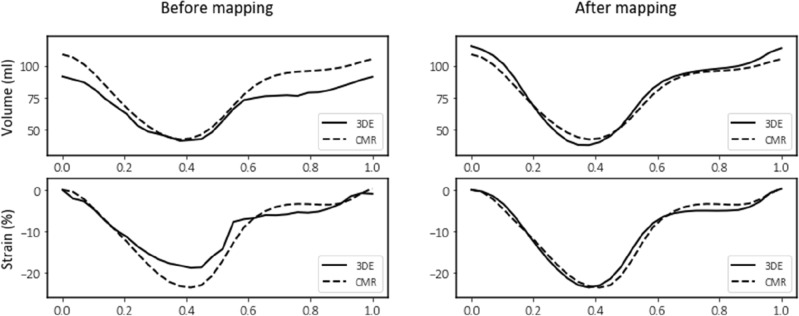
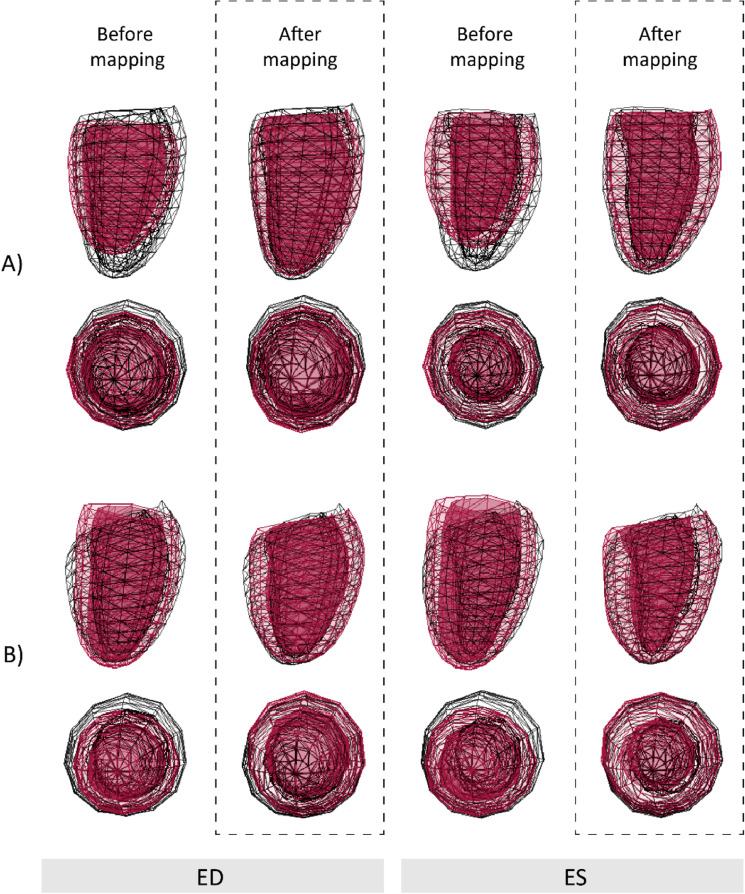
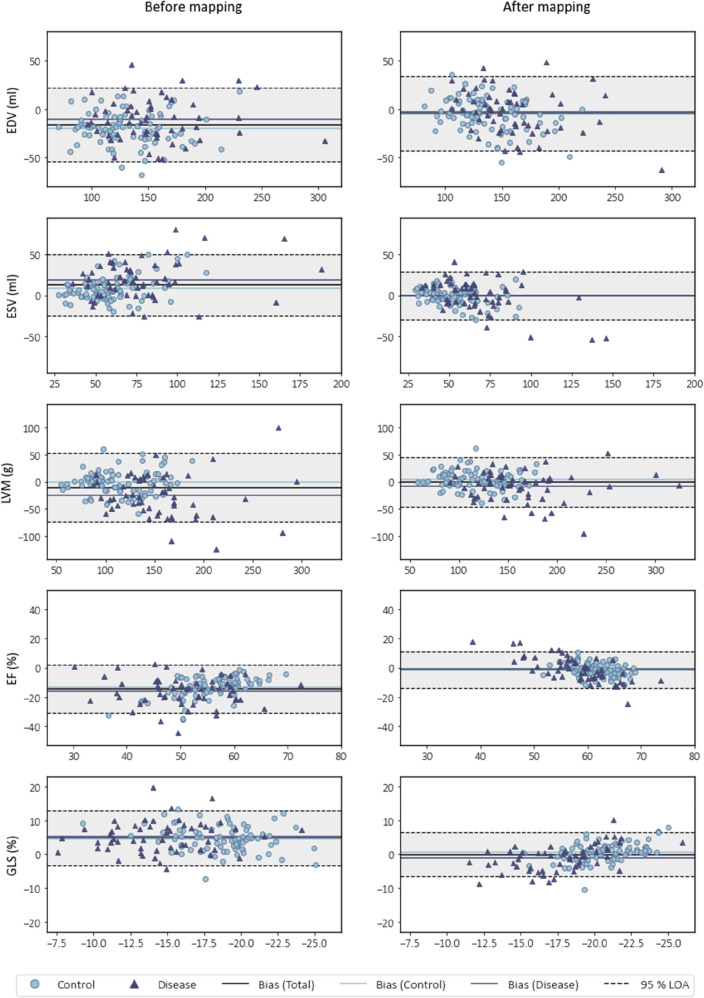
Cardiovascular imaging studies provide a multitude of structural and functional data to better understand disease mechanisms. While pooling data across studies enables more powerful and broader applications, performing quantitative comparisons across datasets with varying acquisition or analysis methods is problematic due to inherent measurement biases specific to each protocol. We show how dynamic time warping and partial least squares regression can be applied to effectively map between left ventricular geometries derived from different imaging modalities and analysis protocols to account for such differences. To demonstrate this method, paired real-time 3D echocardiography (3DE) and cardiac magnetic resonance (CMR) sequences from 138 subjects were used to construct a mapping function between the two modalities to correct for biases in left ventricular clinical cardiac indices, as well as regional shape. Leave-one-out cross-validation revealed a significant reduction in mean bias, narrower limits of agreement, and higher intraclass correlation coefficients for all functional indices between CMR and 3DE geometries after spatiotemporal mapping. Meanwhile, average root mean squared errors between surface coordinates of 3DE and CMR geometries across the cardiac cycle decreased from 7 ± 1 to 4 ± 1 mm for the total study population. Our generalised method for mapping between time-varying cardiac geometries obtained using different acquisition and analysis protocols enables the pooling of data between modalities and the potential for smaller studies to leverage large population databases for quantitative comparisons.
心血管成像研究提供了大量的结构和功能数据,以更好地了解疾病机制。虽然跨研究汇集数据可以实现更强大和更广泛的应用,但由于每个协议都存在特定的固有测量偏差,因此在具有不同采集或分析方法的数据集之间进行定量比较是有问题的。我们展示了如何应用动态时间扭曲和偏最小二乘回归来有效地在不同成像方式和分析协议得出的左心室几何形状之间进行映射,以解决这些差异。为了演示这种方法,使用 138 名受试者的实时 3 维超声心动图(3DE)和心脏磁共振(CMR)序列对配对数据进行了构建,以构建两种模式之间的映射函数,以校正左心室临床心脏指数和区域形状的偏差。在时空映射后,CMR 和 3DE 几何结构之间的所有功能指数的平均偏差、协议范围更窄,以及内部相关性系数都显著降低。同时,3DE 和 CMR 几何结构表面坐标在整个心动周期之间的平均均方根误差从 7±1 降至 4±1 毫米,适用于整个研究人群。我们用于不同采集和分析协议获得的时变心脏几何形状之间映射的通用方法,可以在模式之间汇集数据,并使较小的研究能够利用大型人群数据库进行定量比较。