Laboratory of Malaria and Vector Research, National Institute of Allergy and Infectious Diseases, National Institutes of Health, 12735 Twinbrook Parkway, Rockville, MD, 20852, USA.
Biostatistics Research Branch, National Institute of Allergy and Infectious Diseases, National Institutes of Health, Rockville, MD, 20852, USA.
Malar J. 2023 May 19;22(1):159. doi: 10.1186/s12936-023-04591-6.
For blood-stage malaria vaccine development, the in vitro growth inhibition assay (GIA) has been widely used to evaluate functionality of vaccine-induced antibodies (Ab), and Plasmodium falciparum reticulocyte-binding protein homolog 5 (RH5) is a leading blood-stage antigen. However, precision, also called "error of assay (EoA)", in GIA readouts and the source of EoA has not been evaluated systematically.
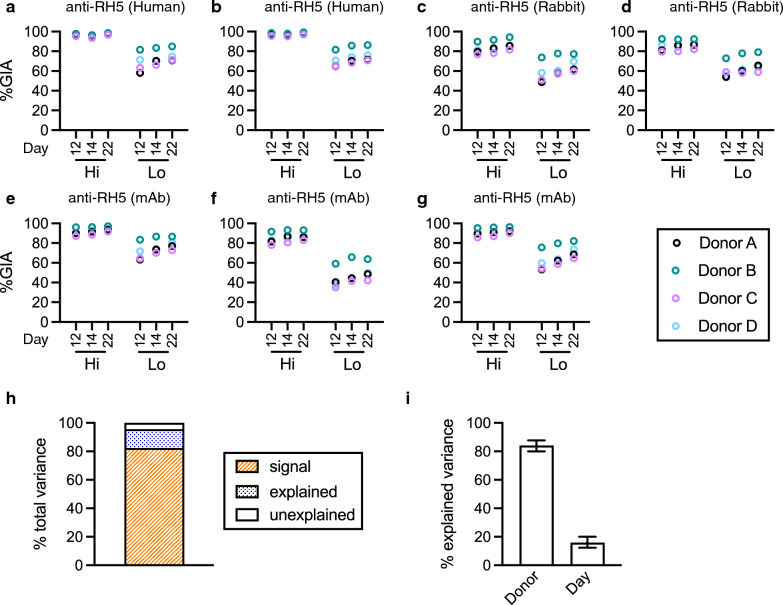
In the Main GIA experiment, 4 different cultures of P. falciparum 3D7 parasites were prepared with red blood cells (RBC) collected from 4 different donors. For each culture, 7 different anti-RH5 Ab (either monoclonal or polyclonal Ab) were tested by GIA at two concentrations on three different days (168 data points). To evaluate sources of EoA in % inhibition in GIA (%GIA), a linear model fit was conducted including donor (source of RBC) and day of GIA as independent variables. In addition, 180 human anti-RH5 polyclonal Ab were tested in a Clinical GIA experiment, where each Ab was tested at multiple concentrations in at least 3 independent GIAs using different RBCs (5,093 data points). The standard deviation (sd) in %GIA and in GIA (Ab concentration that gave 50%GIA) readouts, and impact of repeat assays on 95% confidence interval (95%CI) of these readouts was estimated.
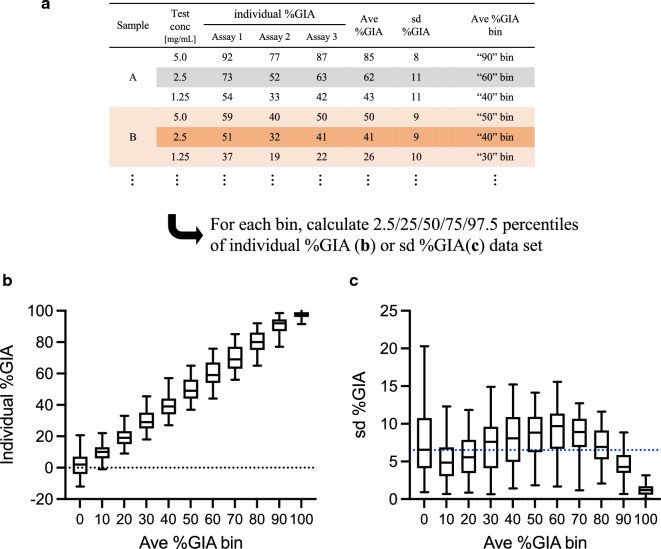
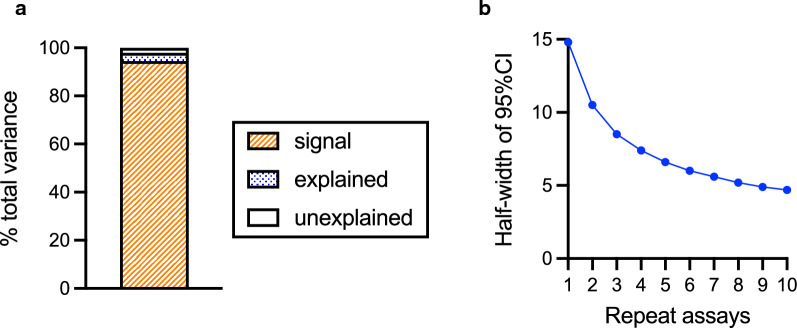
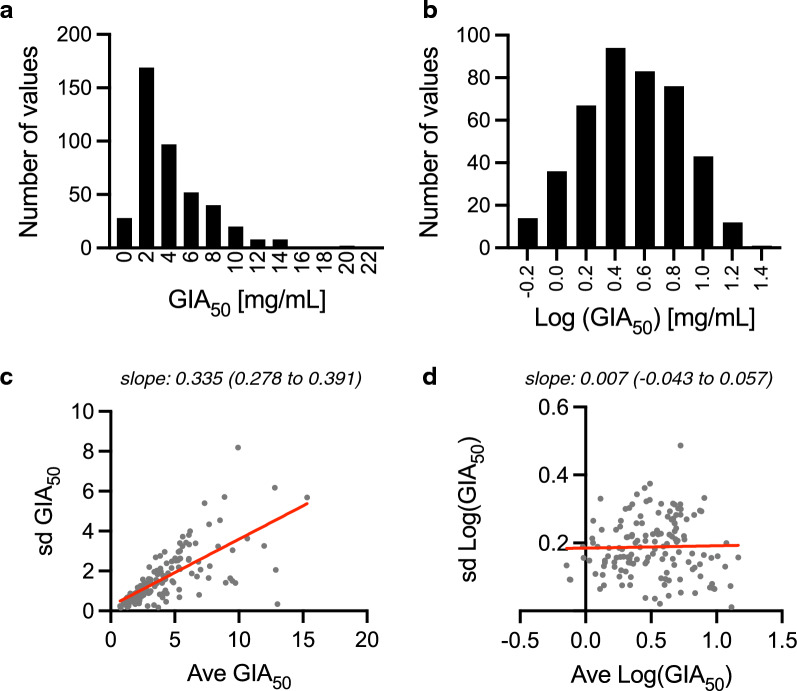
The Main GIA experiment revealed that the RBC donor effect was much larger than the day effect, and an obvious donor effect was also observed in the Clinical GIA experiment. Both %GIA and log-transformed GIA data reasonably fit a constant sd model, and sd of %GIA and log-transformed GIA measurements were calculated as 7.54 and 0.206, respectively. Taking the average of three repeat assays (using three different RBCs) reduces the 95%CI width in %GIA or in GIA measurements by ~ half compared to a single assay.
The RBC donor effect (donor-to-donor variance on the same day) in GIA was much bigger than the day effect (day-to-day variance using the same donor's RBC) at least for the RH5 Ab evaluated in this study; thus, future GIA studies should consider the donor effect. In addition, the 95%CI for %GIA and GIA shown here help when comparing GIA results from different samples/groups/studies; therefore, this study supports future malaria blood-stage vaccine development.
在血阶段疟疾疫苗的开发中,体外生长抑制试验(GIA)已被广泛用于评估疫苗诱导的抗体(Ab)的功能,恶性疟原虫红细胞结合蛋白同源物 5(RH5)是一种主要的血阶段抗原。然而,GIA 读数的精度,也称为“测定误差(EoA)”,以及 EoA 的来源尚未系统评估。
在主要 GIA 实验中,使用来自 4 个不同供体的红细胞(RBC)制备了 4 种不同的恶性疟原虫 3D7 寄生虫培养物。对于每种培养物,在 3 个不同的日子(168 个数据点)上用 GIA 测试了 7 种不同的抗 RH5 Ab(单克隆或多克隆 Ab)。为了评估 GIA 中测定误差(EoA)在抑制百分比(%GIA)中的来源,进行了线性模型拟合,其中供体(RBC 来源)和 GIA 日为独立变量。此外,在临床 GIA 实验中测试了 180 种人类抗 RH5 多克隆 Ab,其中每种 Ab 在至少 3 个使用不同 RBC 的独立 GIA 中以多个浓度进行测试(5093 个数据点)。估计了 %GIA 和 GIA(产生 50%GIA 的 Ab 浓度)读数中的标准偏差(sd),以及重复测定对这些读数的 95%置信区间(95%CI)的影响。
主要 GIA 实验表明,RBC 供体效应远大于日效应,并且在临床 GIA 实验中也观察到明显的供体效应。%GIA 和对数转换 GIA 数据都很好地符合常数 sd 模型,%GIA 和对数转换 GIA 测量的 sd 分别计算为 7.54 和 0.206。与单次测定相比,使用三个不同 RBC 进行三次重复测定(使用三个不同的 RBC)将 %GIA 或 GIA 测量的 95%CI 宽度减少了约一半。
至少在本研究评估的 RH5 Ab 中,GIA 中的 RBC 供体效应(同一天的供体间方差)远大于日效应(使用同一供体 RBC 的日间方差);因此,未来的 GIA 研究应考虑供体效应。此外,此处显示的 %GIA 和 GIA 的 95%CI 有助于比较来自不同样本/组/研究的 GIA 结果;因此,本研究支持未来的疟疾血阶段疫苗开发。