Department of Biological Sciences and Bioengineering, Indian Institute of Technology, Kanpur 208016, India.
BioEM Lab, Biozentrum, University of Basel, 4056 Basel, Switzerland.
Mol Cell. 2023 Jun 15;83(12):2091-2107.e7. doi: 10.1016/j.molcel.2023.04.025. Epub 2023 May 19.
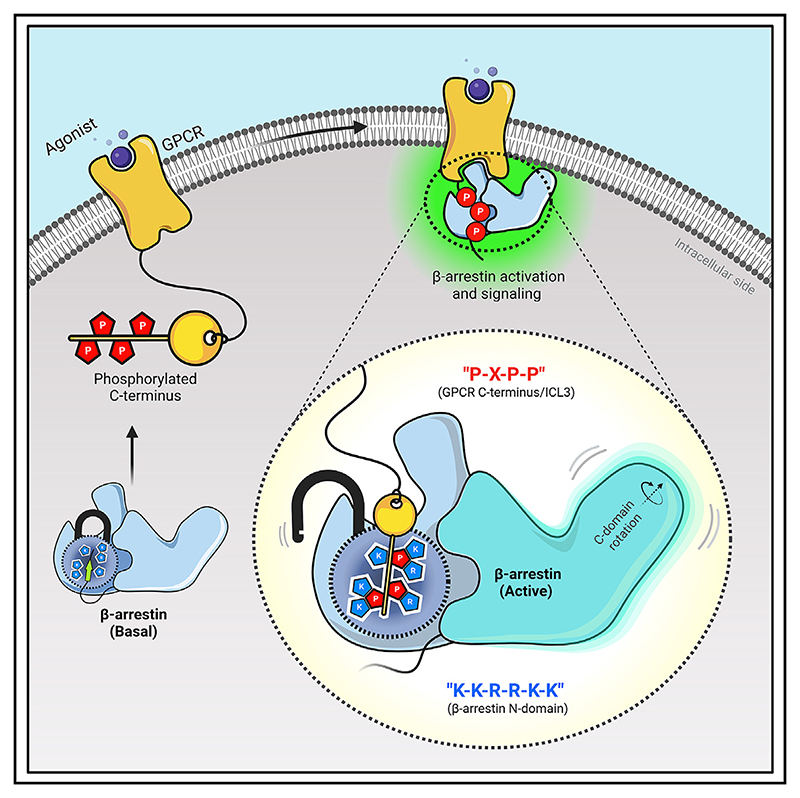
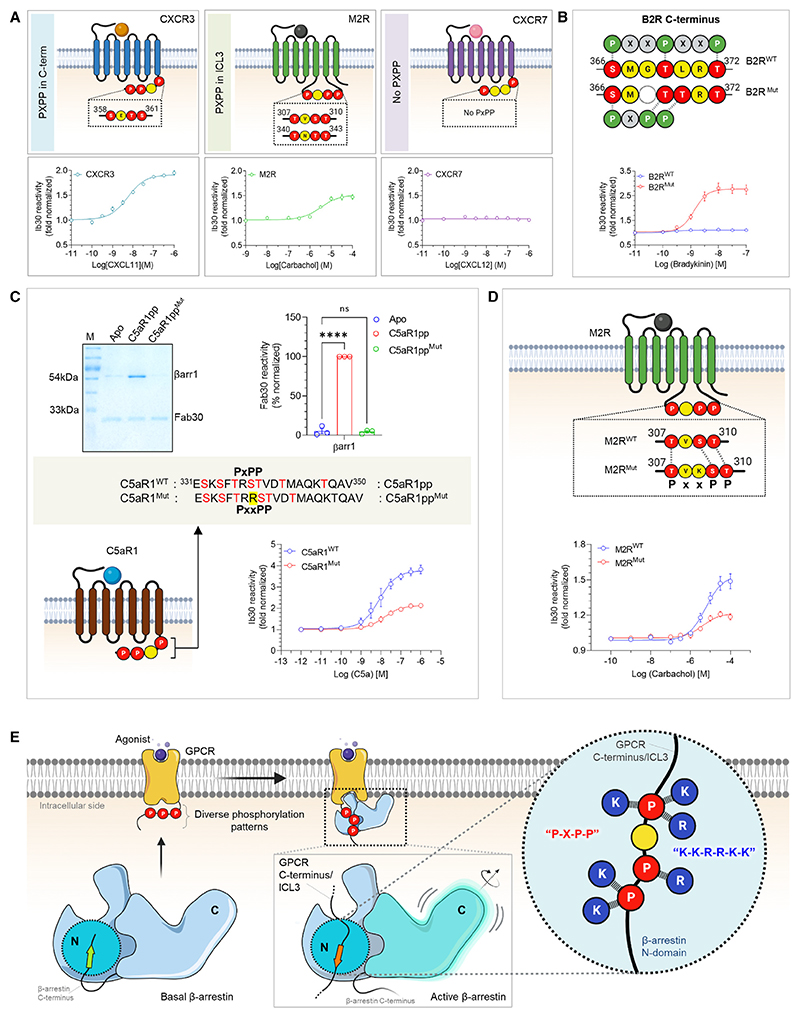
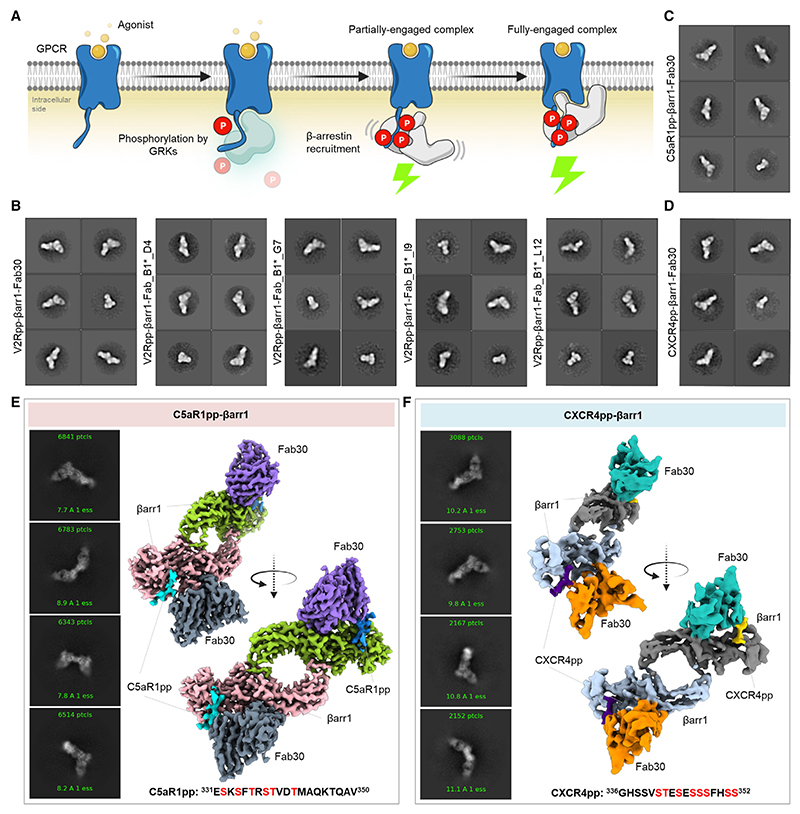
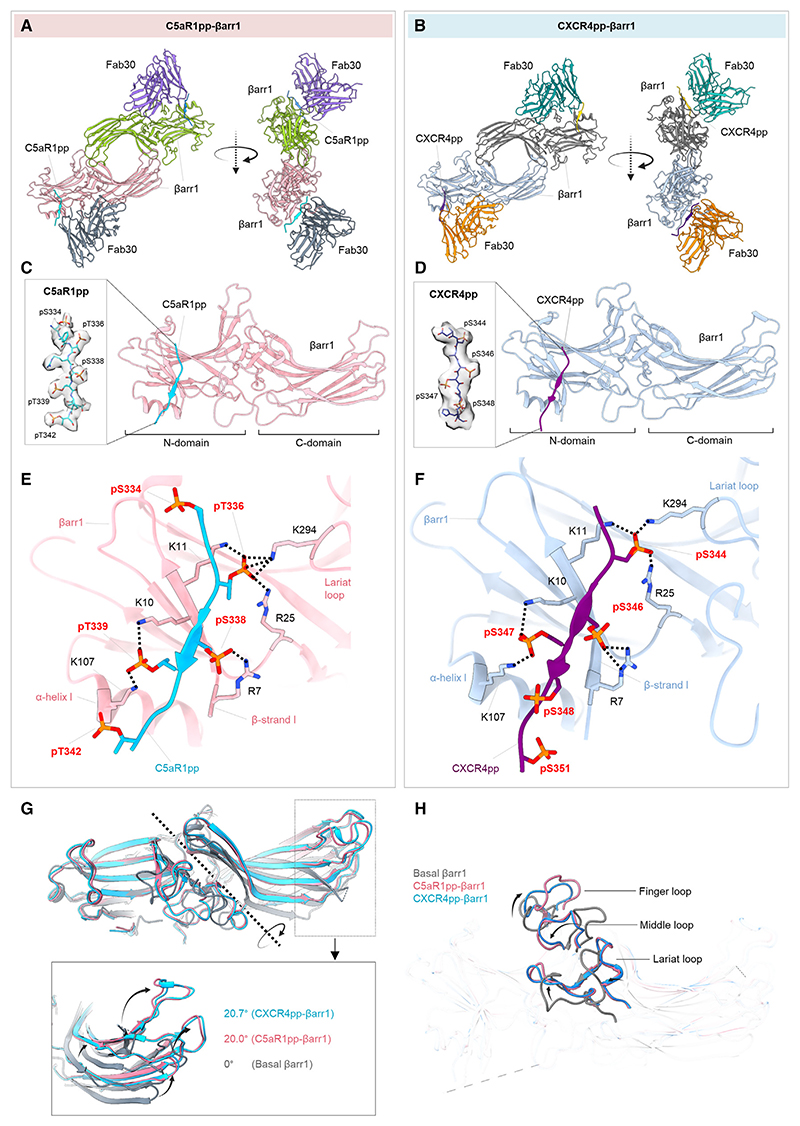
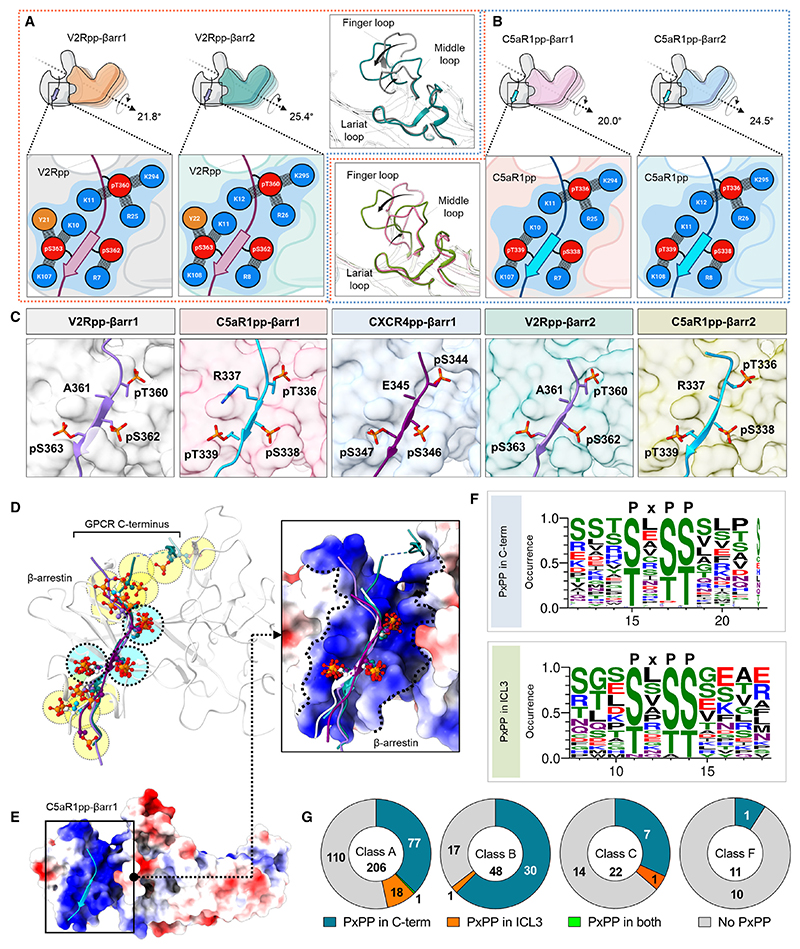
Agonist-induced GPCR phosphorylation is a key determinant for the binding and activation of β-arrestins (βarrs). However, it is not entirely clear how different GPCRs harboring divergent phosphorylation patterns impart converging active conformation on βarrs leading to broadly conserved functional responses such as desensitization, endocytosis, and signaling. Here, we present multiple cryo-EM structures of activated βarrs in complex with distinct phosphorylation patterns derived from the carboxyl terminus of different GPCRs. These structures help identify a P-X-P-P type phosphorylation motif in GPCRs that interacts with a spatially organized K-K-R-R-K-K sequence in the N-domain of βarrs. Sequence analysis of the human GPCRome reveals the presence of this phosphorylation pattern in a large number of receptors, and its contribution in βarr activation is demonstrated by targeted mutagenesis experiments combined with an intrabody-based conformational sensor. Taken together, our findings provide important structural insights into the ability of distinct GPCRs to activate βarrs through a significantly conserved mechanism.
激动剂诱导的 G 蛋白偶联受体(GPCR)磷酸化是β-arrestin(βarrs)结合和激活的关键决定因素。然而,不同的 GPCR 具有不同的磷酸化模式,它们如何赋予βarrs 收敛的活性构象,从而导致广泛保守的功能反应,如脱敏、内化和信号转导,这一点尚不完全清楚。在这里,我们展示了多个与不同 GPCR 羧基末端衍生的不同磷酸化模式结合的激活的βarrs 的冷冻电镜结构。这些结构有助于确定 GPCR 中的 P-X-P-P 型磷酸化基序,该基序与βarrs N 结构域中空间组织的 K-K-R-R-K-K 序列相互作用。对人类 GPCRome 的序列分析表明,这种磷酸化模式存在于大量的受体中,通过靶向突变实验结合基于内体的构象传感器证明了其在βarr 激活中的作用。总之,我们的研究结果为不同的 GPCR 通过一种高度保守的机制激活βarrs 的能力提供了重要的结构见解。