Department of Anesthesiology, the Affiliated Hospital of Guilin Medical University, Guilin, 541001, Guangxi, China.
Department of Epidemiology and Statistics, School of Public Health, Guilin Medical University, Guilin, 541199, Guangxi, China.
BMC Anesthesiol. 2023 May 20;23(1):170. doi: 10.1186/s12871-023-02143-8.
To explore the postoperative effects of sufentanil preemptive analgesia combined with psychological intervention on breast cancer patients undergoing radical surgery.
112 female breast cancer patients aged 18-80 years old who underwent radical surgery by the same surgeon were randomly divided into 4 groups, and there were 28 patients in each group. Patients in group A were given 10 µg sufentanil preemptive analgesia combined with perioperative psychological support therapy (PPST), group B had only 10 µg sufentanil preemptive analgesia, group C had only PPST, and group D were under general anesthesia with conventional intubation. Visual analogue scoring (VAS) was used for analgesic evaluation at 2, 12 and 24 h after surgery and compared among the four groups by ANOVA method.
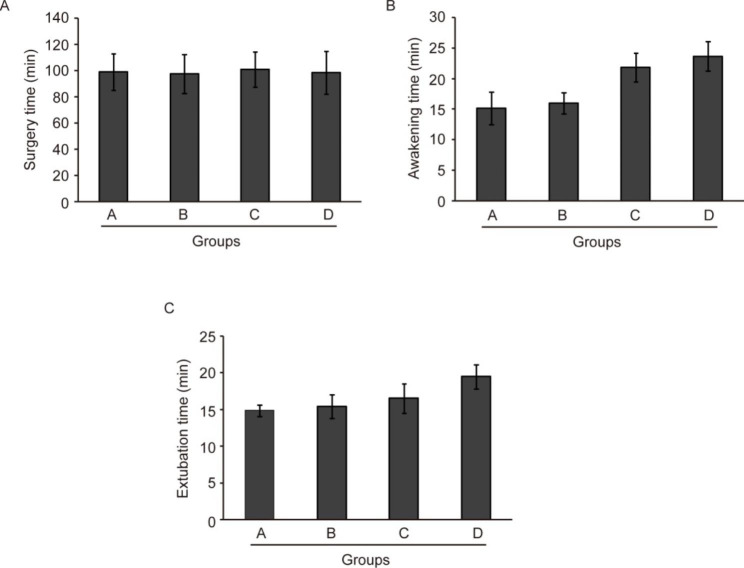
The awakening time of patients in group A or B was significantly shorter than that in group C or D, and the awakening time in group C was significantly shorter than that in group D. Moreover, patients in group A had the shortest extubation time, while the group D had the longest extubation time. The VAS scores at different time points showed significant difference, and the VAS scores at 12 and 24 h were significantly lower than those at 2 h (P < 0.05). The VAS scores and the changing trend of VAS scores were varied among the four groups (P < 0.05). In addition, we also found that patients in group A had the longest time to use the first pain medication after surgery, while patients in group D had the shortest time. But the adverse reactions among the four groups showed no difference.
Sufentanil preemptive analgesia combined with psychological intervention can effectively relieve the postoperative pain of breast cancer patients.
探讨舒芬太尼超前镇痛联合心理干预对乳腺癌根治术患者术后的影响。
选择我院收治的 112 例年龄 18-80 岁的女性乳腺癌根治术患者,随机分为 4 组,每组 28 例。A 组患者给予舒芬太尼 10μg 超前镇痛联合围术期心理支持治疗(PPST),B 组患者仅给予舒芬太尼 10μg 超前镇痛,C 组患者仅给予 PPST,D 组患者采用全身麻醉复合常规气管插管。采用视觉模拟评分(VAS)评估患者术后 2、12、24 h 的镇痛效果,并采用方差分析比较四组患者的镇痛效果。
A 组或 B 组患者的苏醒时间明显短于 C 组或 D 组,C 组患者的苏醒时间明显短于 D 组;且 A 组患者的拔管时间最短,D 组患者的拔管时间最长。不同时间点的 VAS 评分比较差异有统计学意义,12、24 h 的 VAS 评分明显低于 2 h(P<0.05);VAS 评分及变化趋势在四组间比较差异有统计学意义(P<0.05)。此外,还发现 A 组患者术后首次使用止痛药的时间最长,D 组患者最短。但四组患者的不良反应无明显差异。
舒芬太尼超前镇痛联合心理干预能有效缓解乳腺癌根治术患者的术后疼痛。