Department of Anesthesiology, Critical Care and Pain Medicine, Boston Children's Hospital, Harvard Medical School, Boston, MA, 02115, USA.
Department of Neurology, School of Mental Health and Neuroscience, Maastricht University Medical Center+, Maastricht, The Netherlands.
Orphanet J Rare Dis. 2023 May 20;18(1):120. doi: 10.1186/s13023-023-02741-2.
Niemann-Pick disease type C (NPC) is a rare inherited lysosomal storage disease typified by accumulation of cholesterol and other lipids in late endosomes/lysosomes, thereby resulting in a spectrum of neurological, psychiatric, and systemic symptoms (notably liver disease). Though it is well-known that NPC exacts a physical and emotional toll on both patients and caregivers, the burden of NPC can vary between patients, while the challenges of living with NPC can evolve over time (i.e., from time of diagnosis to the present day). To further grasp patient and caregiver perceptions and experiences with NPC, we carried out focus group discussions with pediatric and adult individuals with NPC (N = 19), with partial or full representation of the patient by their caregiver. Furthermore, we utilized our NPC focus group discussion to provide guidance on study design parameters and feasibility of prospective investigations aiming to characterize the central manifestations of NPC using neuroimaging, specifically, magnetic resonance imaging (MRI) methodology.
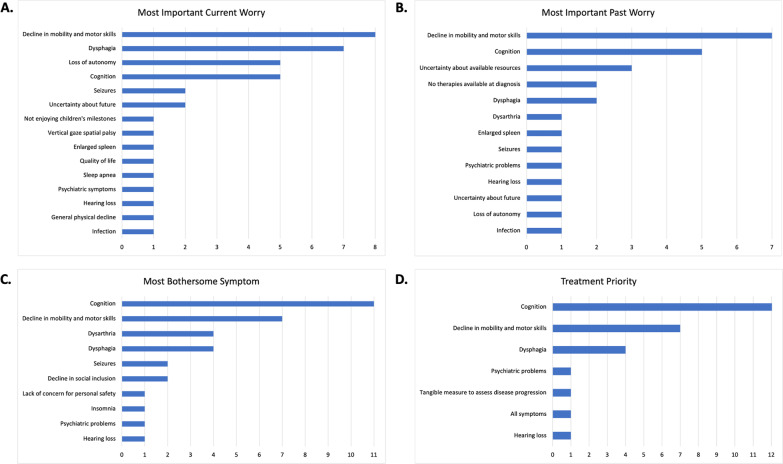
Focus group discussions revealed that neurological signs, including declining cognition, memory loss, and psychiatric symptoms, as well as increasingly impaired mobility and motor function, are among the most pressing past and current concerns for patients and caregivers. Moreover, several participants also expressed concern over a loss of independence, social exclusion, and uncertainty for what the future holds. Caregivers described the challenges that participation in research poses, which included logistical difficulties mainly due to traveling with medical equipment and the need for sedation in a minority of patients when undergoing MRI.
The findings derived from focus group discussions highlight the outstanding challenges that NPC patients and their caregivers face daily, while also providing direction on the potential scope and feasibility of future studies focusing on the central phenotypes of NPC.
尼曼-匹克病 C 型(NPC)是一种罕见的遗传性溶酶体贮积病,其特征是胆固醇和其他脂质在内体/溶酶体中积累,从而导致一系列神经、精神和全身症状(特别是肝脏疾病)。尽管众所周知 NPC 会给患者和照顾者带来身体和情感上的负担,但 NPC 的负担在患者之间可能有所不同,而与 NPC 一起生活的挑战随着时间的推移也会发生变化(即从诊断时到现在)。为了进一步了解患者和照顾者对 NPC 的看法和体验,我们对 19 名 NPC 儿科和成年患者(部分或全部由其照顾者代表)进行了焦点小组讨论,此外,我们还利用 NPC 焦点小组讨论为使用神经影像学(特别是磁共振成像 [MRI] 方法)描述 NPC 中枢表现的前瞻性研究设计参数和可行性提供指导。
焦点小组讨论揭示了神经系统症状,包括认知能力下降、记忆力减退和精神症状,以及运动功能逐渐受损,是患者和照顾者过去和现在最关注的问题。此外,一些参与者还对丧失独立性、社会排斥以及对未来的不确定性表示担忧。照顾者描述了参与研究带来的挑战,其中包括主要由于携带医疗设备而产生的后勤困难,以及少数患者在进行 MRI 时需要镇静。
焦点小组讨论的结果强调了 NPC 患者及其照顾者每天面临的巨大挑战,同时也为未来关注 NPC 中枢表型的研究的潜在范围和可行性提供了方向。