Teachers College, Columbia University, USA.
The Pennsylvania State University, USA.
Soc Sci Med. 2023 Jun;327:115942. doi: 10.1016/j.socscimed.2023.115942. Epub 2023 May 1.
There is substantial heterogeneity in how people react to potentially traumatic events (PTEs). Although some literature has explored this heterogeneity, there are only a few studies identifying factors associated with it within the disaster literature.
The current investigation identified latent classes of post-traumatic stress disorder (PTSD) symptoms and differences between these classes after exposure to Hurricane Ike.
Adults living in Galveston and Chambers County, Texas, (n = 658) completed a battery of measures during an interview conducted two to five months after Hurricane Ike. Latent class analysis (LCA) was performed to identify latent classes of PTSD symptoms. Additionally, gender, age, racial or ethnic minority status, depression severity, anxiety severity, quality of life, perceived need for services, and disaster exposure were examined to explore class differences.
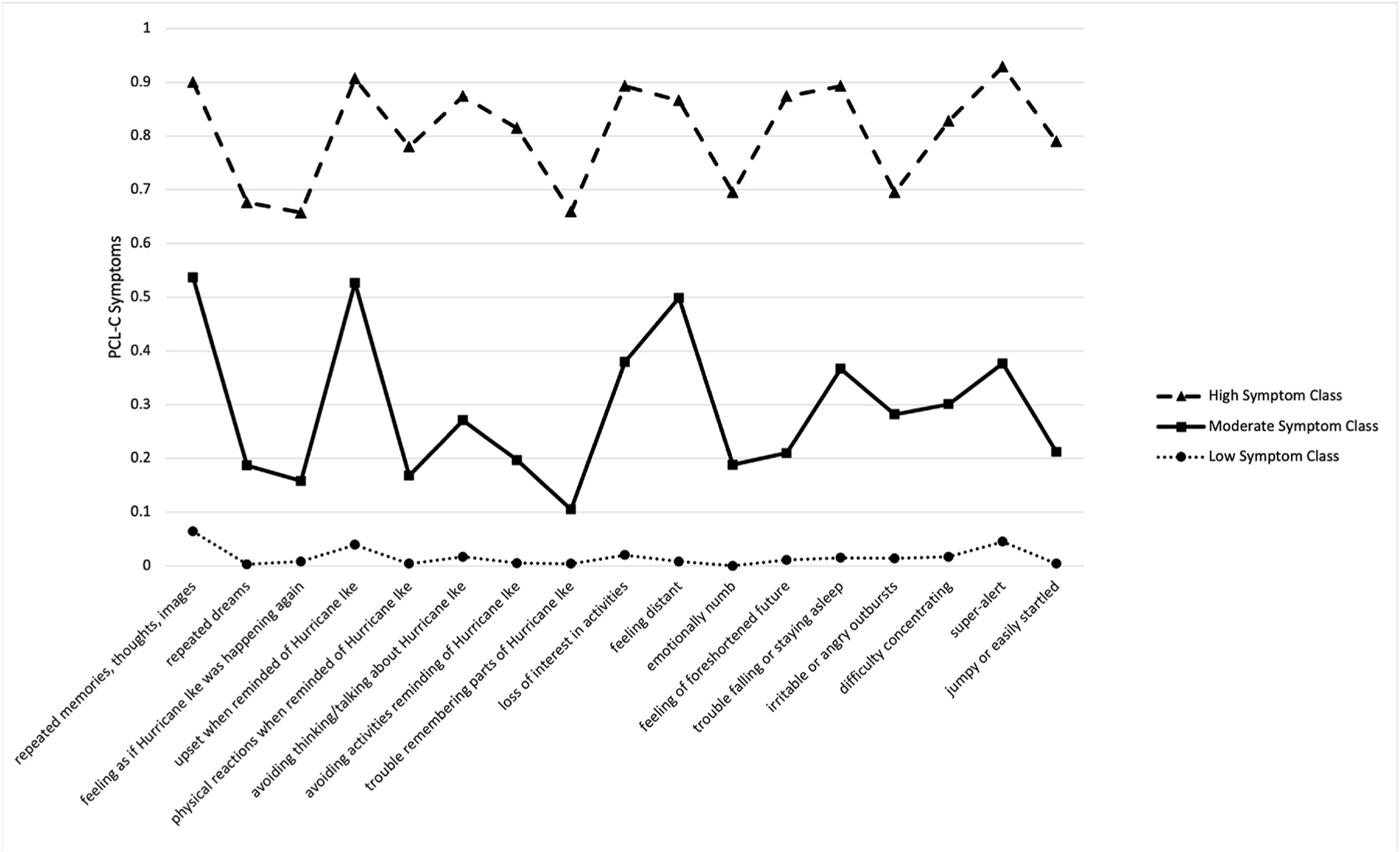
LCA supported a 3-class model with low (n = 407, 61.9%), moderate (n = 191, 29.0%), and high PTSD symptoms (n = 60, 9.1%). Women appeared most at-risk for a moderate-severity presentation as compared to a low-severity presentation. Further, racial or ethnic minority groups appeared most at-risk for a high-severity presentation as compared to a moderate-severity presentation. Overall, the high symptom class had the poorest well-being, the most perceived need for services, and the highest exposure to the disaster, followed by the moderate symptom class, and finally the low symptom class.
PTSD symptom classes appeared to be differentiated primarily by overall severity as well as important psychological, contextual, and demographic dimensions.
人们对潜在创伤性事件(PTE)的反应存在很大的异质性。尽管有一些文献探讨了这种异质性,但在灾难文献中,只有少数研究确定了与之相关的因素。
本研究旨在确定创伤后应激障碍(PTSD)症状的潜在类别,并在经历飓风艾克后,比较这些类别之间的差异。
德克萨斯州加尔维斯顿和钱伯斯县的成年人(n=658)在飓风艾克发生后 2 至 5 个月期间接受了一次访谈,完成了一系列的测量工具。采用潜在类别分析(LCA)来确定 PTSD 症状的潜在类别。此外,还研究了性别、年龄、种族或民族少数群体地位、抑郁严重程度、焦虑严重程度、生活质量、感知服务需求以及灾难暴露情况,以探索类别的差异。
LCA 支持一个 3 类模型,包括低 PTSD 症状(n=407,61.9%)、中 PTSD 症状(n=191,29.0%)和高 PTSD 症状(n=60,9.1%)。与低严重程度组相比,女性更有可能出现中度严重程度的 PTSD。此外,与中度严重程度组相比,少数族裔群体更有可能出现高度严重程度的 PTSD。总的来说,高症状组的幸福感最差,感知服务需求最高,对灾难的暴露程度最高,其次是中症状组,最后是低症状组。
PTSD 症状类别似乎主要通过总体严重程度以及重要的心理、背景和人口统计学维度来区分。