University of Mississippi Medical Center, Jackson, MS, United States; Boston University, Boston, MA, United States.
University of Mississippi Medical Center, Jackson, MS, United States.
J Anxiety Disord. 2014 Jan;28(1):16-24. doi: 10.1016/j.janxdis.2013.11.002. Epub 2013 Nov 24.
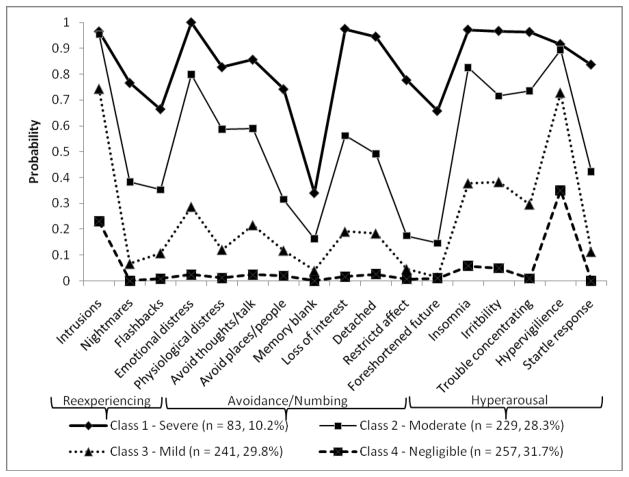
The present study applied latent class analysis to a sample of 810 participants residing in southern Mississippi at the time of Hurricane Katrina to determine if people would report distinct, meaningful PTSD symptom classes following a natural disaster. We found a four-class solution that distinguished persons on the basis of PTSD symptom severity/pervasiveness (Severe, Moderate, Mild, and Negligible Classes). Multinomial logistic regression models demonstrated that membership in the Severe and Moderate Classes was associated with potentially traumatic hurricane-specific experiences (e.g., being physically injured, seeing dead bodies), pre-hurricane traumatic events, co-occurring depression symptom severity and suicidal ideation, certain religious beliefs, and post-hurricane stressors (e.g., social support). Collectively, the findings suggest that more severe/pervasive typologies of natural disaster PTSD may be predicted by the frequency and severity of exposure to stressful/traumatic experiences (before, during, and after the disaster), co-occurring psychopathology, and specific internal beliefs.
本研究对卡特里娜飓风期间居住在密西西比州南部的 810 名参与者进行了潜在类别分析,以确定人们在自然灾害后是否会报告明显的、有意义的 PTSD 症状类别。我们发现了一个四分类解决方案,根据 PTSD 症状严重程度/普遍性(严重、中度、轻度和可忽略不计类别)区分个体。多项逻辑回归模型表明,严重和中度类别与潜在创伤性的飓风特定经历(例如身体受伤、看到尸体)、飓风前的创伤性事件、共病抑郁症状严重程度和自杀意念、某些宗教信仰和飓风后应激源(例如社会支持)有关。总的来说,这些发现表明,更严重/普遍的自然灾害 PTSD 可能可以通过暴露于压力/创伤性经历的频率和严重程度(灾难前、期间和之后)、共病精神病理学和特定的内部信念来预测。