Yeom Jung Sook, Kim Rock Bum, Cho Jae Young, Park Ji Sook, Park Eun Sil, Seo Ji-Hyun, Lim Jae-Young, Woo Hyang-Ok
Department of Pediatrics, Gyeongsang National University of Hospital, Jinju, Korea.
Gyeongsang National University School of Medicine, Gyeongsang Institute of Health Sciences, Jinju, Korea.
Clin Exp Pediatr. 2023 Jun;66(6):252-261. doi: 10.3345/cep.2023.00101. Epub 2023 May 19.
In clinical practice, the importance of interactive engagement behaviors is overlooked in children with developmental problems other than autism spectrum disorder (ASD). Parenting stress affects children's development but lacks attention from clinicians.
This study aimed to identify the characteristics of interactive engagement behaviors and parenting stress among non-ASD children with developmental delays (DDs). We also analyzed whether engagement behaviors affect parenting stress.
At Gyeongsang National University Hospital, between May 2021 and October 2021, we retrospectively enrolled 51 consecutive patients diagnosed with DDs in language or cognition (but not ASD) in the delayed group and 24 typically developing children in the control group. The Korean version of the Parenting Stress Index-4 and Child Interactive Behavior Test were used to assess the participants.
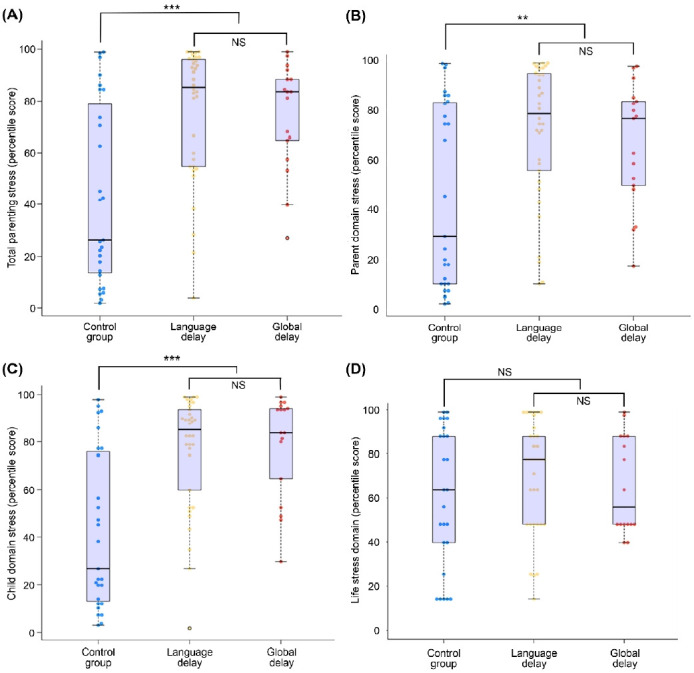
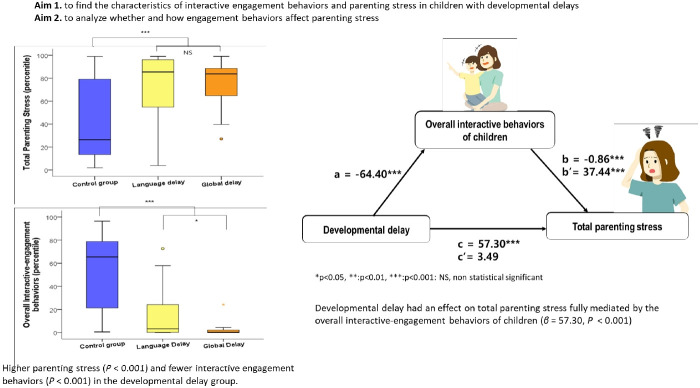
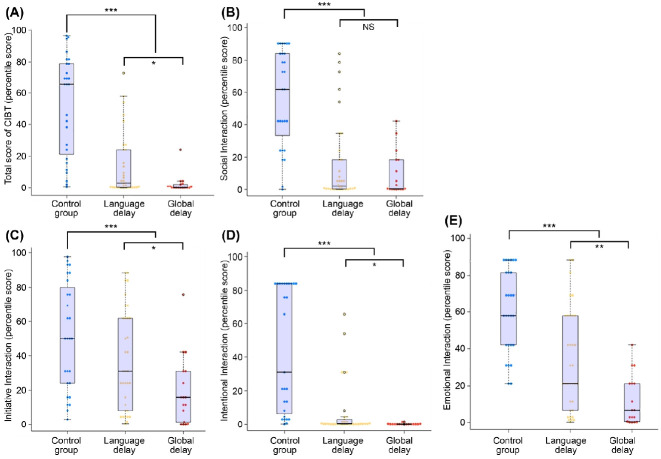
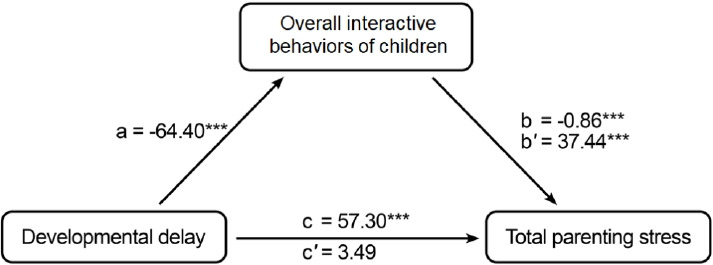
The median age of the delayed group was 31.0 months (interquartile range, 25.0-35.5 months); this group included 42 boys (82.4%). There were no intergroup differences in child age, child sex, parental age, parental educational background, mother's employment status, or marital status. Higher parenting stress (P<0.001) and fewer interactive engagement behaviors (P<0.001) were observed in the delayed group. Low parental acceptance and competence had the largest effects on total parenting stress in the delayed group. A mediation analysis revealed that DDs did not directly affect total parenting stress (β=3.49, P=0.440). Instead, DDs contributed to total parenting stress, which was mediated by children's overall interactive engagement behaviors (β=57.30, P<0.001).
Interactive engagement behaviors were significantly reduced in non-ASD children with DDs and significantly mediated parenting stress. The importance of parenting stress and interactive behaviors in children with DDs should be further examined in clinical practice.
在临床实践中,除自闭症谱系障碍(ASD)外,发育问题儿童的互动参与行为的重要性被忽视。育儿压力会影响儿童的发育,但临床医生对此缺乏关注。
本研究旨在确定发育迟缓(DD)的非ASD儿童的互动参与行为和育儿压力的特征。我们还分析了参与行为是否会影响育儿压力。
在庆尚国立大学医院,于2021年5月至2021年10月期间,我们回顾性纳入了延迟组中51例连续诊断为语言或认知发育迟缓(但非ASD)的患者,以及对照组中24名发育正常的儿童。采用韩语版的《育儿压力指数-4》和《儿童互动行为测试》对参与者进行评估。
延迟组的中位年龄为31.0个月(四分位间距,25.0 - 35.5个月);该组包括42名男孩(82.4%)。两组在儿童年龄、儿童性别、父母年龄、父母教育背景、母亲就业状况或婚姻状况方面无差异。延迟组的育儿压力更高(P<0.001),互动参与行为更少(P<0.001)。父母低接纳度和低能力对延迟组的总体育儿压力影响最大。中介分析显示,发育迟缓并未直接影响总体育儿压力(β = 3.49,P = 0.440)。相反,发育迟缓导致总体育儿压力增加,这是由儿童的总体互动参与行为介导的(β = 57.30,P<0.001)。
发育迟缓的非ASD儿童的互动参与行为显著减少,并显著介导育儿压力。在临床实践中,应进一步研究育儿压力和互动行为在发育迟缓儿童中的重要性。