Borkenstein Andreas F, Borkenstein Eva-Maria, Mühlbacher Inge, Flock Michaela
Borkenstein & Borkenstein Private Practice, Privatklinik der Kreuzschwestern Graz, Kreuzgasse 35, 8010, Graz, Austria.
Institute of Inorganic Chemistry, University of Technology Graz, Stremayrgasse 9, 8010, Graz, Austria.
Ophthalmol Ther. 2023 Aug;12(4):2087-2101. doi: 10.1007/s40123-023-00728-7. Epub 2023 May 21.
Intraocular lenses (IOL) should remain in the eye for life after implantation into the capsular bag during cataract surgery. The material must meet various requirements. It is crucial that the material has the best biocompatibility, and it should be flexible and soft for best possible implantation process but also sufficiently stable and stiff for good centering in the eye and posterior capsule opacification prevention.
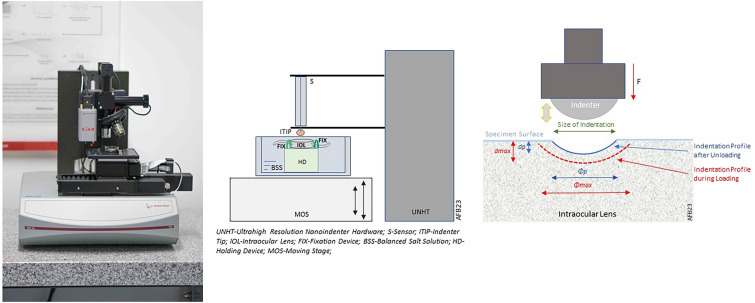
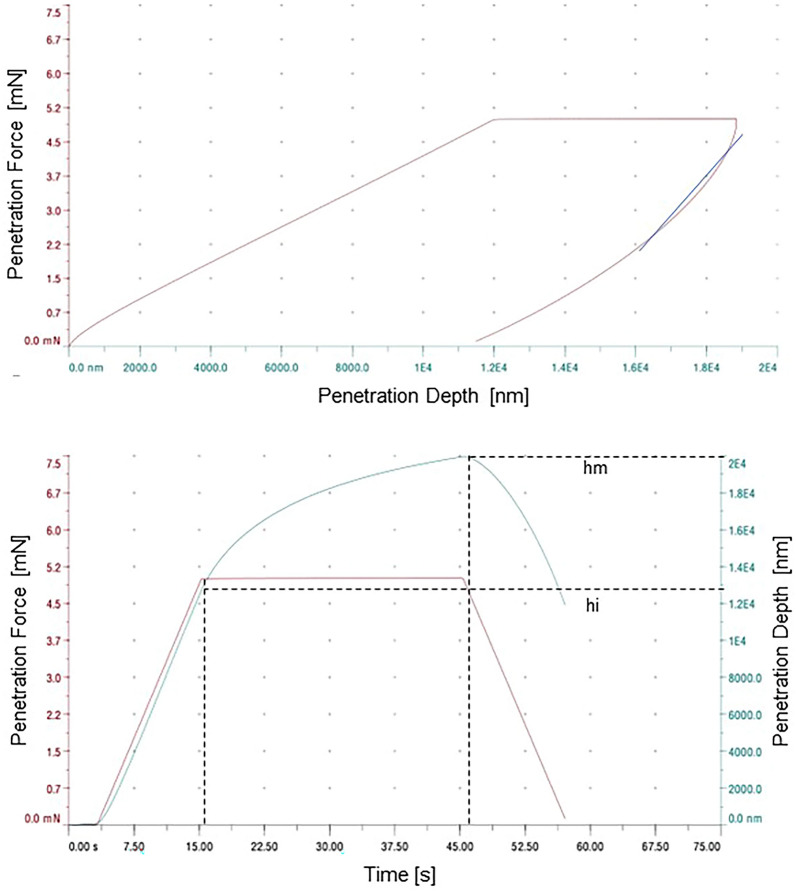
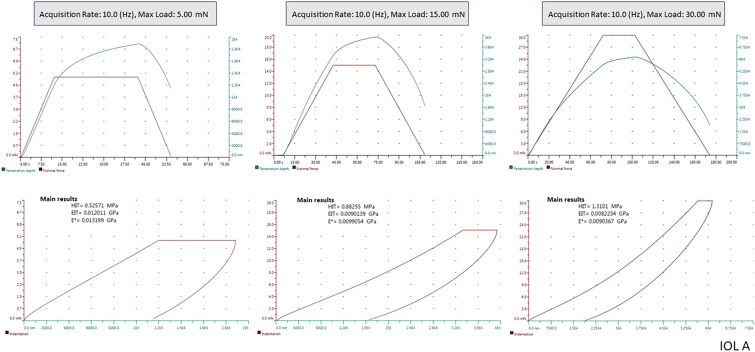
In this laboratory experiment, we used nano-indentation for the mechanical assessment of three hydrophobic acrylic (A, B, C), three hydrophilic acrylic (D, E, F), and one silicone (G) intraocular lens. We wanted to determine whether some react more sensitively to touching/handling than others. The indentation elastic modulus and the creep were obtained from the force displacement curve. For measuring penetration depth and testing of possible damage to the intraocular lenses, the samples were measured at room temperature. A 200-µm-diameter ruby spherical tipped indenter was used for all the tests. Indentations were made to three different maximum loads, namely 5 mN (milli Newton), 15 mN, and 30 mN and repeated three times.
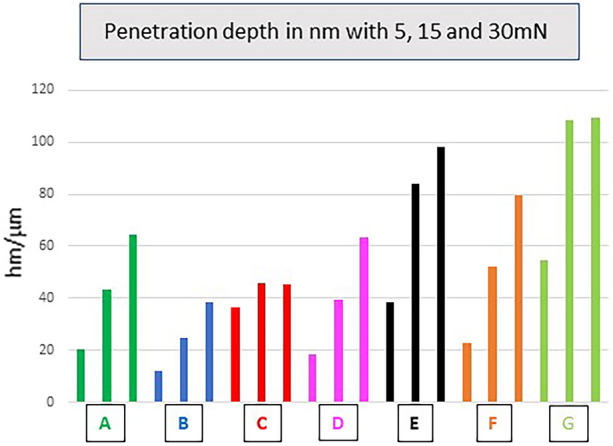
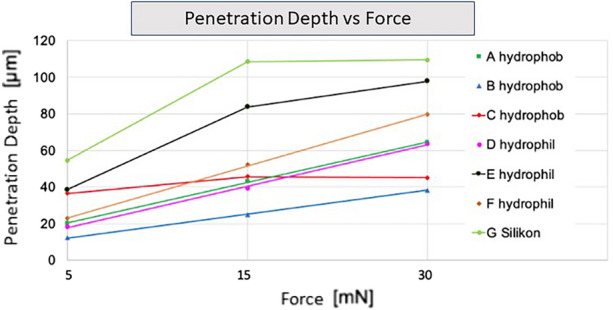
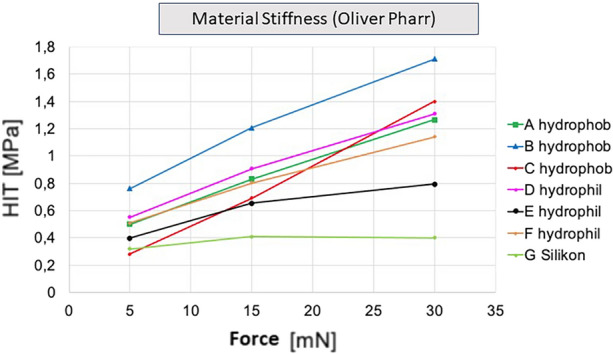
The lowest penetration depth (12 µm) was observed with IOL B. However, IOL A, D, and F showed similar low penetration depths (20, 18, and 23 µm, respectively). Lenses C and E showed slightly higher penetration depths of 36 and 39 µm, respectively. The silicone lens (G) showed the greatest penetration depth of 54.6 µm at a maximum load of 5 mN. With higher maximal loads (15 and 30 mN) the penetration depth increased significantly. Lens C, however, showed the same results at both 15 and 30 mN with no increase of penetration depth. This seems to fit well with the material and manufacturing process of the lens (lathe-cut). During the holding time of 30 s at constant force all six acrylic lenses showed a significant increase of the creep (C 21-43%). Lens G showed the smallest creep with 14%. The mean indentation modulus (E) values ranged from 1 to 37 MPa. IOL B had the largest E of 37 MPa, which could be caused by the low water content.
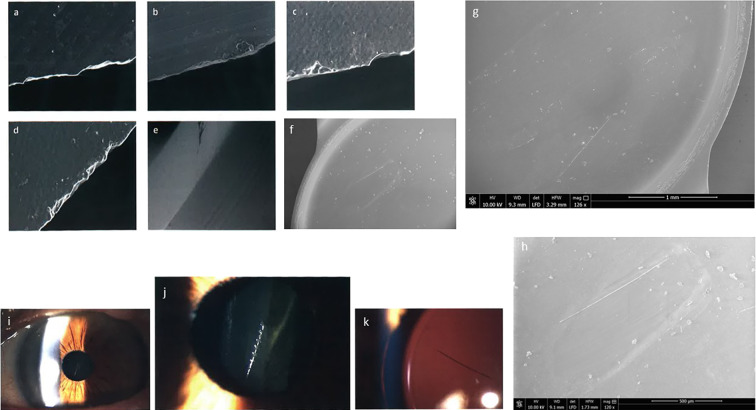
It was found that results correlate very well with the water content of the material in the first place. The manufacturing process (molded versus lathe-cut) seems to play another important role. Since all included acrylic lenses are very similar, it was not surprising that the measured differences are marginal. Even though hydrophobic materials with lower water content showed higher relative stiffness, penetration and defects can also occur with these. The surgeon and scrub nurse should always be aware that macroscopic changes are difficult to detect but that defects could theoretically lead to clinical effects. The principle of not touching the center of the IOL optic at any time should be taken seriously.
人工晶状体(IOL)在白内障手术植入囊袋后应终生留在眼内。该材料必须满足各种要求。至关重要的是,材料要具有最佳的生物相容性,并且应柔软灵活以便于最佳的植入过程,但同时也要足够稳定和坚硬,以便在眼内良好居中并防止后囊膜混浊。
在本实验室实验中,我们使用纳米压痕技术对三种疏水丙烯酸酯(A、B、C)、三种亲水丙烯酸酯(D、E、F)和一种硅酮(G)人工晶状体进行力学评估。我们想确定某些人工晶状体是否比其他人工晶状体对触摸/操作更敏感。从力 - 位移曲线获得压痕弹性模量和蠕变。为了测量穿透深度并测试人工晶状体可能的损伤情况,在室温下对样品进行测量。所有测试均使用直径为200 µm的红宝石球形尖端压头。对三种不同的最大载荷进行压痕,即5 mN(毫牛顿)、15 mN和30 mN,并重复三次。
人工晶状体B的穿透深度最低(12 µm)。然而,人工晶状体A、D和F的穿透深度也较低(分别为20 µm、18 µm和23 µm)。晶状体C和E的穿透深度略高,分别为36 µm和39 µm。硅酮晶状体(G)在最大载荷为5 mN时的穿透深度最大,为54.6 µm。随着最大载荷增加(15 mN和30 mN),穿透深度显著增加。然而,晶状体C在15 mN和30 mN时结果相同,穿透深度没有增加。这似乎与晶状体的材料和制造工艺(车床切割)非常吻合。在恒定力下保持30秒的时间内,所有六种丙烯酸酯晶状体的蠕变都有显著增加(C为21 - 43%)。晶状体G的蠕变最小,为14%。平均压痕模量(E)值范围为1至37 MPa。人工晶状体B的E值最大,为37 MPa,这可能是由于其含水量低所致。
首先发现结果与材料的含水量密切相关。制造工艺(模制与车床切割)似乎也起着重要作用。由于所有纳入的丙烯酸酯晶状体非常相似,所以测量到的差异很小并不奇怪。尽管含水量较低的疏水材料表现出较高的相对刚度,但这些材料也可能出现穿透和缺陷。外科医生和洗手护士应始终意识到宏观变化难以检测,但理论上缺陷可能导致临床影响。任何时候都不触碰人工晶状体光学部中心的原则应得到重视。