MOE Key Laboratory of Tumor Molecular Biology and Key Laboratory of Functional Protein Research of Guangdong Higher Education Institutes, Institute of Life and Health Engineering, College of Life Science and Technology, Jinan University, Guangzhou 510632, China.
MOE Key Laboratory of Tumor Molecular Biology and Key Laboratory of Functional Protein Research of Guangdong Higher Education Institutes, Institute of Life and Health Engineering, College of Life Science and Technology, Jinan University, Guangzhou 510632, China.
Mol Ther. 2023 Jul 5;31(7):2169-2187. doi: 10.1016/j.ymthe.2023.05.015. Epub 2023 May 21.
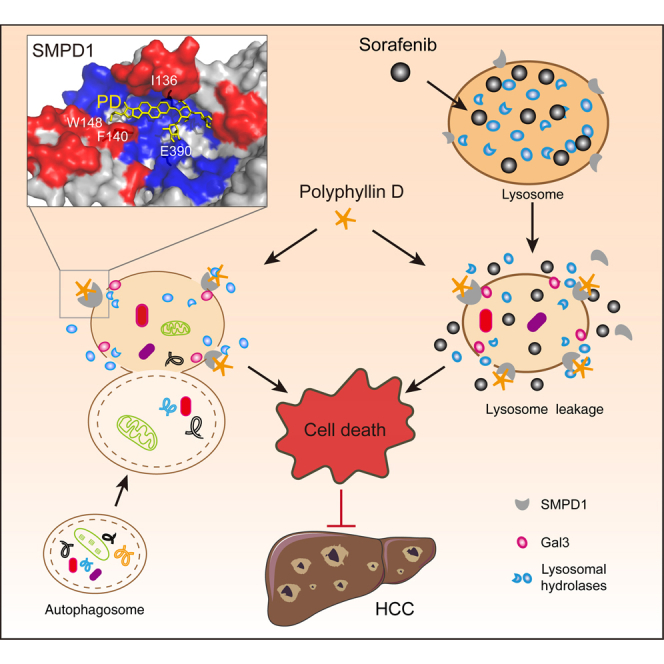
Hypertrophic lysosomes are critical for tumor progression and drug resistance; however, effective and specific lysosome-targeting compounds for cancer therapy are lacking. Here we conducted a lysosomotropic pharmacophore-based in silico screen in a natural product library (2,212 compounds), and identified polyphyllin D (PD) as a novel lysosome-targeted compound. PD treatment was found to cause lysosomal damage, as evidenced by the blockade of autophagic flux, loss of lysophagy, and the release of lysosomal contents, thus exhibiting anticancer effects on hepatocellular carcinoma (HCC) cell both in vitro and in vivo. Closer mechanistic examination revealed that PD suppressed the activity of acid sphingomyelinase (SMPD1), a lysosomal phosphodieserase that catalyzes the hydrolysis of sphingomyelin to produce ceramide and phosphocholine, by directly occupying its surface groove, with Trp148 in SMPD1 acting as a major binding residue; this suppression of SMPD1 activity irreversibly triggers lysosomal injury and initiates lysosome-dependent cell death. Furthermore, PD-enhanced lysosomal membrane permeabilization to release sorafenib, augmenting the anticancer effect of sorafenib both in vivo and in vitro. Overall, our study suggests that PD can potentially be further developed as a novel autophagy inhibitor, and a combination of PD with classical chemotherapeutic anticancer drugs could represent a novel therapeutic strategy for HCC intervention.
肥大的溶酶体对于肿瘤的进展和耐药性至关重要;然而,用于癌症治疗的有效和特异的溶酶体靶向化合物仍然缺乏。在这里,我们在天然产物库(2212 种化合物)中进行了基于溶酶体靶向药效团的计算机筛选,并鉴定出重楼苷 D(PD)是一种新型溶酶体靶向化合物。PD 处理被发现会导致溶酶体损伤,这表现在自噬通量的阻断、溶酶体吞噬作用的丧失和溶酶体内容物的释放,从而在体外和体内对肝癌(HCC)细胞表现出抗癌作用。更深入的机制研究表明,PD 通过直接占据其表面凹槽来抑制酸性鞘磷脂酶(SMPD1)的活性,SMPD1 是一种溶酶体磷酸二酯酶,可催化鞘磷脂水解生成神经酰胺和磷酸胆碱;SMPD1 中的色氨酸 148 (Trp148)是主要结合残基;这种 SMPD1 活性的抑制会不可逆转地引发溶酶体损伤,并引发溶酶体依赖性细胞死亡。此外,PD 增强了溶酶体膜的通透性,以释放索拉非尼,从而增强了索拉非尼在体内和体外的抗癌作用。总的来说,我们的研究表明,PD 可能被进一步开发为新型自噬抑制剂,并且将 PD 与经典的化学抗癌药物联合使用可能代表 HCC 干预的一种新的治疗策略。