Department of Oncology, The Affiliated Hospital of Southwest Medical University, Luzhou 646099, Sichuan Province, China.
World J Gastroenterol. 2023 May 7;29(17):2679-2700. doi: 10.3748/wjg.v29.i17.2679.
Multiple studies investigating the relationship between intake of different types of fruit and colorectal cancer (CRC) risk have yielded inconsistent results.
To perform a meta-analysis of existing studies to assess the association between the intake of different kinds of fruit and the incidence of CRC.
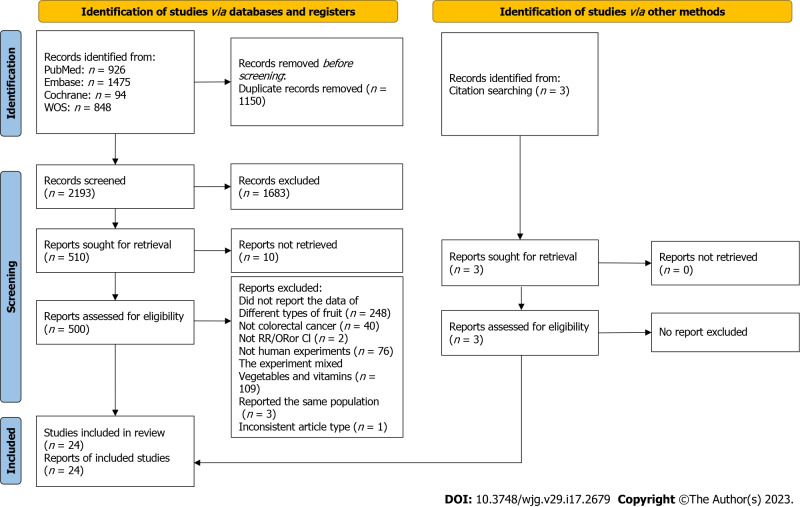
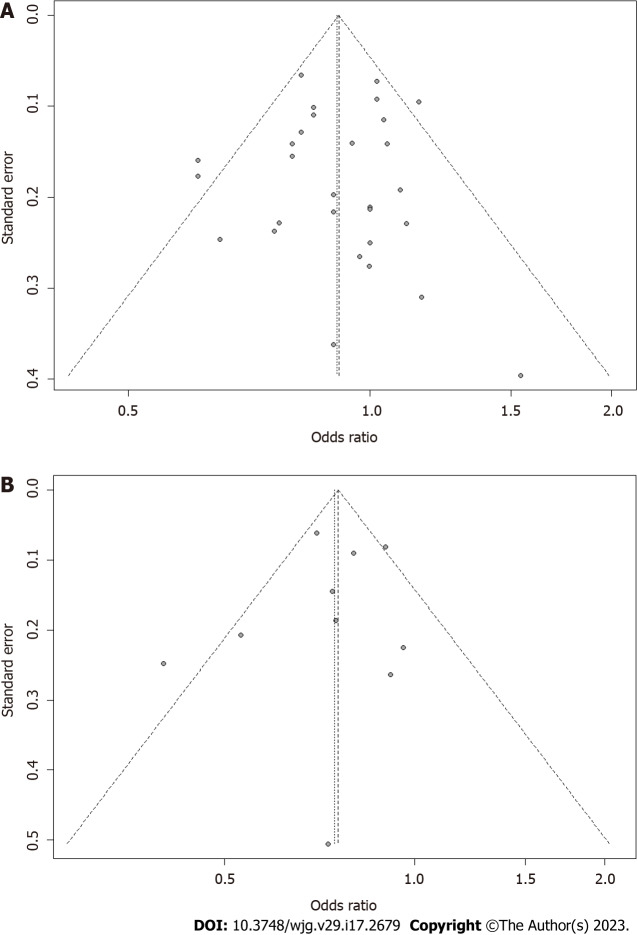
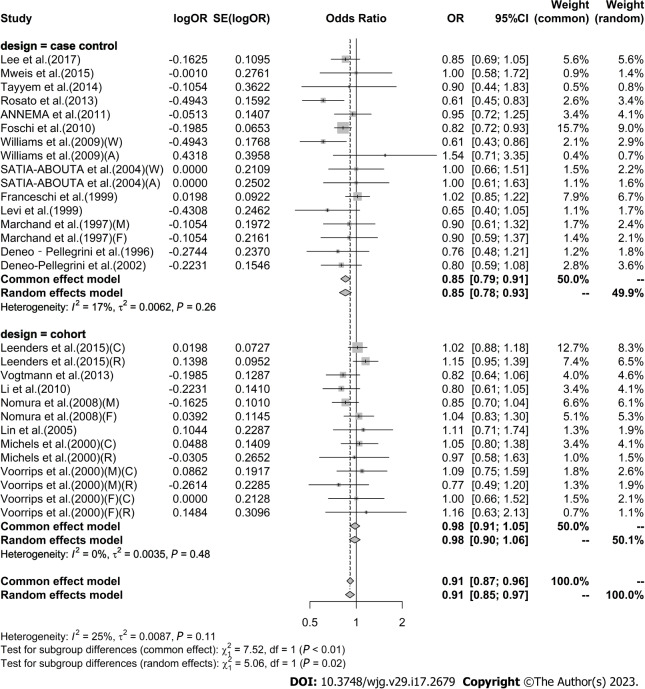
We searched online literature databases including PubMed, Embase, WOS, and Cochrane Library for relevant articles available up to August 2022. With data extracted from observational studies, odds ratios (ORs) with 95% confidence intervals (CIs) were assessed using random-effects models. A funnel plot and Egger's test were used to determine publication bias. Furthermore, subgroup analysis and dose-response analysis were performed. All analyses were conducted using R (version 4.1.3).
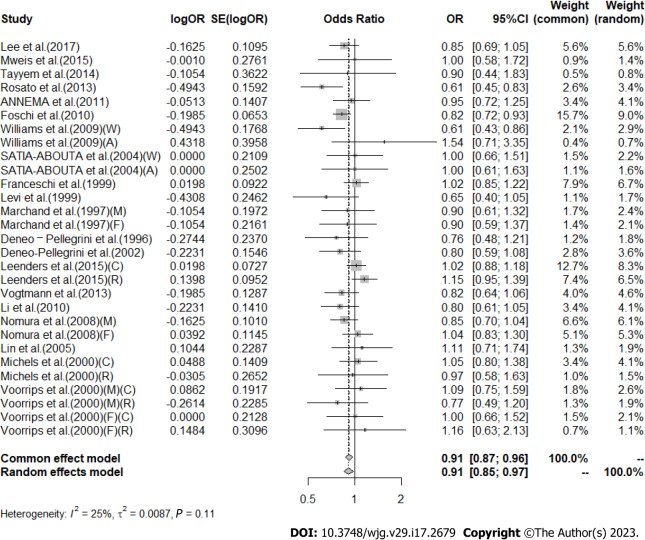
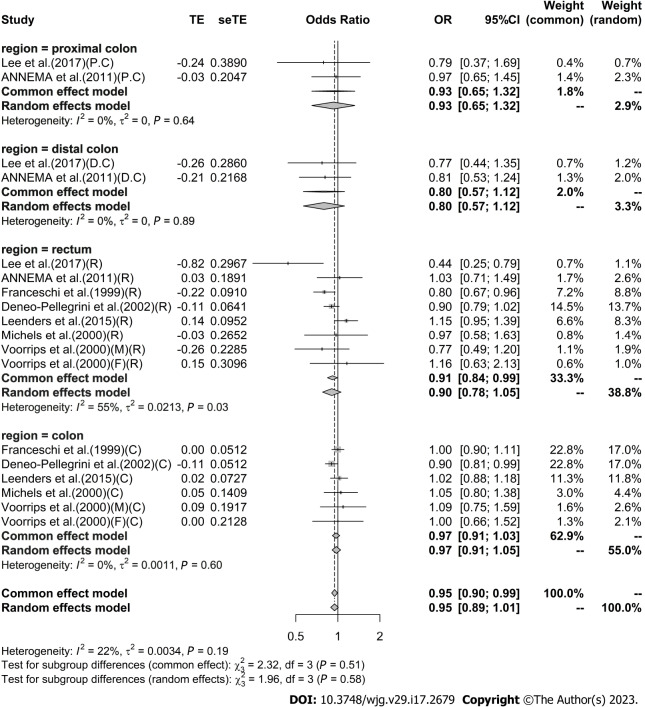
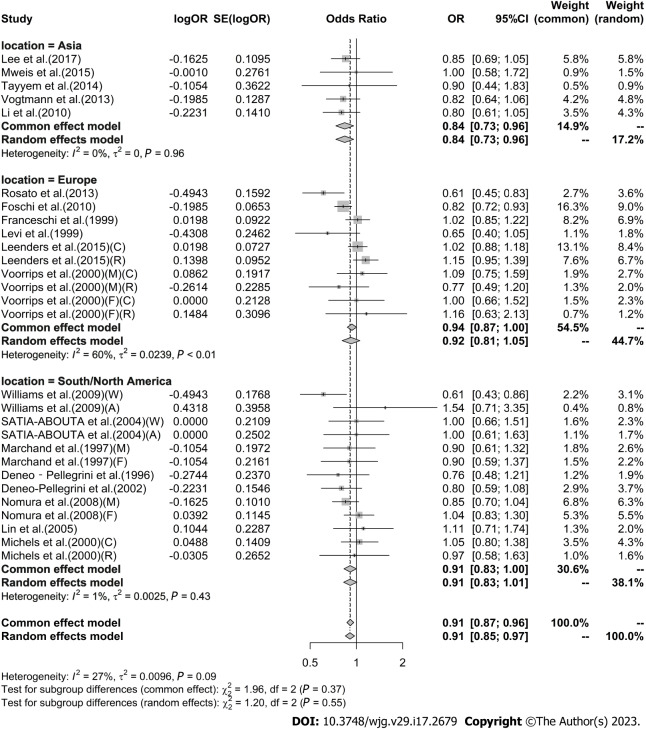
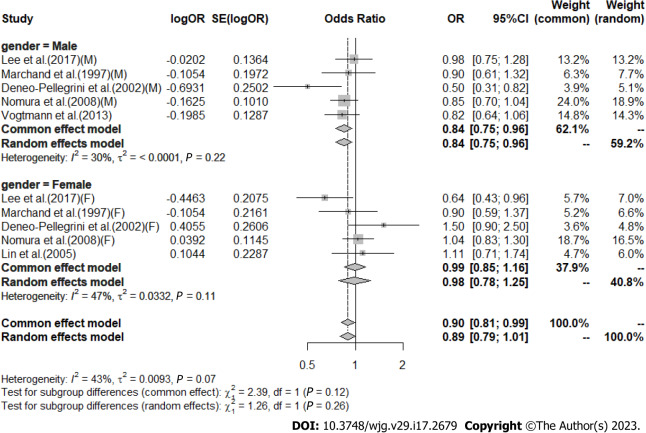
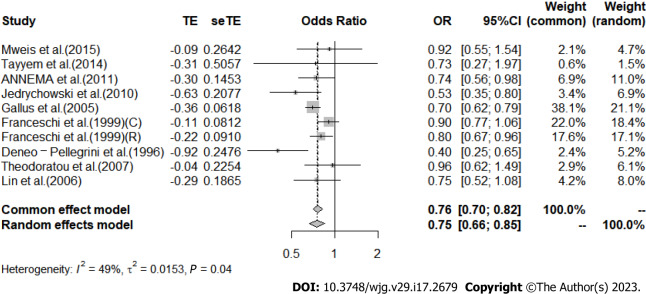
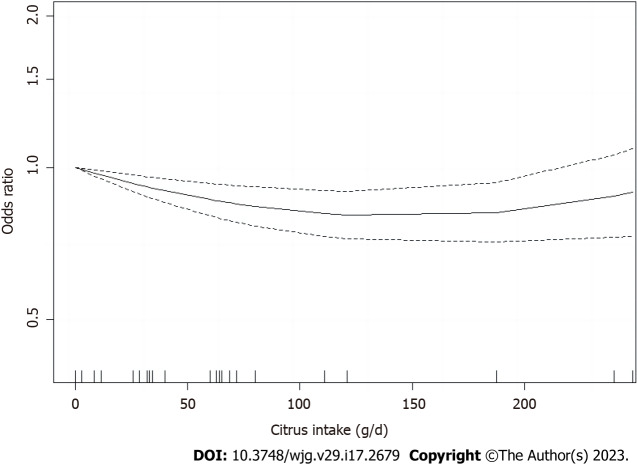
Twenty-four eligible studies involving 1068158 participants were included in this review. The meta-analysis showed that compared to a low intake, a higher intake of citrus, apples, watermelon, and kiwi reduced the risk of CRC by 9% [OR (95%CI) = 0.91 (0.85-0.97)], 25% [OR (95%CI) = 0.75 (0.66-0.85)], 26% [OR (95%CI) = 0.74 (0.58-0.94)], 13% [OR (95%CI) = 0.87 (0.78-0.96)], respectively. No significant association was observed between the intake of other types of fruit and the risk of CRC. In the dose-response analysis, a nonlinear association was found [R (95%CI) = -0.0031 (-0.0047 to -0.0014)] between citrus intake and CRC risk ( < 0.001), with the risk minimized around 120 g/d (OR = 0.85), while no significant dose-response correlation was observed after continued increase in intake.
We found that a higher intake of citrus, apples, watermelon, and kiwi was negatively associated with the risk of CRC, while the intake of other types of fruits were not significantly associated with CRC. Citrus intake showed a non-linear dose-response relationship with the risk of CRC. This meta-analysis provides further evidence that a higher intake of specific types of fruit is effective in preventing the occurrence of CRC.
多项研究调查了不同类型水果的摄入与结直肠癌(CRC)风险之间的关系,但其结果并不一致。
对现有研究进行荟萃分析,以评估不同种类水果的摄入与 CRC 发生率之间的关系。
我们检索了在线文献数据库,包括 PubMed、Embase、WOS 和 Cochrane Library,以获取截至 2022 年 8 月的相关文章。对于观察性研究,我们使用随机效应模型评估了比值比(OR)及其 95%置信区间(CI)。采用漏斗图和 Egger 检验来评估发表偏倚。此外,还进行了亚组分析和剂量-反应分析。所有分析均使用 R(版本 4.1.3)进行。
本综述共纳入了 24 项纳入 1068158 名参与者的合格研究。荟萃分析显示,与低摄入量相比,较高摄入量的柑橘、苹果、西瓜和猕猴桃可使 CRC 风险分别降低 9%[OR(95%CI)=0.91(0.85-0.97)]、25%[OR(95%CI)=0.75(0.66-0.85)]、26%[OR(95%CI)=0.74(0.58-0.94)]和 13%[OR(95%CI)=0.87(0.78-0.96)]。其他类型水果的摄入量与 CRC 风险之间未见显著相关性。在剂量-反应分析中,发现柑橘摄入量与 CRC 风险之间存在非线性关联[R(95%CI)=-0.0031(-0.0047 至 -0.0014)](<0.001),摄入量约为 120 g/d 时风险最低(OR=0.85),而继续增加摄入量后,未见明显的剂量-反应相关性。
我们发现,较高的柑橘、苹果、西瓜和猕猴桃摄入量与 CRC 风险呈负相关,而其他类型水果的摄入量与 CRC 风险无显著相关性。柑橘摄入量与 CRC 风险之间存在非线性剂量-反应关系。本荟萃分析进一步证实,较高的特定类型水果摄入可有效预防 CRC 的发生。