Institute of Physical Education, Xinjiang Normal University, Urumqi, China.
Front Public Health. 2023 May 4;11:1128552. doi: 10.3389/fpubh.2023.1128552. eCollection 2023.
Most studies have focused on overweight/obesity and its secular trend, with insufficient studies on the factors influencing thinness and trends recently. To examine the trends of prevalence and sociodemographic determinants of thinness, overweight, and obesity among Chinese children and adolescents aged 7 to 18 years from 2010 to 2018.
This study was based on cross-sectional data of 11,234 children and adolescents aged 7 to 18 years from the Chinese Family Panel Studies (CFPS) in 2010, 2014, and 2018, including anthropometric and sociodemographic characteristics variables. The nutritional status of each individual was determined according to China and WHO criteria. The demographic characteristics of different subgroups were tested by chi-square, and log-binomial regression was used to analyze the trend of prevalence and the relationship between sociodemographic characteristics and different nutritional statuses.
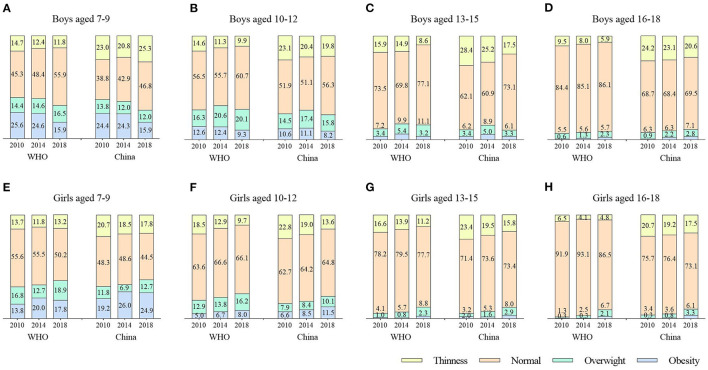
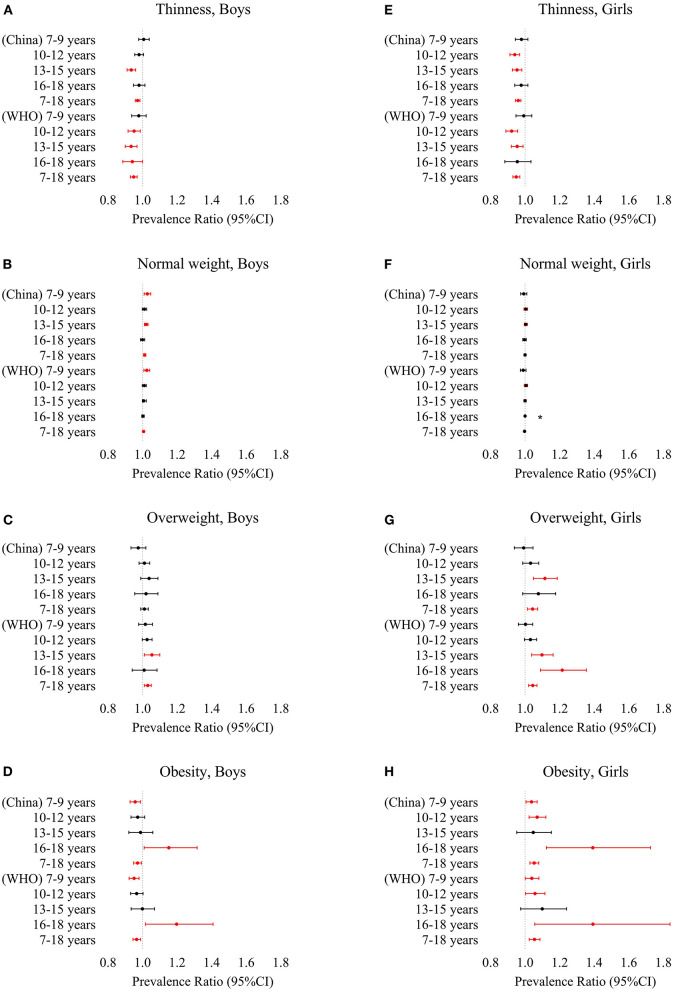
After adjusting for age, from 2010 to 2018, the overall prevalence of thinness decreased, and the prevalence of overweight increased in Chinese children and adolescents. The overall prevalence of obesity declined in boys and increased in girls, but in adolescents aged 16-18 years, it increased significantly. Log-binomial regression analysis showed that among all subjects, time (years), 16-18 years were negatively associated with thinness, while 13-15 years, walking to school, large family size, and paternal age at childbirth older than 30 years old were positively associated with thinness; 10-12/13-15/16-18 years, boarding at school, medium and large family sizes, and mother's education at junior middle school/junior high school and above were negatively associated with overweight/obesity, while time (years), boys were positively associated with overweight/obesity in the multivariate model by adjusting for the statistically significant factors (all < 0.05).
Chinese children and adolescents are facing a double burden of malnutrition. Future public health policies and interventions should prioritize high-risk groups specifically young age groups, boys, larger family sizes and so on.
大多数研究都集中在超重/肥胖及其长期趋势上,而对最近影响消瘦的因素及其趋势的研究则不足。本研究旨在探讨 2010 年至 2018 年中国 7 至 18 岁儿童青少年消瘦、超重和肥胖的流行趋势及其社会人口学决定因素。
本研究基于中国家庭追踪调查(CFPS)2010、2014 和 2018 年的 11234 名 7 至 18 岁儿童青少年的横断面数据,包括人体测量和社会人口学特征变量。根据中国和世界卫生组织的标准,确定个体的营养状况。采用卡方检验比较不同亚组的人口统计学特征,采用对数二项式回归分析流行趋势及社会人口学特征与不同营养状况的关系。
在调整年龄后,2010 年至 2018 年,中国儿童青少年消瘦总体流行率下降,超重流行率上升。男孩肥胖总体流行率下降,女孩肥胖流行率上升,但在 16-18 岁青少年中,肥胖流行率显著上升。Log-binomial 回归分析显示,在所有受试者中,时间(年)、16-18 岁与消瘦呈负相关,而 13-15 岁、步行上学、大家庭和父亲生育年龄大于 30 岁与消瘦呈正相关;10-12/13-15/16-18 岁、住校、中等和大家庭、母亲初中及以上教育程度与超重/肥胖呈负相关,而时间(年)、男孩与超重/肥胖呈正相关,在调整有统计学意义的因素后(均<0.05)。
中国儿童青少年正面临着双重营养负担。未来的公共卫生政策和干预措施应优先考虑高风险人群,特别是年龄较小的儿童青少年、男孩、大家庭等。