Singh Ravindra Pal, Bhardwaj Aditi
Department of Industrial Biotechnology, Gujarat Biotechnology University, Gandhinagar, Gujarat, India.
Front Nutr. 2023 May 5;10:1143682. doi: 10.3389/fnut.2023.1143682. eCollection 2023.
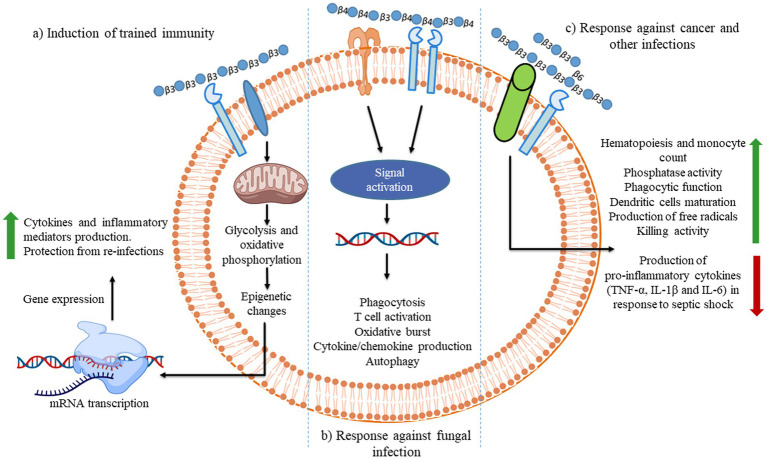
The human gastrointestinal (GI) tract holds a complex and dynamic population of microbial communities, which exerts a marked influence on the host physiology during homeostasis and disease conditions. Diet is considered one of the main factors in structuring the gut microbiota across a lifespan. Intestinal microbial communities play a vital role in sustaining immune and metabolic homeostasis as well as protecting against pathogens. The negatively altered gut bacterial composition has related to many inflammatory diseases and infections. glucans are a heterogeneous assemblage of glucose polymers with a typical structure comprising a leading chain of (1,4) and/or (1,3)-glucopyranosyl units with various branches and lengths as a side chain. glucans bind to specific receptors on immune cells and initiate immune responses. However, glucans from different sources differ in their structures, conformation, physical properties, and binding affinity to receptors. How these properties modulate biological functions in terms of molecular mechanisms is not known in many examples. This review provides a critical understanding of the structures of glucans and their functions for modulating the gut microbiota and immune system.
人类胃肠道拥有复杂且动态变化的微生物群落群体,在体内平衡和疾病状态下,这些微生物群落对宿主生理机能有着显著影响。饮食被认为是在整个生命周期中构建肠道微生物群的主要因素之一。肠道微生物群落在维持免疫和代谢平衡以及抵御病原体方面发挥着至关重要的作用。肠道细菌组成的负面改变与许多炎症性疾病和感染有关。葡聚糖是葡萄糖聚合物的异质组合,其典型结构包括由(1,4)和/或(1,3)-吡喃葡萄糖基单元组成的主链,以及具有不同分支和长度的侧链。葡聚糖与免疫细胞上的特定受体结合并引发免疫反应。然而,来自不同来源的葡聚糖在其结构、构象、物理性质以及与受体的结合亲和力方面存在差异。在许多情况下,这些特性如何从分子机制上调节生物学功能尚不清楚。本综述对葡聚糖的结构及其调节肠道微生物群和免疫系统的功能提供了关键的理解。