
使用导电纳米纤维支架调控神经细胞以实现多糖和神经生长因子的控释
Regulation of nerve cells using conductive nanofibrous scaffolds for controlled release of polysaccharides and nerve growth factor.
作者信息
Wang Jing, Liu Yuan, Lv Minmin, Zhao Xiaoli, So Kwok Fai, Li Hui, El-Newehy Mohamed, El-Hamshary Hany, Morsi Yosry, Mo Xiumei
机构信息
Research Center for Human Tissues and Organs Degeneration, Institute of Biomedicine and Biotechnology, Shenzhen Institutes of Advanced Technology, Chinese Academy of Sciences, Shenzhen, 518055, P.R. China.
Department of Orthopedics, Shanghai Sixth People's Hospital, Shanghai, 201306, P.R. China.
出版信息
Regen Biomater. 2023 Apr 20;10:rbad038. doi: 10.1093/rb/rbad038. eCollection 2023.
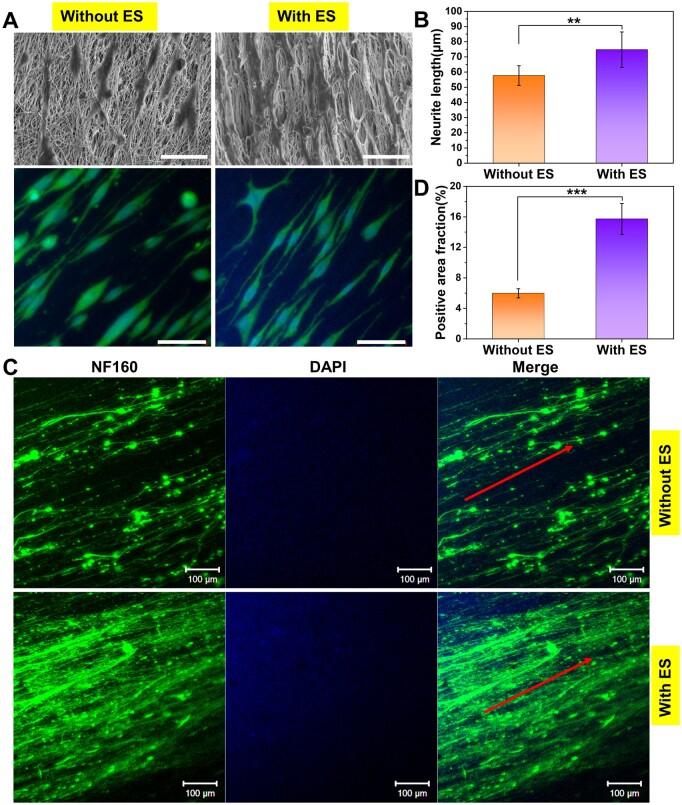
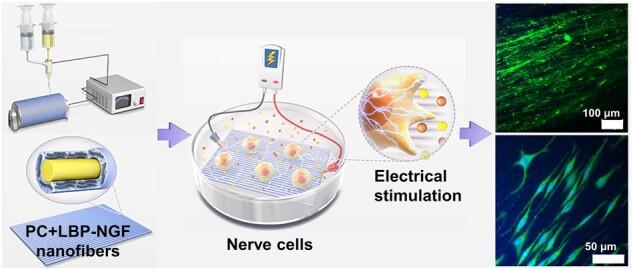
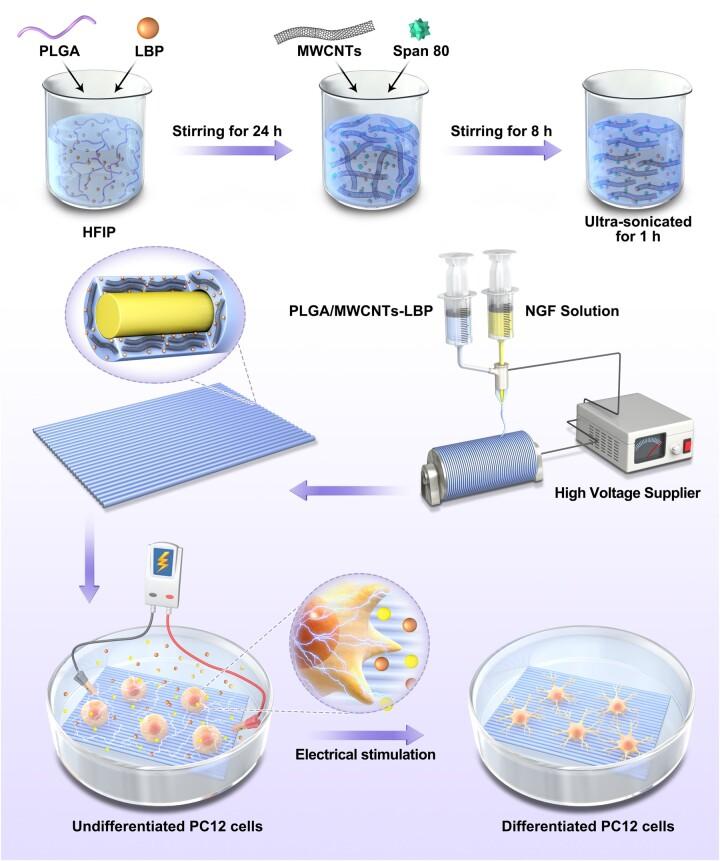
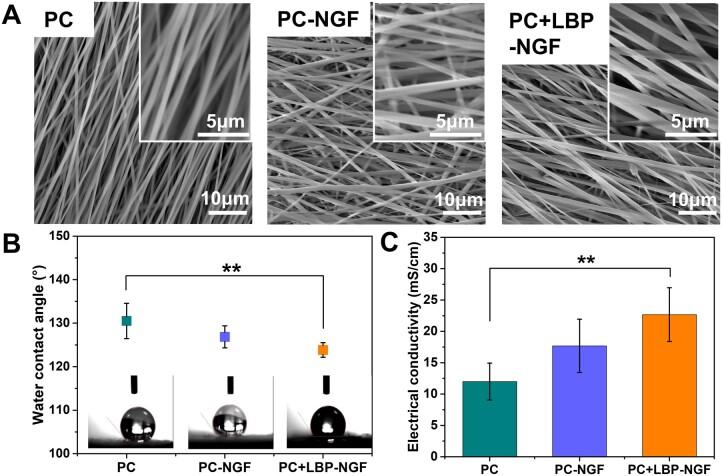
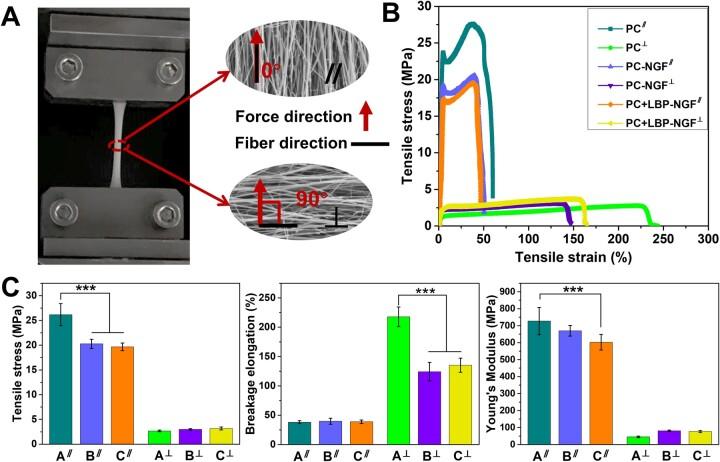
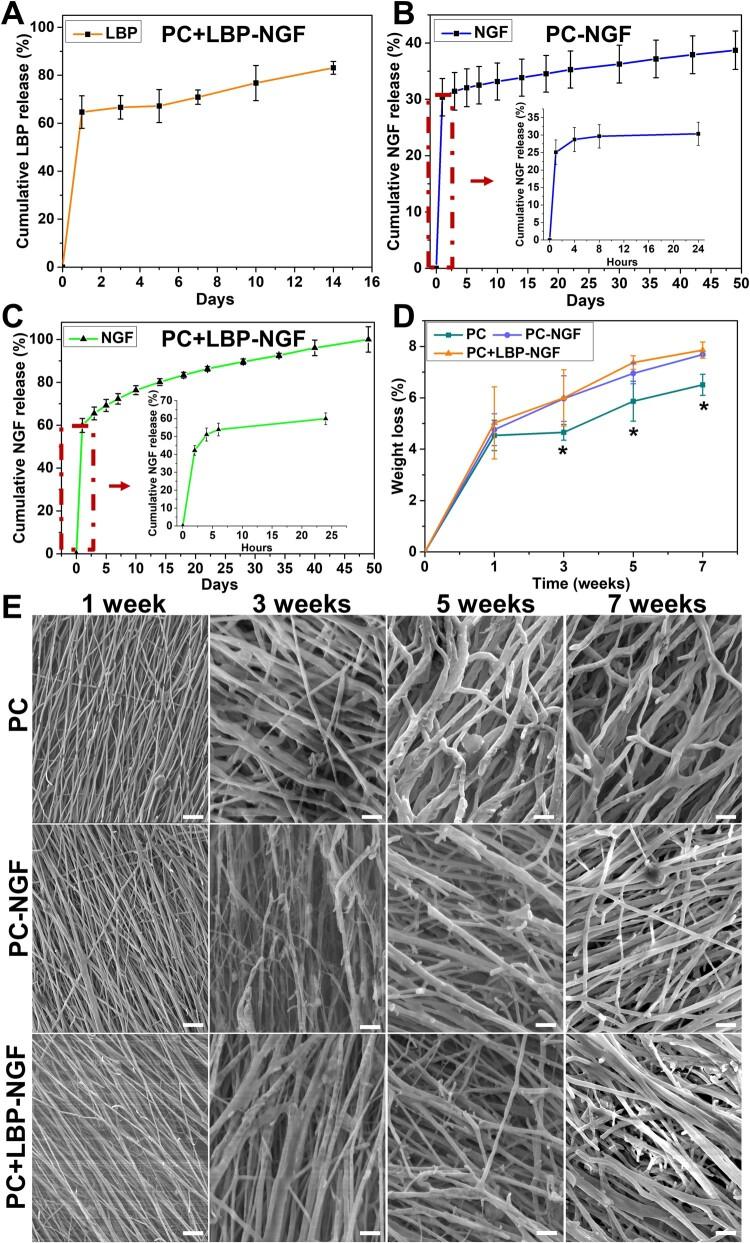
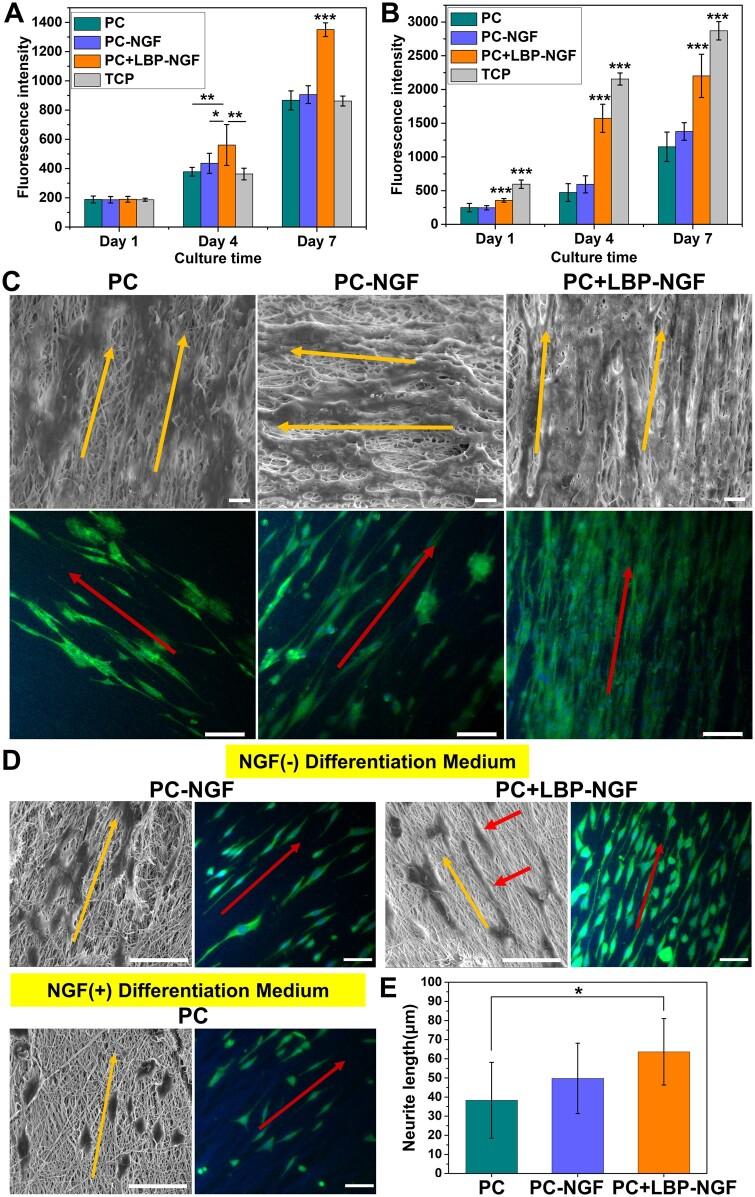
Currently, more and more patients suffer from peripheral nerve injury due to trauma, tumor and other causes worldwide. Biomaterial-based nerve conduits are increasingly recognized as a potential alternative to nerve autografts for the treatment of peripheral nerve injury. However, an ideal nerve conduit must offer topological guidance and biochemical and electrical signal transduction mechanisms. In this work, aligned conductive nanofibrous scaffolds comprising polylactic-co-glycolic acid and multiwalled carbon nanotubes (MWCNTs) were fabricated via coaxial electrospinning, and nerve growth factor (NGF) and Lycium barbarum polysaccharides (LBP) purified from the wolfberry were loaded on the core and shell layers of the nanofibers, respectively. LBP were confirmed to accelerate long-distance axon regeneration after severe peripheral nerve injury. In addition, the synergistic promotion of LBP and NGF on nerve cell proliferation and neurite outgrowth was demonstrated. MWCNTs were introduced into the aligned fibers to further increase the electrical conductivity, which promoted the directional growth and neurite extension of neurons . Further, the combination of conductive fibrous scaffolds with electrical stimulation that mimics endogenous electric fields significantly promoted the differentiation of PC12 cells and the axon outgrowth of neurons. Based on robust cell-induced behaviors, conductive composite fibers with optimized fiber alignment may be used for the promotion of nerve recovery.
目前,全球范围内越来越多的患者因创伤、肿瘤等原因遭受周围神经损伤。基于生物材料的神经导管作为治疗周围神经损伤的神经自体移植潜在替代物,越来越受到认可。然而,理想的神经导管必须提供拓扑引导以及生化和电信号转导机制。在这项工作中,通过同轴静电纺丝制备了包含聚乳酸 - 乙醇酸共聚物和多壁碳纳米管(MWCNTs)的排列导电纳米纤维支架,并将从枸杞中纯化的神经生长因子(NGF)和枸杞多糖(LBP)分别负载在纳米纤维的芯层和壳层上。已证实LBP可加速严重周围神经损伤后的长距离轴突再生。此外,还证明了LBP和NGF对神经细胞增殖和神经突生长的协同促进作用。将MWCNTs引入排列的纤维中以进一步提高电导率,这促进了神经元的定向生长和神经突延伸。此外,导电纤维支架与模拟内源性电场的电刺激相结合,显著促进了PC12细胞的分化和神经元的轴突生长。基于强大的细胞诱导行为,具有优化纤维排列的导电复合纤维可用于促进神经恢复。
 Zotero 插件