Dalmaijer Edwin S, Gibbons Sophie G, Bignardi Giacomo, Anwyl-Irvine Alexander L, Siugzdaite Roma, Smith Tess A, Uh Stepheni, Johnson Amy, Astle Duncan E
15 Chaucer Road, Cambridge, CB2 7EF UK MRC Cognition and Brain Sciences Unit, University of Cambridge.
Curr Psychol. 2023;42(12):9637-9651. doi: 10.1007/s12144-021-02232-2. Epub 2021 Sep 4.
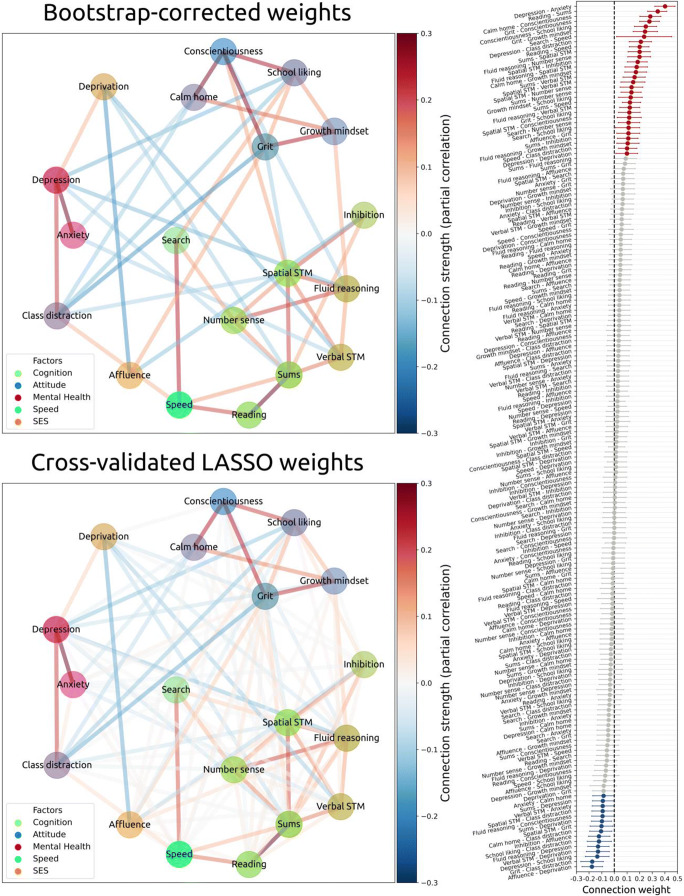
A child's socio-economic environment can profoundly affect their development. While existing literature focusses on simplified metrics and pair-wise relations between few variables, we aimed to capture complex interrelationships between several relevant domains using a broad assessment of 519 children aged 7-9 years. Our analyses comprised three multivariate techniques that complimented each other, and worked at different levels of granularity. First, an exploratory factor analysis (principal component analysis followed by varimax rotation) revealed that our sample varied along continuous dimensions of cognition, attitude and mental health (from parallel analysis); with potentially emerging dimensions speed and socio-economic status (passed Kaiser's criterion). Second, k-means cluster analysis showed that children did not group into discrete phenotypes. Third, a network analysis on the basis of bootstrapped partial correlations (confirmed by both cross-validated LASSO and multiple comparisons correction of binarised connection probabilities) uncovered how our developmental measures interconnected: educational outcomes (reading and maths fluency) were directly related to cognition (short-term memory, number sense, processing speed, inhibition). By contrast, mental health (anxiety and depression symptoms) and attitudes (conscientiousness, grit, growth mindset) showed indirect relationships with educational outcomes via cognition. Finally, socio-economic factors (neighbourhood deprivation, family affluence) related directly to educational outcomes, cognition, mental health, and even grit. In sum, cognition is a central cog through which mental health and attitude relate to educational outcomes. However, through direct relations with all components of developmental outcomes, socio-economic status acts as a great 'unequaliser'.
The online version contains supplementary material available at 10.1007/s12144-021-02232-2.
儿童的社会经济环境会对其发展产生深远影响。虽然现有文献侧重于简化指标以及少数变量之间的两两关系,但我们旨在通过对519名7至9岁儿童进行广泛评估,来捕捉几个相关领域之间复杂的相互关系。我们的分析包括三种相互补充且在不同粒度水平上起作用的多变量技术。首先,探索性因素分析(主成分分析后进行方差最大化旋转)表明,我们的样本在认知、态度和心理健康的连续维度上存在差异(通过平行分析);还有可能出现速度和社会经济地位维度(通过凯泽准则)。其次,k均值聚类分析表明,儿童并未聚集成离散的表型。第三,基于自抽样偏相关的网络分析(通过交叉验证的套索回归和二值化连接概率的多重比较校正得到证实)揭示了我们的发展测量指标是如何相互关联的:教育成果(阅读和数学流利程度)与认知(短期记忆、数字感、处理速度、抑制能力)直接相关。相比之下,心理健康(焦虑和抑郁症状)和态度(尽责性、毅力、成长型思维模式)通过认知与教育成果呈现间接关系。最后,社会经济因素(邻里贫困、家庭富裕程度)与教育成果、认知、心理健康甚至毅力直接相关。总之,认知是心理健康和态度与教育成果相关联的核心环节。然而,社会经济地位通过与发展成果的所有组成部分直接相关,起到了巨大的“均衡器”作用。
在线版本包含可在10.1007/s12144 - 021 - 02232 - 2获取的补充材料。