IDEEV, Bât. 680,12, 91190 Gif Sur Yvette, France.
Institut de Systématique, Evolution et Biodiversité (UMR 7205 CNRS/MNHN/SU/EPHE/UA), Muséum National d'Histoire Naturelle-CP50, 75005 Paris, France.
Gigascience. 2022 Dec 28;12. doi: 10.1093/gigascience/giad033. Epub 2023 May 22.
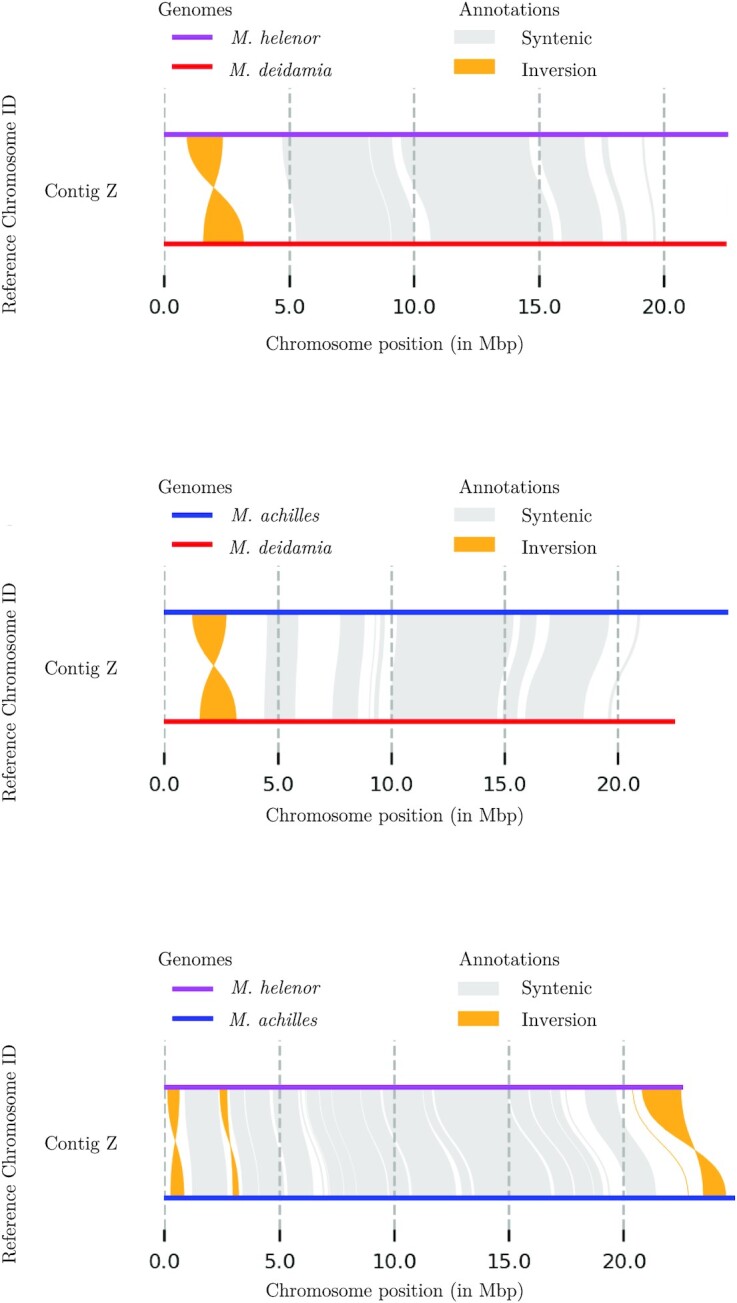
The genomic processes enabling speciation and species coexistence in sympatry are still largely unknown. Here we describe the whole-genome sequencing and assembly of 3 closely related species from the butterfly genus Morpho: Morpho achilles (Linnaeus, 1758), Morpho helenor (Cramer, 1776), and Morpho deidamia (Höbner, 1819). These large blue butterflies are emblematic species of the Amazonian rainforest. They live in sympatry in a wide range of their geographical distribution and display parallel diversification of dorsal wing color pattern, suggesting local mimicry. By sequencing, assembling, and annotating their genomes, we aim at uncovering prezygotic barriers preventing gene flow between these sympatric species. We found a genome size of 480 Mb for the 3 species and a chromosomal number ranging from 2n = 54 for M. deidamia to 2n = 56 for M. achilles and M. helenor. We also detected inversions on the sex chromosome Z that were differentially fixed between species, suggesting that chromosomal rearrangements may contribute to their reproductive isolation. The annotation of their genomes allowed us to recover in each species at least 12,000 protein-coding genes and to discover duplications of genes potentially involved in prezygotic isolation like genes controlling color discrimination (L-opsin). Altogether, the assembly and the annotation of these 3 new reference genomes open new research avenues into the genomic architecture of speciation and reinforcement in sympatry, establishing Morpho butterflies as a new eco-evolutionary model.
在同域中促使物种形成和物种共存的基因组过程在很大程度上仍然未知。在这里,我们描述了来自蝴蝶属 Morpho 的 3 个密切相关物种的全基因组测序和组装:Morpho achilles (Linnaeus, 1758)、Morpho helenor (Cramer, 1776) 和 Morpho deidamia (Höbner, 1819)。这些大型蓝色蝴蝶是亚马逊雨林的标志性物种。它们在广泛的地理分布范围内同域生活,并表现出背部翅膀颜色图案的平行多样化,表明存在局部拟态。通过测序、组装和注释它们的基因组,我们旨在揭示阻止这些同域物种之间基因流动的合子前障碍。我们发现这 3 个物种的基因组大小为 480Mb,染色体数目从 2n = 54(M. deidamia)到 2n = 56(M. achilles 和 M. helenor)不等。我们还检测到了性染色体 Z 上的倒位,这些倒位在物种之间存在差异固定,表明染色体重排可能有助于它们的生殖隔离。它们基因组的注释使我们能够在每个物种中恢复至少 12,000 个编码蛋白质的基因,并发现了可能参与合子前隔离的基因(如控制颜色识别的 L-视蛋白)的基因重复。总的来说,这 3 个新参考基因组的组装和注释为同域物种形成和强化的基因组结构研究开辟了新的途径,使 Morpho 蝴蝶成为一个新的生态进化模型。