Institut de Systématique, Evolution et Biodiversité (UMR 7205 CNRS/Muséum National d'Histoire Naturelle/Sorbonne Université/Ecole Pratique des Hautes Etudes/Université des Antilles), Muséum National d'Histoire Naturelle-CP50, Paris 75005, France.
CNRS, Institut des Sciences de l'Évolution de Montpellier (Université de Montpellier), Montpellier 34095, France.
Proc Natl Acad Sci U S A. 2023 Sep 12;120(37):e2303060120. doi: 10.1073/pnas.2303060120. Epub 2023 Sep 5.
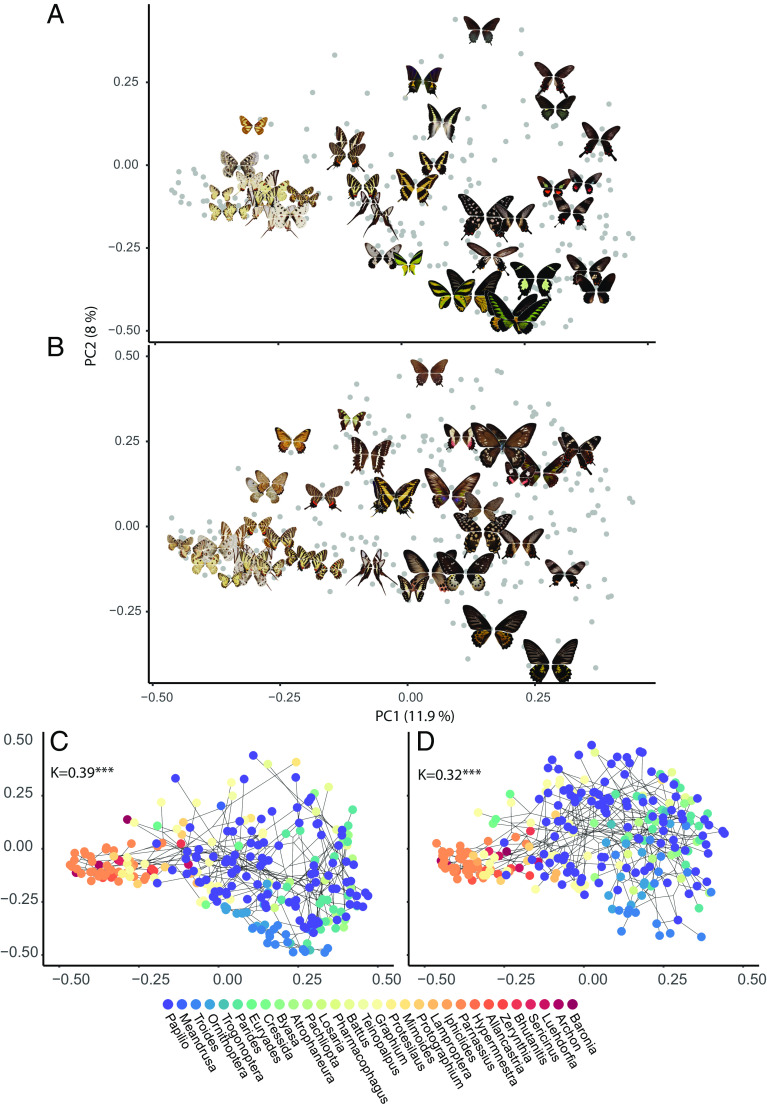
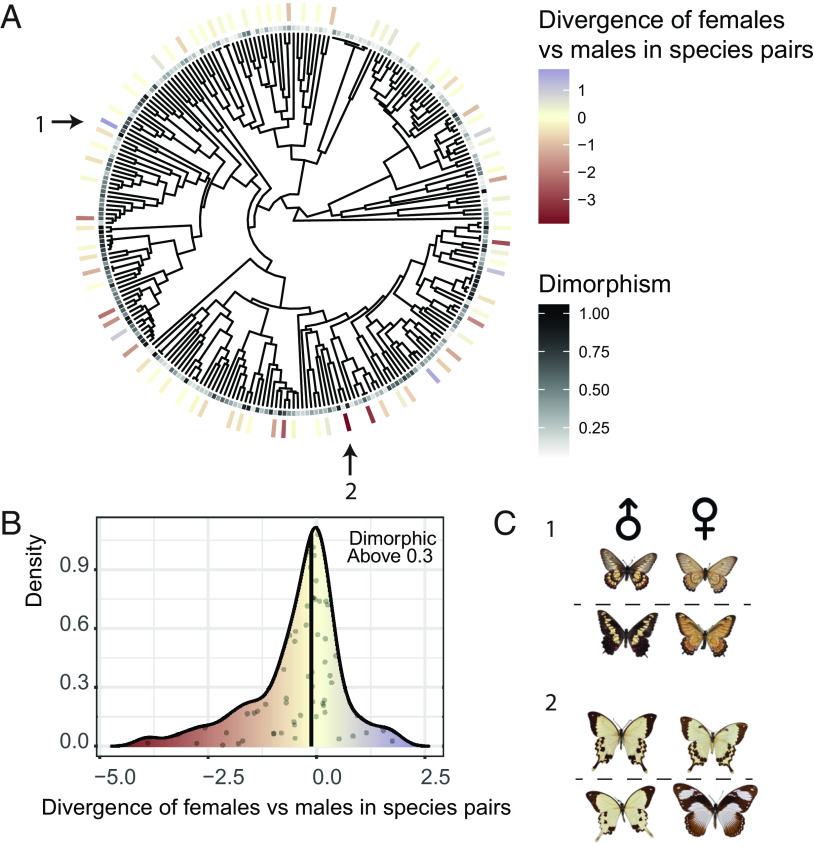
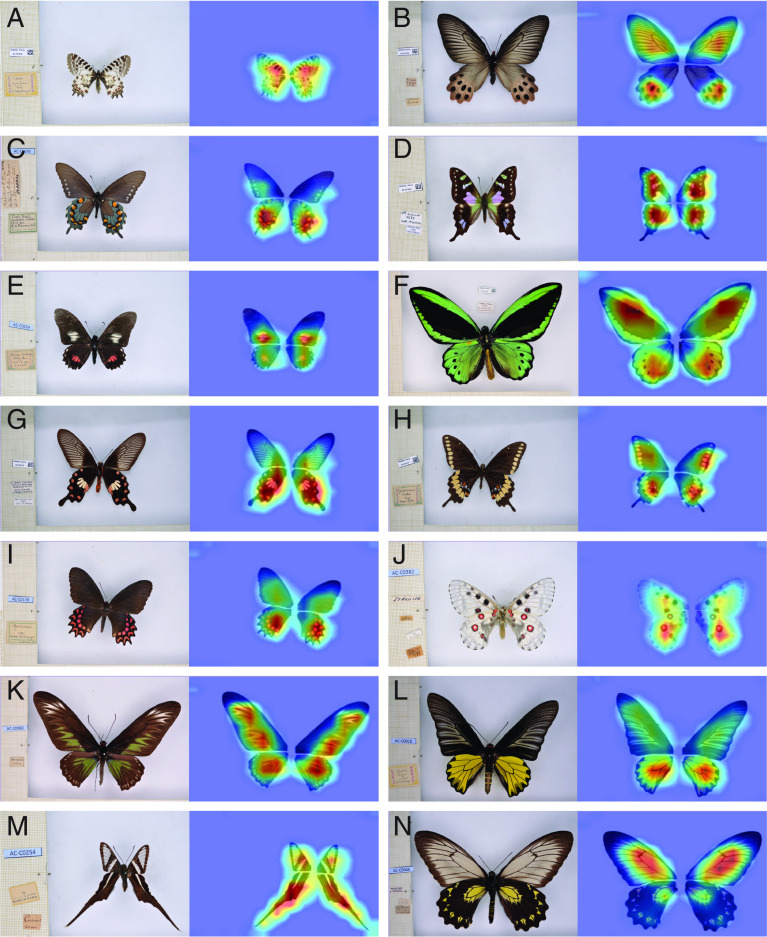
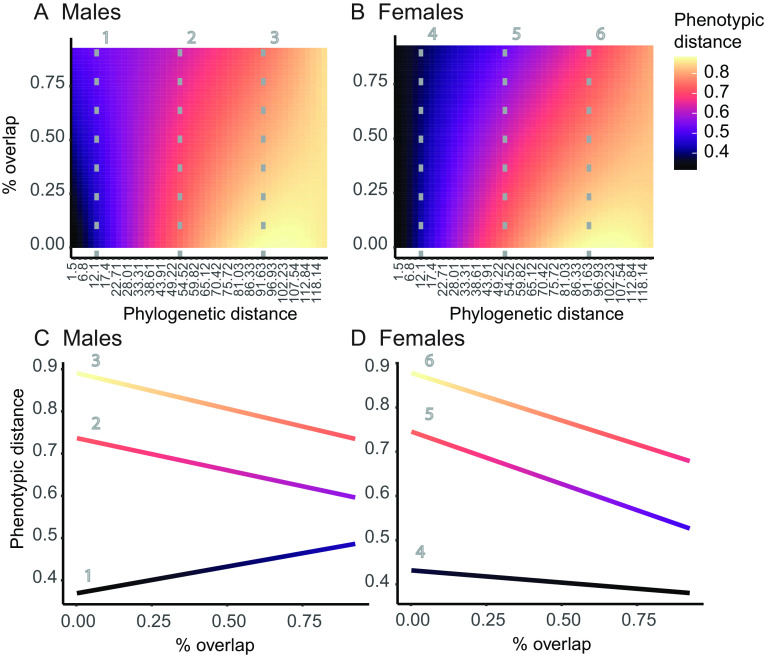
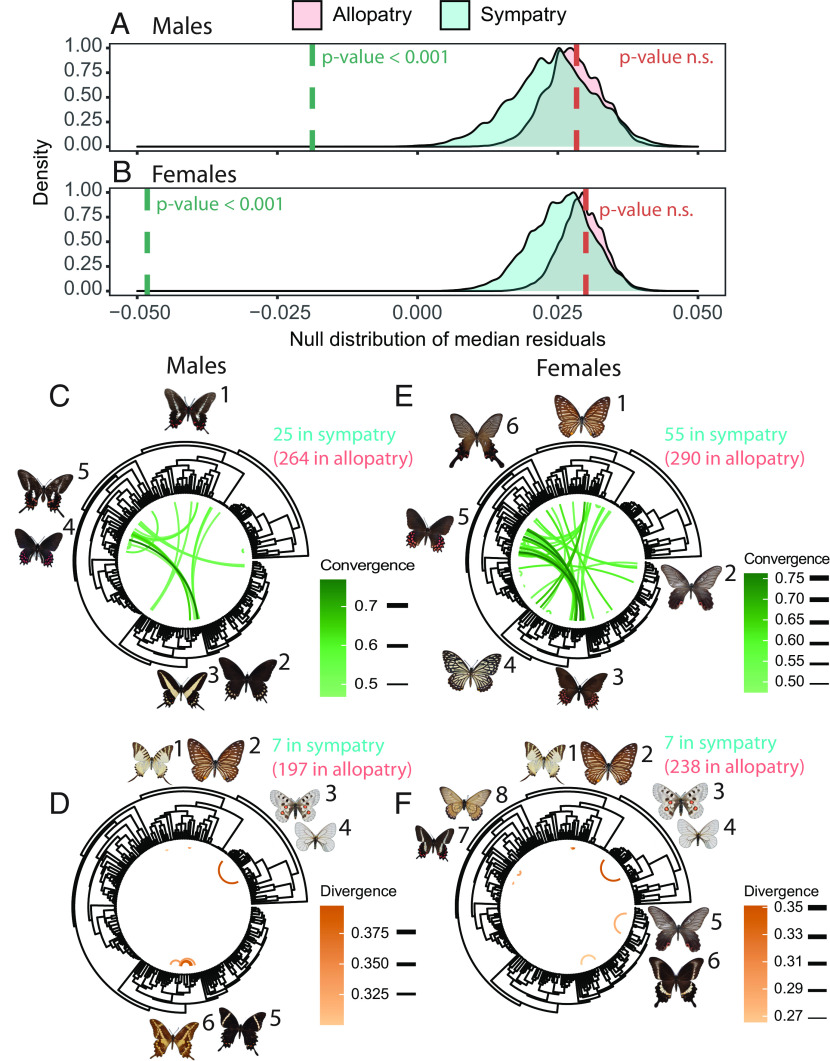
Ecological interactions can promote phenotypic diversification in sympatric species. While competition can enhance trait divergence, other ecological interactions may promote convergence in sympatric species. Within butterflies, evolutionary convergences in wing color patterns have been reported between distantly related species, especially in females of palatable species, where mimetic color patterns are promoted by predator communities shared with defended species living in sympatry. Wing color patterns are also often involved in species recognition in butterflies, and divergence in this trait has been reported in closely related species living in sympatry as a result of reproductive character displacement. Here, we investigate the effect of sympatry between species on the convergence vs. divergence of their wing color patterns in relation to phylogenetic distance, focusing on the iconic swallowtail butterflies (family Papilionidae). We developed an unsupervised machine learning-based method to estimate phenotypic distances among wing color patterns of 337 species, enabling us to finely quantify morphological diversity at the global scale among species and allowing us to compute pairwise phenotypic distances between sympatric and allopatric species pairs. We found phenotypic convergence in sympatry, stronger among distantly related species, while divergence was weaker and restricted to closely related males. The convergence was stronger among females than males, suggesting that differential selective pressures acting on the two sexes drove sexual dimorphism. Our results highlight the significant effect of ecological interactions driven by predation pressures on trait diversification in Papilionidae and provide evidence for the interaction between phylogenetic proximity and ecological interactions in sympatry, acting on macroevolutionary patterns of phenotypic diversification.
生态相互作用可以促进同域物种的表型多样化。虽然竞争可以增强特征的分化,但其他生态相互作用可能会促进同域物种的趋同。在蝴蝶中,已经报道了远缘物种之间翅膀颜色模式的进化趋同,特别是在可食用物种的雌性中,与受保护物种生活在同域的捕食者群落共同促进了拟态颜色模式。翅膀颜色模式在蝴蝶的物种识别中也经常涉及,并且在同域生活的近缘物种中,由于生殖特征替代,已经报道了该特征的分化。在这里,我们研究了物种同域对它们翅膀颜色模式趋同与分化的影响与系统发育距离的关系,重点关注标志性的燕尾蝶(Papilionidae 科)。我们开发了一种基于无监督机器学习的方法来估计 337 个物种的翅膀颜色模式之间的表型距离,使我们能够在全球范围内精细地量化物种之间的形态多样性,并计算同域和异域物种对之间的成对表型距离。我们发现同域中存在表型趋同,在远缘物种中更为强烈,而分化则较弱且仅限于近缘雄性。雌性的趋同比雄性更强,这表明对两性施加的不同选择压力驱动了性二态性。我们的研究结果强调了捕食压力驱动的生态相互作用对 Papilionidae 物种分化的重要影响,并为系统发育接近度和同域生态相互作用之间的相互作用提供了证据,这些相互作用影响了表型多样化的宏观进化模式。