Guglielmetti Caroline, Cordano Christian, Najac Chloé, Green Ari J, Chaumeil Myriam M
Department of Physical Therapy and Rehabilitation Science, University of California San Francisco, San Francisco, CA, USA.
Department of Radiology and Biomedical Imaging, University of California San Francisco, San Francisco, CA, USA.
Commun Med (Lond). 2023 May 22;3(1):71. doi: 10.1038/s43856-023-00300-1.
In recent years, the ability of conventional magnetic resonance imaging (MRI), including T contrast-enhanced (CE) MRI, to monitor high-efficacy therapies and predict long-term disability in multiple sclerosis (MS) has been challenged. Therefore, non-invasive methods to improve MS lesions detection and monitor therapy response are needed.
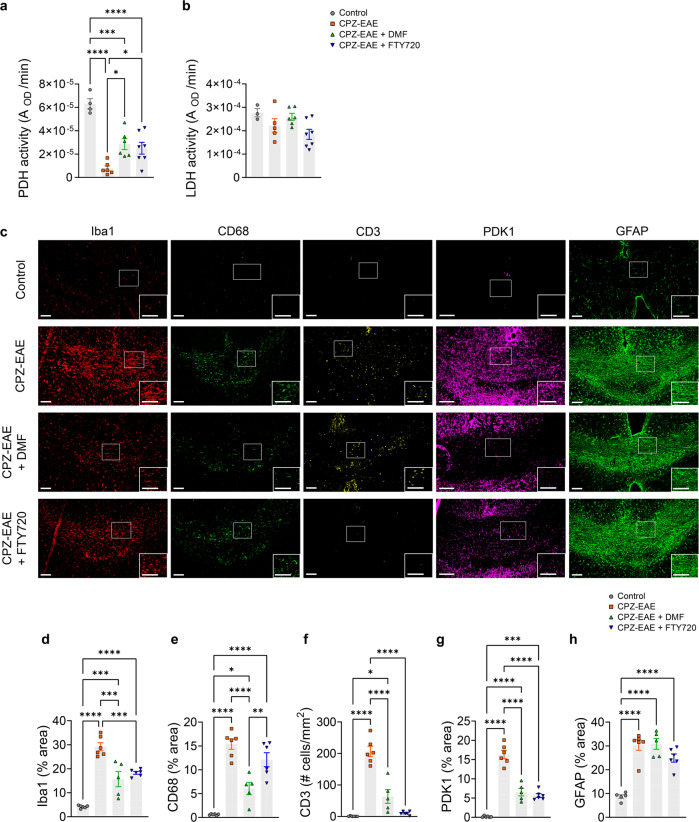
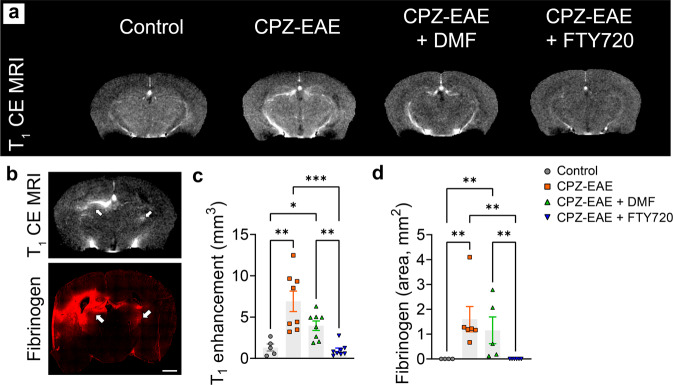
We studied the combined cuprizone and experimental autoimmune encephalomyelitis (CPZ-EAE) mouse model of MS, which presents inflammatory-mediated demyelinated lesions in the central nervous system as commonly seen in MS patients. Using hyperpolarized C MR spectroscopy (MRS) metabolic imaging, we measured cerebral metabolic fluxes in control, CPZ-EAE and CPZ-EAE mice treated with two clinically-relevant therapies, namely fingolimod and dimethyl fumarate. We also acquired conventional T CE MRI to detect active lesions, and performed ex vivo measurements of enzyme activities and immunofluorescence analyses of brain tissue. Last, we evaluated associations between imaging and ex vivo parameters.
We show that hyperpolarized [1-C]pyruvate conversion to lactate is increased in the brain of untreated CPZ-EAE mice when compared to the control, reflecting immune cell activation. We further demonstrate that this metabolic conversion is significantly decreased in response to the two treatments. This reduction can be explained by increased pyruvate dehydrogenase activity and a decrease in immune cells. Importantly, we show that hyperpolarized C MRS detects dimethyl fumarate therapy, whereas conventional T CE MRI cannot.
In conclusion, hyperpolarized MRS metabolic imaging of [1-C]pyruvate detects immunological responses to disease-modifying therapies in MS. This technique is complementary to conventional MRI and provides unique information on neuroinflammation and its modulation.
近年来,包括T加权对比增强(CE)磁共振成像(MRI)在内的传统MRI监测多发性硬化症(MS)高效治疗及预测长期残疾的能力受到了挑战。因此,需要非侵入性方法来改善MS病灶检测并监测治疗反应。
我们研究了联合使用 cuprizone 和实验性自身免疫性脑脊髓炎(CPZ-EAE)的MS小鼠模型,该模型在中枢神经系统中呈现出炎症介导的脱髓鞘病变,这在MS患者中很常见。使用超极化碳磁共振波谱(MRS)代谢成像,我们测量了对照组、CPZ-EAE组以及接受两种具有临床相关性治疗(即芬戈莫德和富马酸二甲酯)的CPZ-EAE小鼠的脑代谢通量。我们还采集了传统的T加权CE MRI以检测活动性病灶,并对脑组织进行了酶活性的离体测量和免疫荧光分析。最后,我们评估了成像参数与离体参数之间的关联。
我们发现,与对照组相比,未经治疗的CPZ-EAE小鼠脑内超极化[1-¹³C]丙酮酸向乳酸的转化增加,这反映了免疫细胞的激活。我们进一步证明,这两种治疗可使这种代谢转化显著降低。这种降低可由丙酮酸脱氢酶活性增加和免疫细胞减少来解释。重要的是,我们发现超极化碳MRS能检测到富马酸二甲酯治疗,而传统的T加权CE MRI则不能。
总之,超极化MRS对[1-¹³C]丙酮酸的代谢成像可检测MS中疾病修饰疗法的免疫反应。该技术是对传统MRI的补充,可提供有关神经炎症及其调节的独特信息。