Grupo Malaria, Facultad de Medicina, Universidad de Antioquia, Carrera 53 No. 61-30, Lab 610, Medellín, Colombia.
FIND, Geneva, Switzerland.
Malar J. 2018 Jul 13;17(1):262. doi: 10.1186/s12936-018-2403-5.
Pregnant women frequently show low-density Plasmodium infections that require more sensitive methods for accurate diagnosis and early treatment of malaria. This is particularly relevant in low-malaria transmission areas, where intermittent preventive treatment is not recommended. Molecular methods, such as polymerase chain reaction (PCR) are highly sensitive, but require sophisticated equipment and advanced training. Instead, loop mediated isothermal amplification (LAMP) provides an opportunity for molecular detection of malaria infections in remote endemic areas, outside a reference laboratory. The aim of the study is to evaluate the performance of LAMP for the screening of malaria in pregnant women in Colombia.
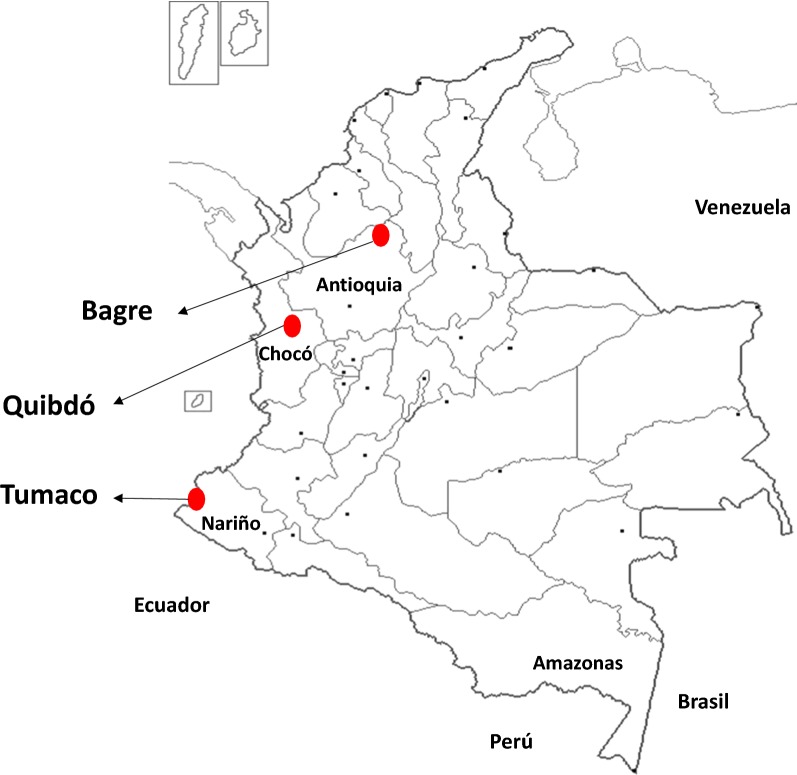
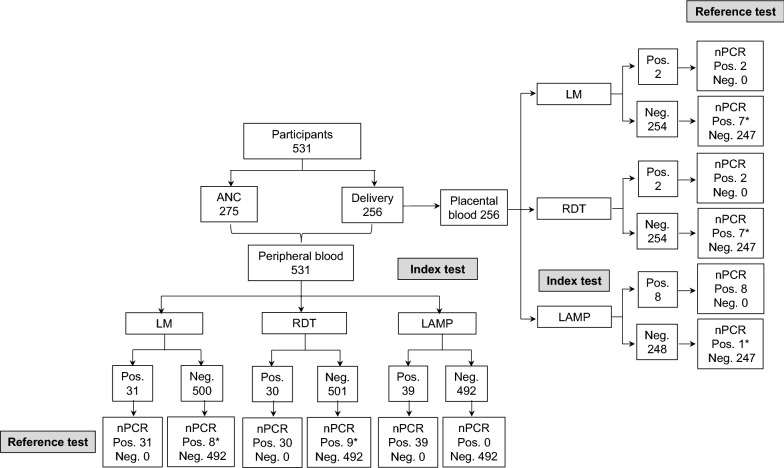
This is a nested prospective study that uses data and samples from a larger cross-sectional project conducted from May 2016 to January 2017 in three Colombian endemic areas (El Bagre, Quibdó, and Tumaco). A total of 531 peripheral and placental samples from pregnant women self-presenting at local hospitals for antenatal care visits, at delivery or seeking medical care for suspected malaria were collected. Samples were analysed for Plasmodium parasites by light microscopy (LM), rapid diagnostic test (RDT) and LAMP. Diagnostic accuracy endpoints (sensitivity, specificity, predictive values, and kappa scores) of LM, RDT and LAMP were compared with nested PCR (nPCR) as the reference standard.
In peripheral samples, LAMP showed an improved sensitivity (100.0%) when compared with LM 79.5% and RDT 76.9% (p < 0.01), particularly in afebrile women, for which LAMP sensitivity was two-times higher than LM and RDT. Overall agreement among LAMP and nPCR was high (kappa value = 1.0). Specificity was similar in all tests (100%). In placental blood, LAMP evidenced a four-fold improvement in sensitivity (88.9%) when compared with LM and RDT (22.2%), being the only method, together with nPCR, able to detect placental infections in peripheral blood.
LAMP is a simple, rapid and accurate molecular tool for detecting gestational and placental malaria, being able to overcome the limited sensitivity of LM and RDT. These findings could guide maternal health programs in low-transmission settings to integrate LAMP in their surveillance systems for the active detection of low-density infections and asymptomatic malaria cases.
孕妇常表现出低密度的疟原虫感染,这需要更敏感的方法进行准确诊断和早期治疗疟疾。这在低疟疾传播地区尤其重要,因为在这些地区不推荐间歇性预防治疗。聚合酶链反应(PCR)等分子方法具有很高的灵敏度,但需要复杂的设备和先进的培训。相反,环介导等温扩增(LAMP)为在偏远的地方性流行地区(不在参考实验室)进行疟疾的分子检测提供了机会。本研究旨在评估 LAMP 筛查哥伦比亚孕妇疟疾的性能。
这是一项嵌套前瞻性研究,使用了 2016 年 5 月至 2017 年 1 月在哥伦比亚三个地方性流行地区(埃尔巴格雷、基布多和图马科)进行的一项较大横断面研究的数据和样本。共采集了 531 名来自当地医院产前就诊、分娩或因疑似疟疾就诊的孕妇的外周和胎盘样本。使用显微镜检查(LM)、快速诊断检测(RDT)和 LAMP 对疟原虫寄生虫进行分析。将 LM、RDT 和 LAMP 的诊断准确性终点(灵敏度、特异性、预测值和 Kappa 评分)与巢式 PCR(nPCR)作为参考标准进行比较。
在外周样本中,与 LM(79.5%)和 RDT(76.9%)相比,LAMP 的灵敏度(100.0%)得到了提高(p<0.01),特别是在无发热的女性中,LAMP 的灵敏度比 LM 和 RDT 高两倍。LAMP 与 nPCR 的总体一致性较高(Kappa 值=1.0)。所有检测方法的特异性均相似(100%)。在胎盘血中,与 LM 和 RDT(22.2%)相比,LAMP 的灵敏度提高了四倍(88.9%),是唯一一种能够在外周血中检测胎盘感染的方法,与 nPCR 一起。
LAMP 是一种简单、快速、准确的分子工具,可用于检测妊娠期和胎盘疟疾,能够克服 LM 和 RDT 的灵敏度限制。这些发现可以指导低传播环境下的孕产妇保健计划,将 LAMP 纳入其监测系统,以主动检测低密度感染和无症状疟疾病例。