Sugimoto Kazuto, Zhou Yanni, Galindo Tania Guadalupe Peñaflor, Kimura Reo, Tagaya Motohiro
Department of Materials Science and Technology, Nagaoka University of Technology, Kamitomioka 1603-1, Nagaoka, Niigata 940-2188, Japan.
Department of Materials Science and Bioengineering, Nagaoka University of Technology, Kamitomioka 1603-1, Nagaoka, Niigata 940-2188, Japan.
Biomimetics (Basel). 2023 Apr 28;8(2):184. doi: 10.3390/biomimetics8020184.
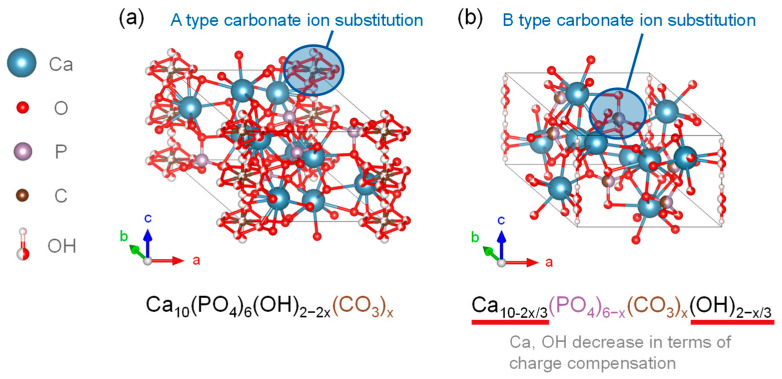
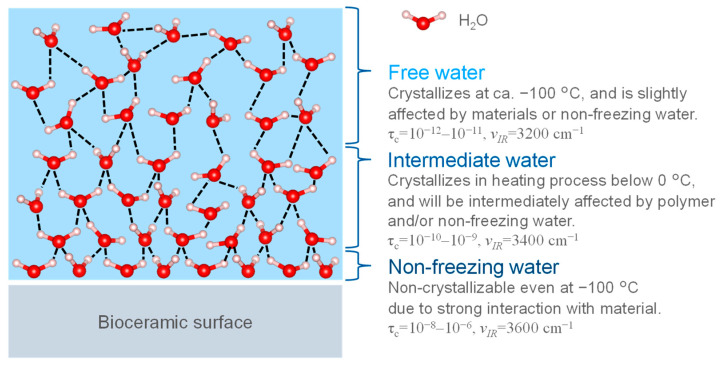
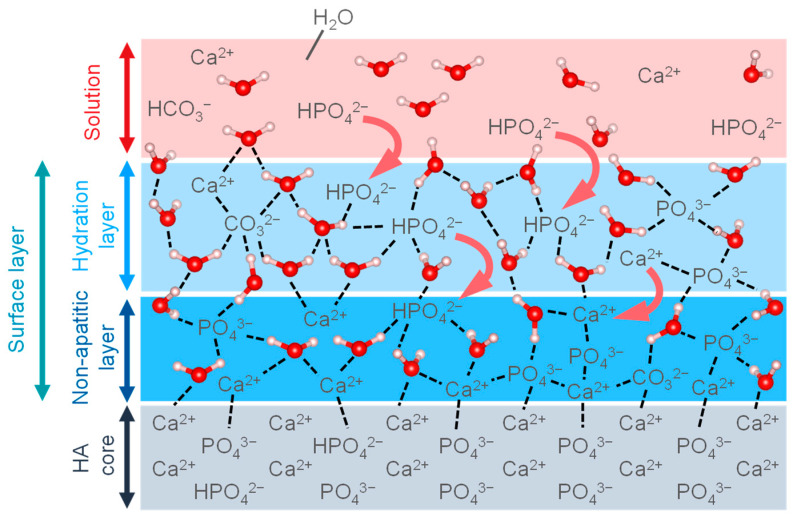
In this review, the current status of the influence of added ions (i.e., SiO, CO, etc.) and surface states (i.e., hydrated and non-apatite layers) on the biocompatibility nature of hydroxyapatite (HA, Ca(PO)(OH)) is discussed. It is well known that HA is a type of calcium phosphate with high biocompatibility that is present in biological hard tissues such as bones and enamel. This biomedical material has been extensively studied due to its osteogenic properties. The chemical composition and crystalline structure of HA change depending on the synthetic method and the addition of other ions, thereby affecting the surface properties related to biocompatibility. This review illustrates the structural and surface properties of HA substituted with ions such as silicate, carbonate, and other elemental ions. The importance of the surface characteristics of HA and its components, the hydration layers, and the non-apatite layers for the effective control of biomedical function, as well as their relationship at the interface to improve biocompatibility, has been highlighted. Since the interfacial properties will affect protein adsorption and cell adhesion, the analysis of their properties may provide ideas for effective bone formation and regeneration mechanisms.
在本综述中,讨论了添加离子(即SiO、CO等)和表面状态(即水合层和非磷灰石层)对羟基磷灰石(HA,Ca(PO)(OH))生物相容性的影响现状。众所周知,HA是一种具有高生物相容性的磷酸钙,存在于骨骼和牙釉质等生物硬组织中。这种生物医学材料因其成骨特性而受到广泛研究。HA的化学成分和晶体结构会因合成方法和其他离子的添加而改变,从而影响与生物相容性相关的表面性质。本综述阐述了用硅酸盐、碳酸盐和其他元素离子等取代HA后的结构和表面性质。强调了HA及其组分的表面特性、水合层和非磷灰石层对于有效控制生物医学功能的重要性,以及它们在界面处改善生物相容性的关系。由于界面性质会影响蛋白质吸附和细胞黏附,对其性质的分析可能为有效的骨形成和再生机制提供思路。