Haugen Margaretha, Brantsæter Anne Lise, Winkvist Anna, Lissner Lauren, Alexander Jan, Oftedal Bente, Magnus Per, Meltzer Helle Margrete
Division of Environmental Medicine, Norwegian Institute of Public Health, P,O, Box 4404, Nydalen NO-0403 Oslo, Norway.
BMC Pregnancy Childbirth. 2014 Jun 11;14:201. doi: 10.1186/1471-2393-14-201.
Excessive gestational weight gain (GWG) is associated with pregnancy complications, and Norwegian Health Authorities have adopted the GWG recommendations of the US Institute of Medicine and National Research Council (IOM). The aim of this study was to evaluate if a GWG outside the IOM recommendation in a Norwegian population is associated with increased risk of pregnancy complications like hypertension, low and high birth weight, preeclampsia, emergency caesarean delivery, and maternal post-partum weight retention (PPWR) at 6 and 18 months.
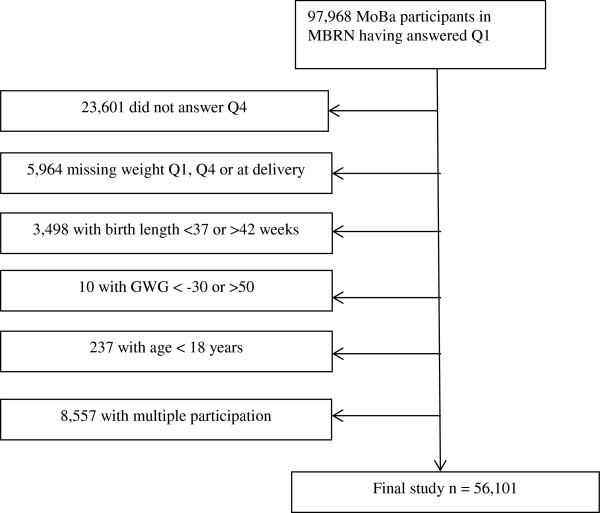
This study was performed in 56 101 pregnant women included in the prospective national Norwegian Mother and Child Cohort Study (MoBa) in the years 1999 to 2008. Women who delivered a singleton live born child during gestational week 37 to 42 were included. Maternal prepregnant and postpartum weight was collected from questionnaires at 17th week of gestation and 6 and 18 months postpartum.
A weight gain less than the IOM recommendations (GWG < IOM rec.) increased the risk for giving birth to a low weight baby among normal weight nulliparous women. A weight gain higher than the IOM recommendations (GWG > IOM rec.) significantly increased the risk of pregnancy hypertension, a high birth weight baby, preeclampsia and emergency cesarean delivery in both nulliparous and parous normal weight women. Similar results were found for overweight women except for no increased risk for gestational hypertension in parous women with GWG > IOM rec. Seventy-four percent of the overweight nulliparous women and 66% of the obese women had a GWG > IOM rec. A GWG > IOM rec. resulted in increased risk of PPWR > 2 kg in all weight classes, but most women attained their prepregnant weight class by 18 months post-partum.
For prepregnant normal weight and overweight women a GWG > IOM rec. increased the risk for unfavorable birth outcomes in both nulliparous and parous women. A GWG > IOM rec. increased the risk of a PPWR > 2 kg at 18 months in all weight classes. This large study supports the Norwegian Health authorities' recommendations for normal weight and overweight women to comply with the IOM rec.
孕期体重增加过多(GWG)与妊娠并发症相关,挪威卫生当局采用了美国医学研究所和国家研究委员会(IOM)的GWG建议。本研究的目的是评估挪威人群中GWG超出IOM建议范围是否与妊娠并发症风险增加相关,如高血压、低出生体重和高出生体重、子痫前期、急诊剖宫产以及产后6个月和18个月时的产妇产后体重滞留(PPWR)。
本研究对1999年至2008年纳入挪威全国前瞻性母婴队列研究(MoBa)的56101名孕妇进行。纳入在妊娠第37至42周分娩单胎活产婴儿的妇女。在妊娠第17周以及产后6个月和18个月时通过问卷收集孕妇孕前和产后体重。
体重增加低于IOM建议值(GWG < IOM建议值)会增加正常体重未生育妇女分娩低体重婴儿的风险。体重增加高于IOM建议值(GWG > IOM建议值)会显著增加未生育和已生育的正常体重妇女患妊娠高血压、高出生体重婴儿、子痫前期和急诊剖宫产的风险。超重妇女也有类似结果,但GWG > IOM建议值的已生育妇女妊娠高血压风险未增加。74%的超重未生育妇女和66%的肥胖妇女GWG > IOM建议值。GWG > IOM建议值会导致所有体重类别中PPWR > 2kg的风险增加,但大多数妇女在产后18个月时达到孕前体重类别。
对于孕前正常体重和超重妇女,GWG > IOM建议值会增加未生育和已生育妇女出现不良分娩结局的风险。GWG > IOM建议值会增加所有体重类别在产后18个月时PPWR > 2kg的风险。这项大型研究支持挪威卫生当局对正常体重和超重妇女遵守IOM建议的推荐。