INSERM U1052, CNRS UMR 5286, Centre de Recherche en Cancérologie de Lyon, Université de Lyon, Lyon, France.
Hospices Civils de Lyon, Lyon, France.
Front Immunol. 2023 May 8;14:1066402. doi: 10.3389/fimmu.2023.1066402. eCollection 2023.
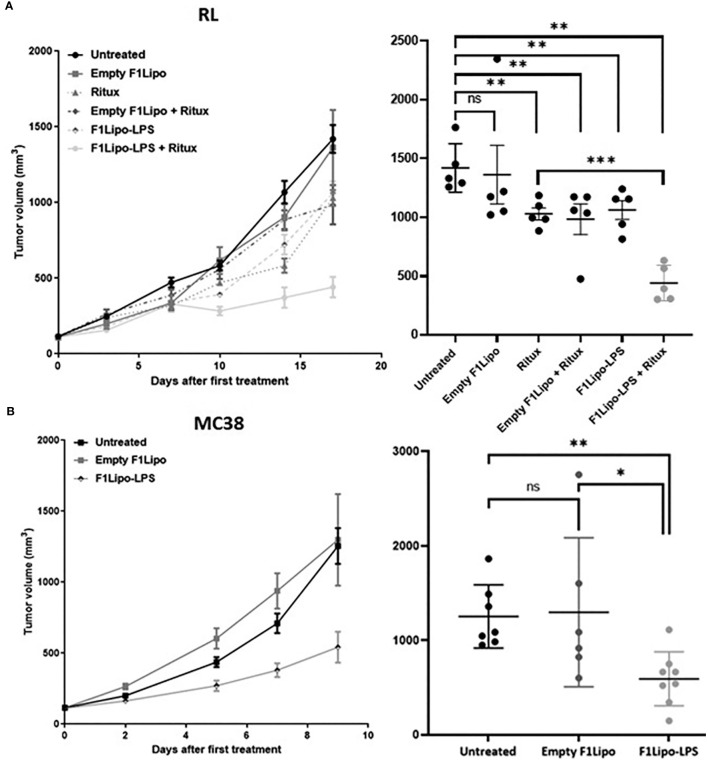
Bacterial lipopolysaccharides (LPS) are potent innate immunostimulants targeting the Toll-like receptor 4 (TLR4), an attractive and validated target for immunostimulation in cancer therapy. Although LPS possess anti-tumor activity, toxicity issues prevent their systemic administration at effective doses in humans. We first demonstrated that LPS formulated in liposomes preserved a potent antitumor activity upon systemic administration in syngeneic models, and significantly enhance the antitumor activity of the anti-CD20 antibody rituximab in mice xenografted with the human RL lymphoma model. Liposomal encapsulation also allowed a 2-fold reduction in the induction of pro-inflammatory cytokines by LPS. Mice receiving an intravenous administration demonstrated a significant increase of neutrophils, monocytes and macrophages at the tumor site as well as an increase of macrophages in spleen. Further, we chemically detoxified LPS to obtain MP-LPS that was associated with a 200-fold decrease in the induction of proinflammatory cytokines. When encapsulated in a clinically approved liposomal formulation, toxicity, notably pyrogenicity (10-fold), was limited while the antitumor activity and immunoadjuvant effect were maintained. This improved tolerance profile of liposomal MP-LPS was associated with the preferential activation of the TLR4-TRIF pathway. Finally, studies demonstrated that stimulation with encapsulated MP-LPS reversed the polarization of M2 macrophages towards an M1 phenotype, and a phase 1 trial in healthy dogs validated its tolerance upon systemic administration up to very high doses (10µg/kg). Altogether, our results demonstrate the strong therapeutic potential of MPLPS formulated in liposomes as a systemically active anticancer agent, supporting its evaluation in patients with cancer.
细菌脂多糖(LPS)是一种针对 Toll 样受体 4(TLR4)的强效先天免疫刺激物,TLR4 是癌症治疗中免疫刺激的有吸引力和经过验证的靶点。尽管 LPS 具有抗肿瘤活性,但毒性问题阻止了它们以有效剂量在人体中进行系统给药。我们首先证明,脂质体包封的 LPS 在同种异体模型中进行系统给药时保留了强大的抗肿瘤活性,并显著增强了抗 CD20 抗体利妥昔单抗在人 RL 淋巴瘤模型异种移植小鼠中的抗肿瘤活性。脂质体包封还允许 LPS 诱导促炎细胞因子的作用降低 2 倍。接受静脉注射的小鼠在肿瘤部位表现出中性粒细胞、单核细胞和巨噬细胞的显著增加,以及脾脏中巨噬细胞的增加。此外,我们对 LPS 进行了化学解毒,得到了 MP-LPS,其诱导促炎细胞因子的能力降低了 200 倍。当包封在临床批准的脂质体制剂中时,毒性,特别是致热性(10 倍)受到限制,而抗肿瘤活性和免疫佐剂作用得以维持。这种改良的脂质体 MP-LPS 的耐受性与其对 TLR4-TRIF 途径的优先激活有关。最后,研究表明,用包封的 MP-LPS 刺激可使 M2 巨噬细胞向 M1 表型极化逆转,并在健康犬中进行的 I 期试验验证了其在高达非常高剂量(10µg/kg)的系统给药下的耐受性。总之,我们的研究结果表明,脂质体包封的 MP-LPS 具有作为一种系统活性抗癌剂的强大治疗潜力,支持其在癌症患者中的评估。