Li XiaoXiao, Li Xingchen, Yang Jielai, Du Yawei, Chen Liang, Zhao Gang, Ye Tingjun, Zhu Yuan, Xu Xiangyang, Deng Lianfu, Cui Wenguo
Department of Orthopaedics, Shanghai Key Laboratory for Prevention and Treatment of Bone and Joint Diseases, Shanghai Institute of Traumatology and Orthopaedics, Ruijin Hospital, Shanghai Jiao Tong University School of Medicine, 197 Ruijin 2nd Road, Shanghai 200025, P. R. China.
Research (Wash D C). 2023 May 2;6:0131. doi: 10.34133/research.0131. eCollection 2023.
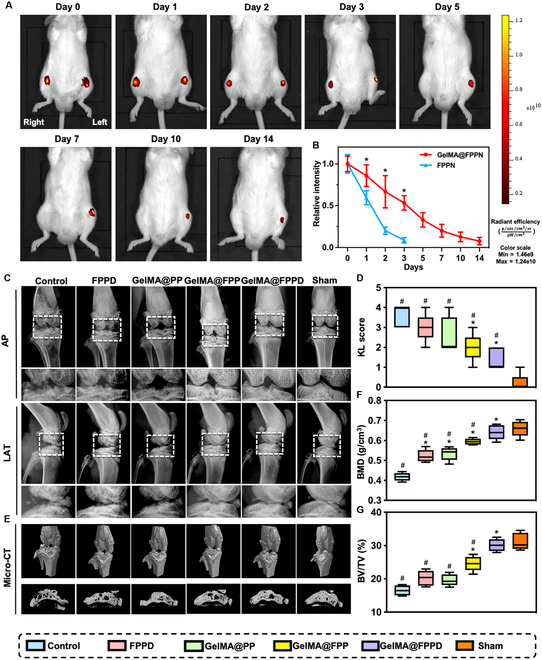
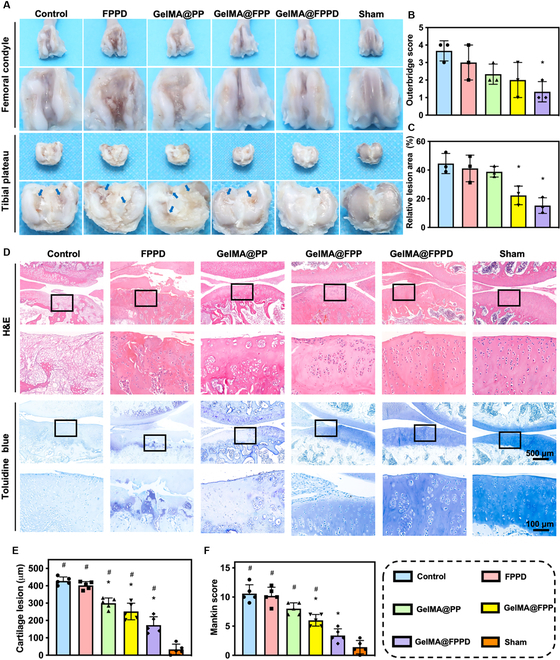
There are still challenges in applying drug nanocarriers for in situ sustained macrophage targeting and regulation, due to the rapid clearance of nanocarriers and burst drug release in vivo. Herein, a nanomicelle-hydrogel microsphere, characterized by its macrophage-targeted nanosized secondary structure that allows it to accurately bind to M1 macrophages through active endocytosis, is employed for in situ sustained macrophage targeting and regulation, and addresses the insufficient osteoarthritis therapeutic efficacy caused by rapid clearance of drug nanocarriers. The 3-dimensional structure of a microsphere can prevent the rapid escape and clearance of a nanomicelle, thus keeping it in joints, while the ligand-guided secondary structure can carry drugs to accurately target and enter M1 macrophages, and release drugs via the transition from hydrophobicity to hydrophilicity of nanomicelles under inflammatory stimulation inside the macrophages. The experiments show that the nanomicelle-hydrogel microsphere can in situ sustainably target and regulate M1 macrophages for more than 14 days in joints, and attenuate local "cytokine storm" by continuous M1 macrophage apoptosis promotion and polarization inhibition. This micro/nano-hydrogel system shows excellent ability to sustainably target and regulate macrophage, realizes the improvement of drug utilization and efficacy inside the macrophage, and thereby can be a potential platform for treating macrophage-related diseases.
由于纳米载体在体内的快速清除和药物的突释,将药物纳米载体应用于原位持续巨噬细胞靶向和调控仍面临挑战。在此,一种纳米胶束-水凝胶微球被用于原位持续巨噬细胞靶向和调控,它具有巨噬细胞靶向的纳米级二级结构,能够通过主动内吞作用准确地与M1巨噬细胞结合,解决了药物纳米载体快速清除导致骨关节炎治疗效果不佳的问题。微球的三维结构可以防止纳米胶束的快速逃逸和清除,从而使其保留在关节中,而配体引导的二级结构可以携带药物准确地靶向并进入M1巨噬细胞,并在巨噬细胞内的炎症刺激下通过纳米胶束从疏水性到亲水性的转变来释放药物。实验表明,纳米胶束-水凝胶微球能够在关节中对M1巨噬细胞进行原位持续靶向和调控超过14天,并通过持续促进M1巨噬细胞凋亡和抑制极化来减轻局部“细胞因子风暴”。这种微/纳米水凝胶系统显示出优异的持续靶向和调控巨噬细胞的能力,实现了巨噬细胞内药物利用率和疗效的提高,因此可能成为治疗巨噬细胞相关疾病的潜在平台。