Department of Microbiology, Perelman School of Medicine, University of Pennsylvania, Philadelphia, PA 19104, USA; Center for Cellular Immunotherapies, Perelman School of Medicine, University of Pennsylvania, Philadelphia, PA 19104, USA; Abramson Cancer Center, Perelman School of Medicine, University of Pennsylvania, Philadelphia, PA 19104, USA; Department of Pathology and Laboratory Medicine, Perelman School of Medicine, University of Pennsylvania, Philadelphia, PA 19104, USA.
Center for Cellular Immunotherapies, Perelman School of Medicine, University of Pennsylvania, Philadelphia, PA 19104, USA; Abramson Cancer Center, Perelman School of Medicine, University of Pennsylvania, Philadelphia, PA 19104, USA; Department of Medicine, Perelman School of Medicine, University of Pennsylvania, Philadelphia, PA 19104, USA.
Cell Rep Med. 2023 Jun 20;4(6):101053. doi: 10.1016/j.xcrm.2023.101053. Epub 2023 May 23.
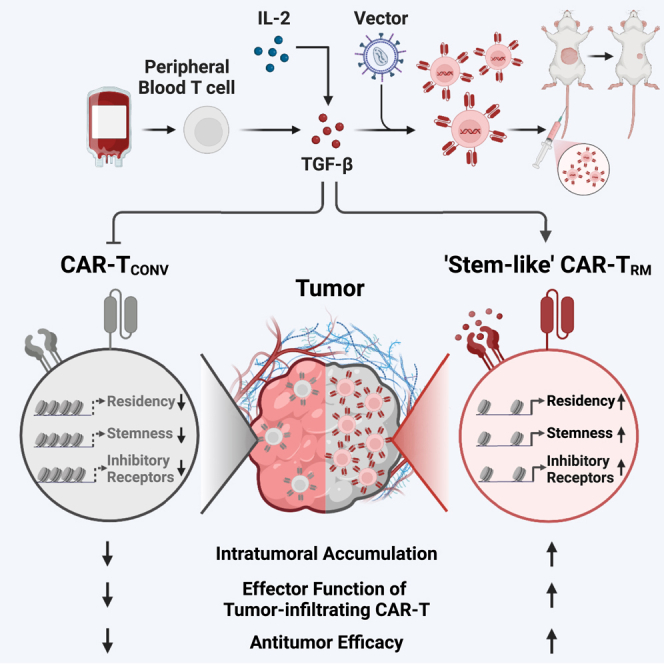
Chimeric antigen receptor (CAR) T cells demonstrate remarkable success in treating hematological malignancies, but their effectiveness in non-hematopoietic cancers remains limited. This study proposes enhancing CAR T cell function and localization in solid tumors by modifying the epigenome governing tissue-residency adaptation and early memory differentiation. We identify that a key factor in human tissue-resident memory CAR T cell (CAR-T) formation is activation in the presence of the pleotropic cytokine, transforming growth factor β (TGF-β), which enforces a core program of both "stemness" and sustained tissue residency by mediating chromatin remodeling and concurrent transcriptional changes. This approach leads to a practical and clinically actionable in vitro production method for engineering peripheral blood T cells into a large number of "stem-like" CAR-T cells resistant to tumor-associated dysfunction, possessing an enhanced ability to accumulate in situ and rapidly eliminate cancer cells for more effective immunotherapy.
嵌合抗原受体 (CAR) T 细胞在治疗血液恶性肿瘤方面取得了显著的成功,但它们在非造血癌症中的疗效仍然有限。本研究提出通过修饰调节组织驻留适应和早期记忆分化的表观基因组来增强 CAR T 细胞在实体瘤中的功能和定位。我们发现,人组织驻留记忆 CAR T 细胞 (CAR-T) 形成的一个关键因素是在多效细胞因子转化生长因子 β (TGF-β) 的存在下被激活,该因子通过介导染色质重塑和同时发生的转录变化,强制实施“干性”和持续的组织驻留的核心程序。这种方法为工程外周血 T 细胞成为大量对肿瘤相关功能障碍具有抗性的“类干细胞”CAR-T 细胞提供了一种实用的、可临床操作的体外生产方法,具有更强的原位积累和快速消除癌细胞的能力,从而实现更有效的免疫治疗。