Maiti Debarati, Naseeruddin Inamdar Mohammed, Almuqbil Mansour, Suresh Sarasija, Mohammed Basheeruddin Asdaq Syed, Alshehri Sultan, Ali Al Arfaj Saad, Musharraf Alamri Ali, Meshary Aldohyan Meshal, Theeb Alqahtani Misfir, Mohammed Alosaimi Turki, Haran Alenazi Sami, Almadani Moneer E, Ahmed S Mulla Jameel, Imam Rabbani Syed
Department of Pharmacology, Al-Ameen College of Pharmacy, Bangalore, India.
Department of Pharmacology, East West College of Pharmacy, Bangalore, India.
Saudi Pharm J. 2023 Jun;31(6):834-844. doi: 10.1016/j.jsps.2023.04.007. Epub 2023 Apr 15.
BACKGROUND & OBJECTIVES: Methotrexate (MTX) is commonly used to manage psoriasis. The drug has erratic absorption characteristics and shows several complications. The present study uses different experimental models to evaluate the solid-lipid nanoparticles of MTX (SLN-MTX) for the anti-psoriatic effect.
A prepared SLN-MTX formulation was used and its permeability studies were conducted on Wistar rat abdominal skin. The organ-level distribution of the drug in the formulation was tested in mice and the anti-psoriatic activity was determined in CL-177; XB-2 keratinocytes cell lines. The efficacy of SLN-MTX formulation was compared with standard MTX and marketed MTX preparations. The results are analyzed statistically using the student's -test.
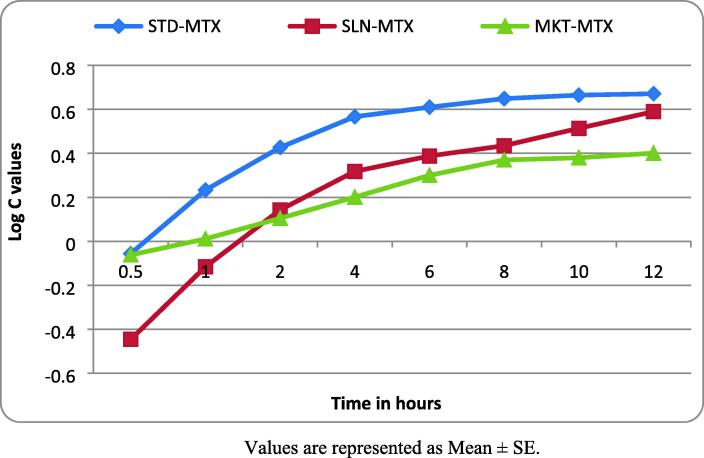
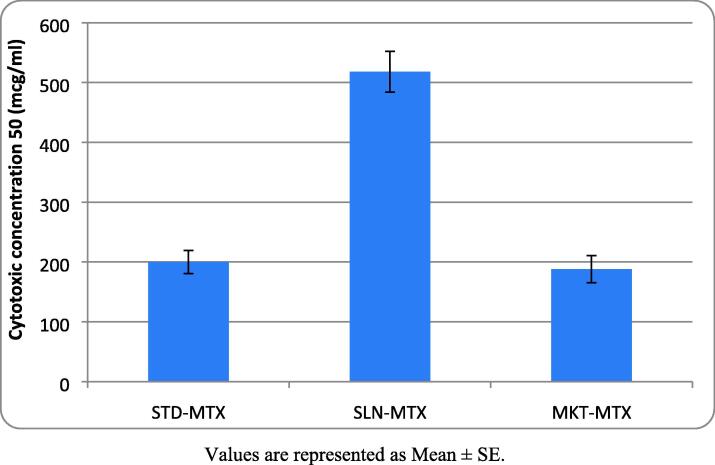
The data suggested that MTX from the formulation was slowly released and completely (80.36%) permeated through the skin. The flux and permeation data were found to be maximum for SLN-MTX compared to marketed and standard preparations. MTX in the formulation was found to be distributed more in the liver (67.5%) and kidney (2.34%). Further, SLN-MTX formulation showed dose-dependent inhibition on the growth of keratinocytes, and the cytotoxic concentration (CTC50) was found to be the least (518 mcg/ml).
INTERPRETATION & CONCLUSION: The findings suggested that MTX in solid-lipid nanoparticles could be a promising formulation for the management of psoriasis since the drug was slowly released, progressively inhibited the growth of keratinocytes, and distributed mostly in organs meant for elimination. More studies in this direction might establish the precise safety and efficacy of SLN-MTX formulation in psoriasis.
甲氨蝶呤(MTX)常用于治疗银屑病。该药物具有吸收不稳定的特点,并会引发多种并发症。本研究使用不同的实验模型来评估甲氨蝶呤固体脂质纳米粒(SLN-MTX)的抗银屑病效果。
使用制备好的SLN-MTX制剂,对Wistar大鼠腹部皮肤进行渗透性研究。在小鼠体内测试该制剂中药物的器官水平分布,并在CL-177和XB-2角质形成细胞系中测定其抗银屑病活性。将SLN-MTX制剂的疗效与标准MTX和市售MTX制剂进行比较。使用学生t检验对结果进行统计学分析。
数据表明,制剂中的MTX释放缓慢,且80.36%可完全透过皮肤。与市售制剂和标准制剂相比,SLN-MTX的通量和渗透数据最高。制剂中的MTX在肝脏(67.5%)和肾脏(2.34%)中的分布更多。此外,SLN-MTX制剂对角质形成细胞的生长呈剂量依赖性抑制,细胞毒性浓度(CTC50)最低(518 mcg/ml)。
研究结果表明,固体脂质纳米粒中的MTX可能是一种有前景的银屑病治疗制剂,因为该药物释放缓慢,能逐渐抑制角质形成细胞的生长,且主要分布在用于排泄的器官中。在这个方向上进行更多研究可能会确定SLN-MTX制剂在银屑病治疗中的精确安全性和有效性。