Feng Hui, Feng Tingyin, Mo Yidi, Sun Suli, Wang Lu, Lu Chunbin, Feng Chengli, Xing Ke, Su Zhijian
Shaanxi Institute of Zoology, Xi'an, Shaanxi, China.
School of Life Sciences, Guangzhou University, Guangzhou, China.
Front Cell Dev Biol. 2023 May 9;11:1156138. doi: 10.3389/fcell.2023.1156138. eCollection 2023.
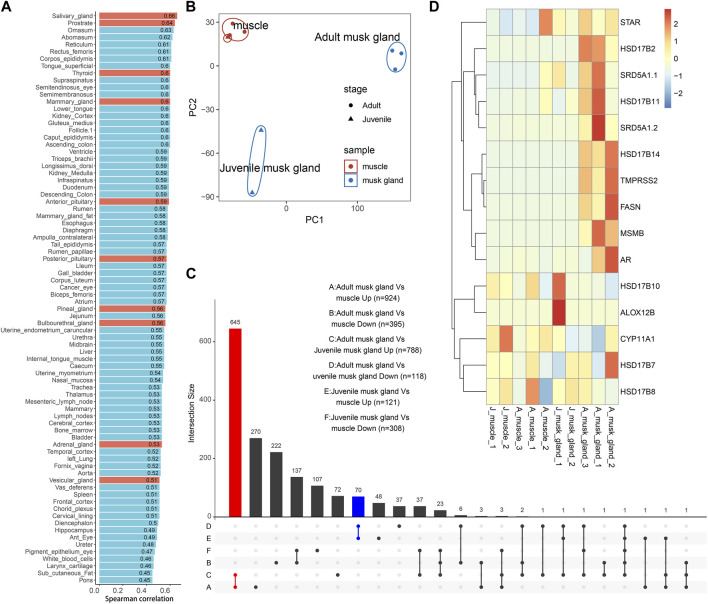
Among the artiodactyls, male animals belonging to the Family Moschidae have a unique tissue, the musk gland, with the capability of musk synthesis. However, the genetic basis of musk gland formation and musk production are still poorly understood. Here, musk gland tissues from two juvenile and three adult Chinese forest musk deer () were utilized to analyze genomic evolution events, evaluate mRNA profiles and investigate cell compositions. By performing genome reannotation and comparison with 11 ruminant genomes, three expanded gene families were identified in the genome. Transcriptional analysis further indicated that the musk gland displayed a prostate-like mRNA expression pattern. Single-cell sequencing revealed that the musk gland is composed of seven distinguishable cell types. Among them, sebaceous gland cells and luminal epithelial cells play important roles in musk synthesis, while endothelial cells master the regulation of cell-to-cell communication. In conclusion, our study provides insights into musk gland formation and the musk-synthesizing process.
在偶蹄目动物中,麝科雄性动物拥有一种独特的组织——麝香腺,具备合成麝香的能力。然而,麝香腺形成和麝香产生的遗传基础仍知之甚少。在此,利用两只幼年和三只成年林麝的麝香腺组织来分析基因组进化事件、评估mRNA谱并研究细胞组成。通过进行基因组重新注释并与11个反刍动物基因组进行比较,在林麝基因组中鉴定出三个扩增的基因家族。转录分析进一步表明,麝香腺呈现出类似前列腺的mRNA表达模式。单细胞测序显示,麝香腺由七种可区分的细胞类型组成。其中,皮脂腺细胞和管腔上皮细胞在麝香合成中发挥重要作用,而内皮细胞则主导细胞间通讯的调节。总之,我们的研究为麝香腺的形成和麝香合成过程提供了见解。