Key Laboratory of Bioresources and Ecoenvironment (Ministry of Education), College of Life Sciences, Sichuan University, Chengdu 610064, People's Republic of China.
Sichuan Engineering Research Center for Medicinal Animals, Xichang 615000, People's Republic of China.
Gigascience. 2018 Apr 1;7(4). doi: 10.1093/gigascience/giy038.
The forest musk deer, Moschus berezovskii, is one of seven musk deer (Moschus spp.) and is distributed in Southwest China. Akin to other musk deer, the forest musk deer has been traditionally and is currently hunted for its musk (i.e., global perfume industry). Considerable hunting pressure and habitat loss have caused significant population declines. Consequently, the Chinese government commenced captive breeding programs for musk harvesting in the 1950s. However, the prevalence of fatal diseases is considerably restricting population increases. Disease severity and extent are exacerbated by inbreeding and genetic diversity declines in captive musk deer populations. It is essential that knowledge of captive and wild forest musk deer populations' immune system and genome be gained in order to improve their physical and genetic health. We have thus sequenced the whole genome of the forest musk deer, completed the genomic assembly and annotation, and performed preliminary bioinformatic analyses.
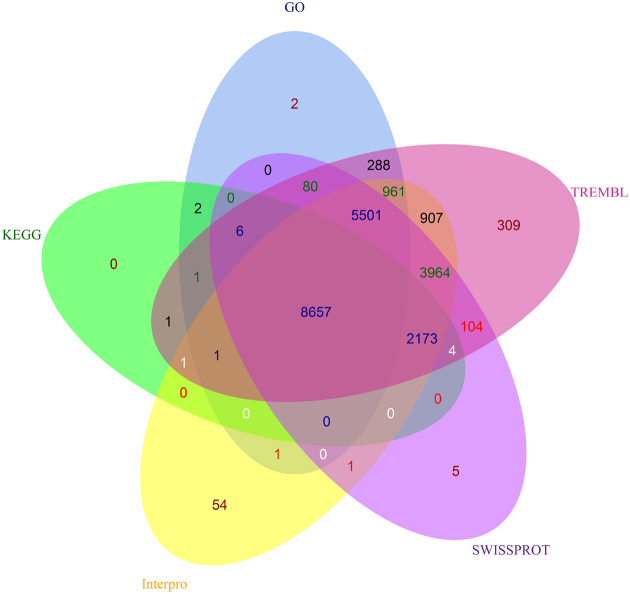
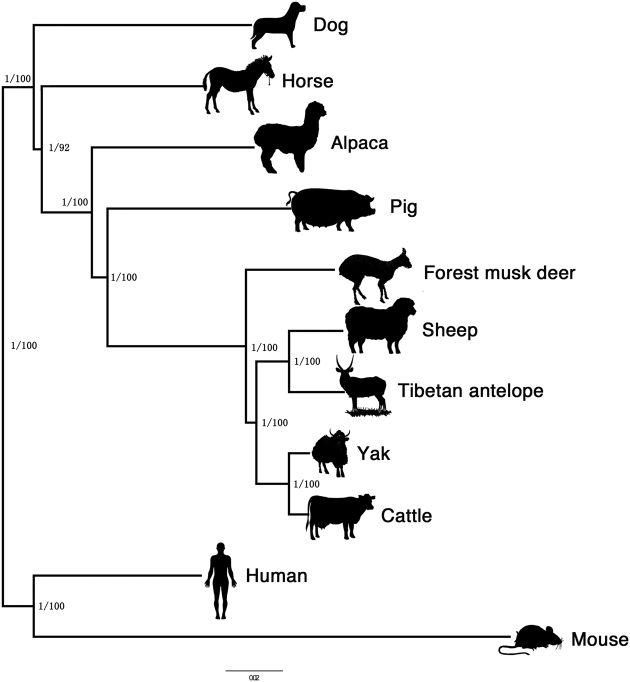
A total of 407 Gb raw reads from whole-genome sequencing were generated using the Illumina HiSeq 4000 platform. The final genome assembly is around 2.72 Gb, with a contig N50 length of 22.6 kb and a scaffold N50 length of 2.85 Mb. We identified 24,352 genes and found that 42.05% of the genome is composed of repetitive elements. We also detected 1,236 olfactory receptor genes. The genome-wide phylogenetic tree indicated that the forest musk deer was within the order Artiodactyla, and it appeared as the sister clade of four members of Bovidae. In total, 576 genes were under positive selection in the forest musk deer lineage.
We provide the first genome sequence and gene annotation for the forest musk deer. The availability of these resources will be very useful for the conservation and captive breeding of this endangered and economically important species and for reconstructing the evolutionary history of the order Artiodactyla.
林麝是麝属的七种麝之一,分布在中国西南部。与其他麝类一样,林麝一直以来都因其麝香(即全球香水工业)而被猎捕。大量的狩猎压力和栖息地的丧失导致其种群数量显著下降。因此,中国政府在 20 世纪 50 年代开始开展圈养繁殖计划以获取麝香。然而,致命疾病的流行极大地限制了种群的增长。圈养林麝种群的近亲繁殖和遗传多样性下降加剧了疾病的严重程度和范围。为了提高其身体和遗传健康,了解圈养和野生林麝种群的免疫系统和基因组是至关重要的。因此,我们对林麝进行了全基因组测序,完成了基因组组装和注释,并进行了初步的生物信息学分析。
我们使用 Illumina HiSeq 4000 平台生成了总计 407 Gb 的全基因组测序原始读数。最终基因组组装约为 2.72 Gb,其 contig N50 长度为 22.6 kb,scaffold N50 长度为 2.85 Mb。我们鉴定出 24352 个基因,发现基因组的 42.05%由重复元件组成。我们还检测到 1236 个嗅觉受体基因。全基因组系统发育树表明,林麝属于偶蹄目,是牛科的四个成员的姐妹分支。在林麝谱系中,共有 576 个基因受到正选择。
我们提供了林麝的首个基因组序列和基因注释。这些资源的可用性对于保护和圈养这一濒危且具有经济重要性的物种,以及重建偶蹄目动物的进化历史将非常有用。