Unit of Biostructure, Faculty of Physical Education and Sport, Wroclaw University of Health and Sport Sciences, Wroclaw, Poland.
Front Public Health. 2023 May 9;11:1163215. doi: 10.3389/fpubh.2023.1163215. eCollection 2023.
This study aimed to assess the importance of socioeconomic status (SES) on health-related fitness (H-RF) measurements in young adults and determine the impact of SES over 20 years of substantial social and economic changes in Poland.
The study compared H-RF differences between 2001 (P) and 2022 (P) in 252 volunteers aged 18 to 28 years who were grouped into quartiles based on SES and gender. The variables measured included height, weight, body mass index, body fat mass, hand strength (hand grip), abdomen strength (sit-ups), flexibility (sit and reach), and leg power (standing long jump), with a synthetic motor performance index (MPSI) calculated for each participant.
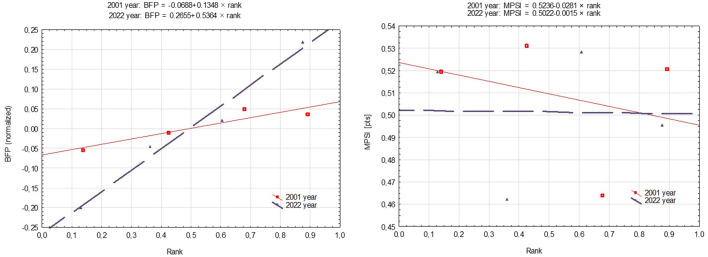
Health-related differences based on social inequalities included body fat mass and MPSI, and two-way analysis of variance (ANOVA) revealed an interaction between SES and period on motor performance (F = 2.73, = 0.045). In addition, tests revealed differences in P between SES quartiles one and two ( = 0.028). Over the last 20 years, physical fitness decreased and body fat increased. The regression slope showed decreased motor performance with higher amounts of body fat in P subjects compared to their P peers.
The observed trends may be associated with lifestyle changes shaped by technology development, high-energy and low-quality food access, and increased physical inactivity.
本研究旨在评估社会经济地位(SES)对年轻成年人健康相关体能(H-RF)测量的重要性,并确定 SES 在波兰 20 多年来发生重大社会和经济变化的情况下对 H-RF 的影响。
该研究比较了 2001 年(P)和 2022 年(P)之间 252 名 18 至 28 岁志愿者的 H-RF 差异,这些志愿者根据 SES 和性别分为四组。测量的变量包括身高、体重、体重指数、体脂肪量、手部力量(握力)、腹部力量(仰卧起坐)、柔韧性(坐立前伸)和腿部力量(立定跳远),并为每位参与者计算了综合运动表现指数(MPSI)。
基于社会不平等的健康相关差异包括体脂肪量和 MPSI,并且双因素方差分析(ANOVA)显示 SES 和时期对运动表现的交互作用(F = 2.73,p = 0.045)。此外,检验显示 SES 四分位数 1 和 2 之间在 P 之间存在差异(p = 0.028)。在过去的 20 年里,体能下降,体脂肪增加。回归斜率显示,与 P 组相比,P 组中体脂肪量较高的受试者运动表现下降。
观察到的趋势可能与生活方式的变化有关,这些变化是由技术发展、高能量低质量食物的获取以及身体活动减少所塑造的。