Amer Bashar, Deshpande Rahul R, Bird Susan S
Thermo Fisher Scientific, San Jose, 95134 CA, USA.
Metabolites. 2023 May 10;13(5):648. doi: 10.3390/metabo13050648.
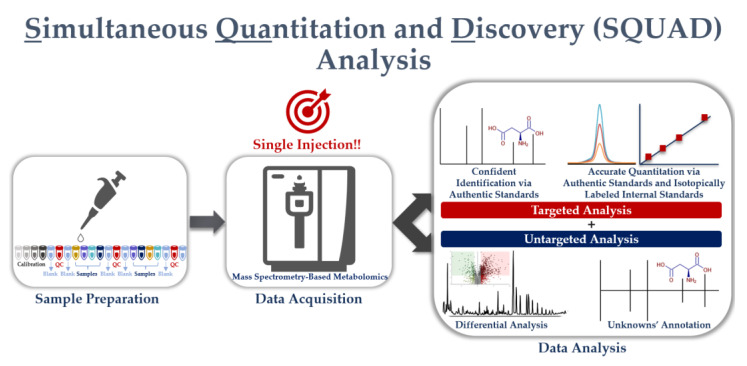
Untargeted and targeted approaches are the traditional metabolomics workflows acquired for a wider understanding of the metabolome under focus. Both approaches have their strengths and weaknesses. The untargeted, for example, is maximizing the detection and accurate identification of thousands of metabolites, while the targeted is maximizing the linear dynamic range and quantification sensitivity. These workflows, however, are acquired separately, so researchers compromise either a low-accuracy overview of total molecular changes (i.e., untargeted analysis) or a detailed yet blinkered snapshot of a selected group of metabolites (i.e., targeted analysis) by selecting one of the workflows over the other. In this review, we present a novel single injection simultaneous quantitation and discovery (SQUAD) metabolomics that combines targeted and untargeted workflows. It is used to identify and accurately quantify a targeted set of metabolites. It also allows data retro-mining to look for global metabolic changes that were not part of the original focus. This offers a way to strike the balance between targeted and untargeted approaches in one single experiment and address the two approaches' limitations. This simultaneous acquisition of hypothesis-led and discovery-led datasets allows scientists to gain more knowledge about biological systems in a single experiment.
非靶向和靶向方法是传统的代谢组学工作流程,旨在更全面地了解目标代谢组。这两种方法都有其优缺点。例如,非靶向方法能最大限度地检测和准确鉴定数千种代谢物,而靶向方法则能最大限度地扩大线性动态范围和定量灵敏度。然而,这些工作流程是分别进行的,因此研究人员通过选择其中一种工作流程,要么只能得到总分子变化的低精度概述(即非靶向分析),要么只能得到选定代谢物组的详细但片面的快照(即靶向分析)。在本综述中,我们介绍了一种新颖的单注射同时定量和发现(SQUAD)代谢组学方法。它用于识别和准确量化一组目标代谢物。它还允许对数据进行追溯挖掘,以寻找不属于原始关注重点的全局代谢变化。这提供了一种在单个实验中平衡靶向和非靶向方法并解决这两种方法局限性的途径。这种同时获取假设驱动和发现驱动数据集的方式使科学家能够在单个实验中获得更多关于生物系统的知识。