Center for Policy Impact in Global Health, Duke Global Health Institute, Duke University, Durham, NC, United States.
ODI, London, United Kingdom.
Front Public Health. 2023 May 10;11:1096224. doi: 10.3389/fpubh.2023.1096224. eCollection 2023.
The United Kingdom (UK) used to be the second largest bilateral provider of official development assistance (ODA) for health. However, in 2021 the UK government cut its annual aid budget by 30%. We aim to understand how these cuts might affect financing for health systems in UK aid recipient countries.
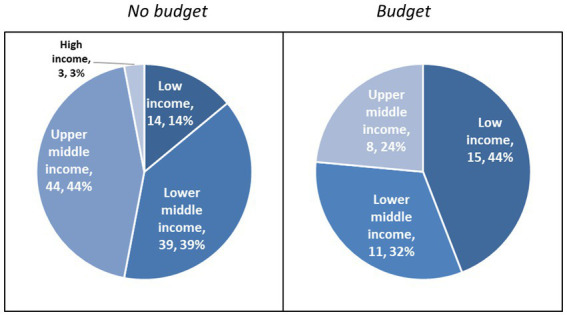
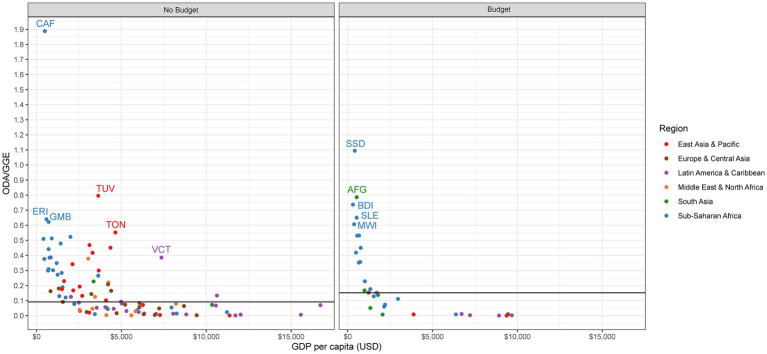
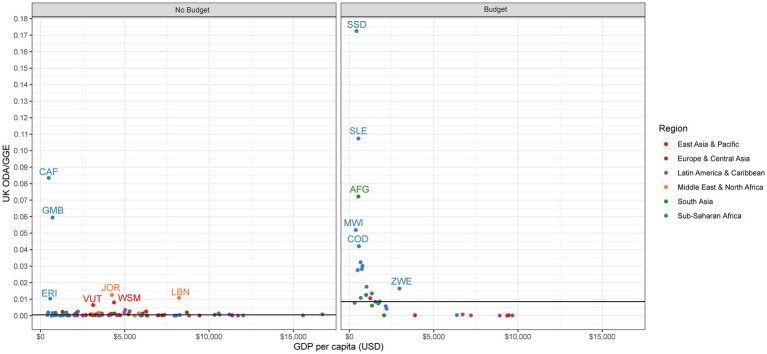
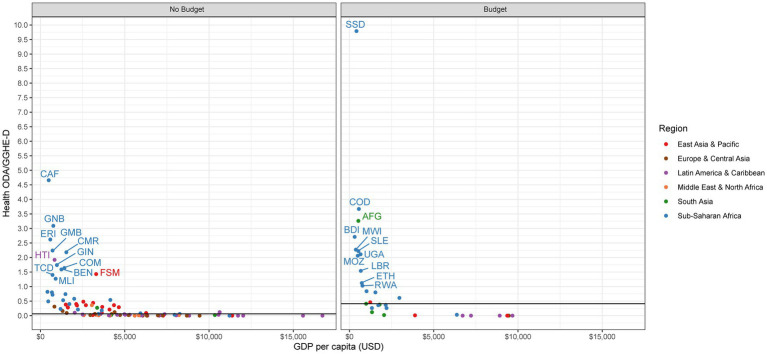
We conducted a retrospective analysis of domestic and external funding for 134 countries that received UK aid for the 2019-2020 budget year. We grouped countries into two cohorts: those that continued to receive aid in 2020-2021 ("budget") and those that did not ("no budget"). Data was collected from publicly available datasets and we compared UK's ODA, UK's health ODA with total ODA, general government expenditures and domestic general government health expenditure to assess the donor dependency and donor concentration of budget and no budget countries.
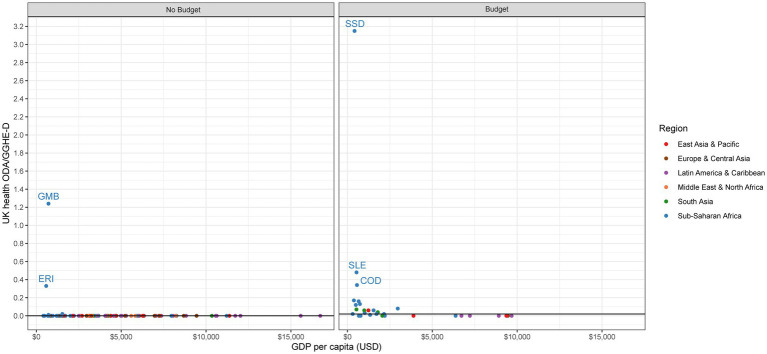
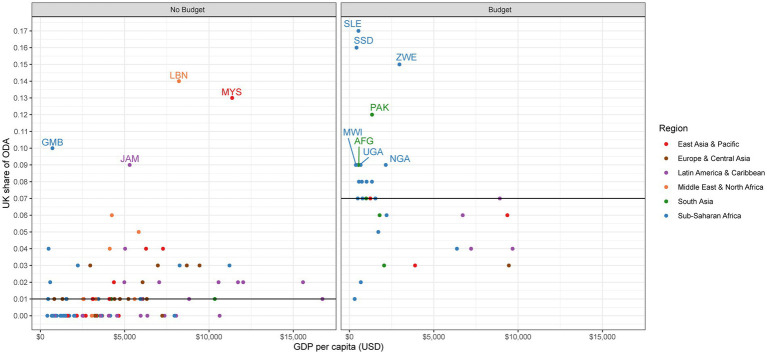
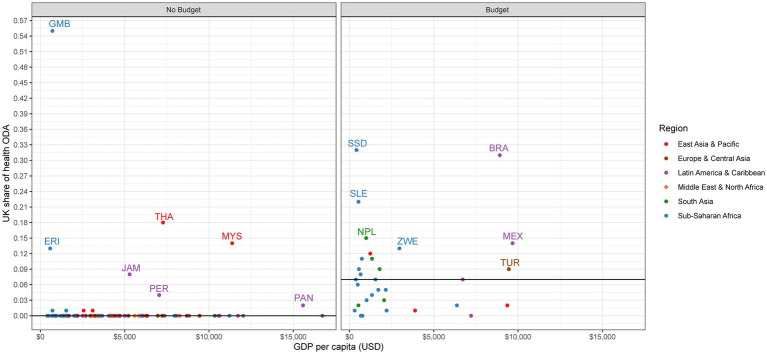
Budget countries are more reliant on external aid to finance their governments and health systems than no budget countries, with a handful of exceptions. While the UK does not appear to be a major ODA contributor among most no budget countries, it is in many budget countries. Two no budget countries in particular may be faced with health systems financing challenges given their high ratios of UK health aid to domestic government health expenditures: the Gambia (1.24:1) and Eritrea (0.33:1). Although "safe" for this budget cycle, a number of low-income countries in Sub-Saharan Africa have very high ratios of UK health aid to domestic government health expenditures, including South Sudan (3.15:1), Sierra Leone (0.48:1), and the Democratic Republic of Congo (0.34:1).
The 2021-2022 UK aid cuts could have negative impacts in a few countries highly dependent on UK health aid. Its departure could leave these countries with rather large funding gaps to fill and create a more concentrated donor climate.
英国曾是卫生领域第二大双边官方发展援助(ODA)提供国。然而,2021 年英国政府将其年度援助预算削减了 30%。我们旨在了解这些削减将如何影响英国援助接受国的卫生系统融资。
我们对 2019-2020 预算年度获得英国援助的 134 个国家的国内和外部资金进行了回顾性分析。我们将这些国家分为两组:在 2020-2021 年继续获得援助的国家(“预算国家”)和未获得援助的国家(“无预算国家”)。数据来自公开数据集,我们比较了英国的 ODA、英国的卫生 ODA 与总 ODA、政府总支出和国内政府卫生支出,以评估预算国家和无预算国家的捐助国依赖性和捐助国集中程度。
预算国家比无预算国家更依赖外部援助来为其政府和卫生系统提供资金,除了少数例外。虽然英国在大多数无预算国家中似乎不是主要的 ODA 捐助国,但在许多预算国家中却是如此。有两个无预算国家可能面临卫生系统融资挑战,因为英国卫生援助与国内政府卫生支出的比例很高:冈比亚(1.24:1)和厄立特里亚(0.33:1)。尽管在这个预算周期内是“安全”的,但撒哈拉以南非洲的一些低收入国家英国卫生援助与国内政府卫生支出的比例非常高,包括南苏丹(3.15:1)、塞拉利昂(0.48:1)和刚果民主共和国(0.34:1)。
2021-2022 年英国援助削减可能会对一些高度依赖英国卫生援助的国家产生负面影响。它的离开可能会使这些国家留下相当大的资金缺口需要填补,并创造一个更加集中的捐助环境。