Gillings School of Global Public Health, University of North Carolina at Chapel Hill, 135 Dauer Drive, Chapel Hill, NC 27599, USA.
Center for Policy Impact in Global Health, Duke Global Health Institute, Duke University, 310 Trent Drive, Durham, NC 27710, USA.
Health Policy Plan. 2022 Oct 12;37(9):1188-1202. doi: 10.1093/heapol/czac063.
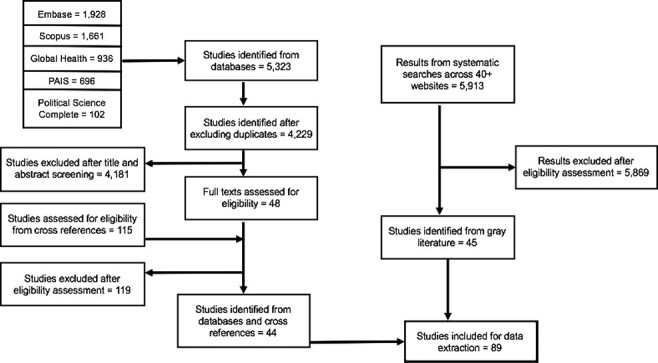
As countries graduate from low-income to middle-income status, many face losses in development assistance for health and must 'transition' to greater domestic funding of their health response. If improperly managed, donor transitions in middle-income countries (MICs) could present significant challenges to global health progress. No prior knowledge synthesis has comprehensively surveyed how donor transitions can affect health systems in MICs. We conducted a scoping review using a structured search strategy across five academic databases and 37 global health donor and think tank websites for literature published between January 1990 and October 2018. We used the World Health Organization health system 'building blocks' framework to thematically synthesize and structure the analysis. Following independent screening, 89 publications out of 11 236 were included for data extraction and synthesis. Most of this evidence examines transitions related to human immunodeficiency virus/Acquired Immune Deficiency Syndrome (AIDS; n = 45, 50%) and immunization programmes (n = 14, 16%), with a focus on donors such as the Global Fund to Fight AIDS, Tuberculosis and Malaria (n = 26, 29%) and Gavi, the Vaccine Alliance (n = 15, 17%). Donor transitions are influenced by the actions of both donors and country governments, with impacts on every component of the health system. Successful transition experiences show that leadership, planning, and pre-transition investments in a country's financial, technical, and logistical capacity are vital to ensuring smooth transition. In the absence of such measures, shortages in financial resources, medical product and supply stock-outs, service disruptions, and shortages in human resources were common, with resulting implications not only for programme continuation, but also for population health. Donor transitions can affect different components of the health system in varying and interconnected ways. More rigorous evaluation of how donor transitions can affect health systems in MICs will create an improved understanding of the risks and opportunities posed by donor exits.
随着国家从低收入向中等收入过渡,许多国家在卫生方面的发展援助减少,必须向国内卫生应对措施投入更多资金。如果管理不当,中等收入国家(MICs)的捐助方过渡可能会对全球卫生进展造成重大挑战。以前没有进行过全面调查,以了解捐助方过渡如何影响 MICs 的卫生系统。我们使用结构化的搜索策略在五个学术数据库和 37 个全球卫生捐助方和智库网站上进行了范围综述,以搜索 1990 年 1 月至 2018 年 10 月期间发表的文献。我们使用世界卫生组织卫生系统“构建块”框架对其进行主题综合分析和结构分析。经过独立筛选,从 11236 篇文献中提取了 89 篇进行数据提取和综合。这些证据大多是关于与人类免疫缺陷病毒/获得性免疫缺陷综合征(AIDS;n=45,50%)和免疫规划相关的过渡(n=14,16%),重点是全球抗击艾滋病、结核病和疟疾基金(n=26,29%)和疫苗联盟(n=15,17%)等捐助方。捐助方过渡受到捐助方和国家政府的行动影响,对卫生系统的每个组成部分都有影响。成功的过渡经验表明,领导、规划以及在国家财政、技术和后勤能力方面的过渡前投资对于确保顺利过渡至关重要。如果没有这些措施,就会出现资金短缺、医疗产品和供应品缺货、服务中断以及人力资源短缺等情况,不仅对方案的继续实施,而且对人口健康都会产生影响。捐助方过渡会以不同的方式和相互关联的方式影响卫生系统的不同组成部分。更严格地评估捐助方过渡如何影响 MICs 的卫生系统,将更好地了解捐助方退出带来的风险和机遇。