Department of Biology, University of Fribourg, 1700, Fribourg, Switzerland.
Neural Signaling and Circuit Plasticity Group, Department of Biology, KU Leuven, 3000, Leuven, Belgium.
Nat Commun. 2023 May 26;14(1):3052. doi: 10.1038/s41467-023-38685-1.
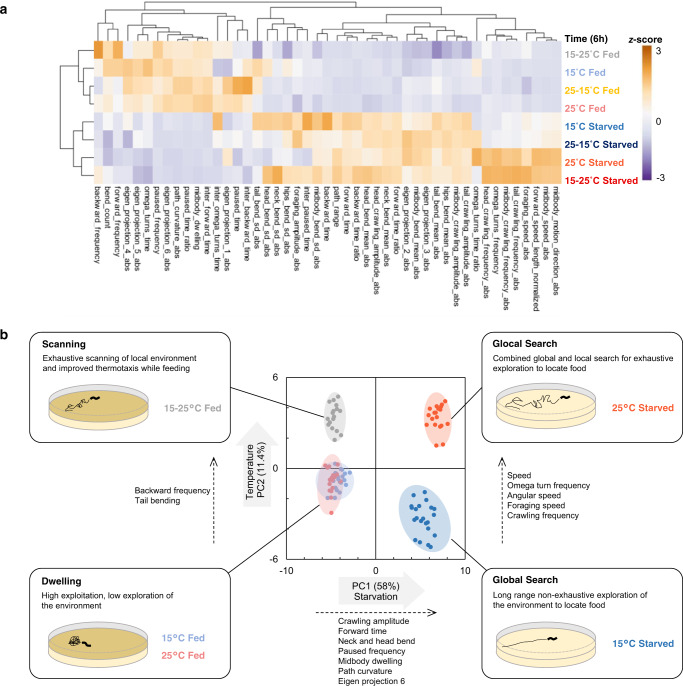
Maintaining or shifting between behavioral states according to context is essential for animals to implement fitness-promoting strategies. How the integration of internal state, past experience and sensory inputs orchestrates persistent multidimensional behavioral changes remains poorly understood. Here, we show that C. elegans integrates environmental temperature and food availability over different timescales to engage in persistent dwelling, scanning, global or glocal search strategies matching thermoregulatory and feeding needs. Transition between states, in each case, involves regulating multiple processes including AFD or FLP tonic sensory neurons activity, neuropeptide expression and downstream circuit responsiveness. State-specific FLP-6 or FLP-5 neuropeptide signaling acts on a distributed set of inhibitory GPCR(s) to promote scanning or glocal search, respectively, bypassing dopamine and glutamate-dependent behavioral state control. Integration of multimodal context via multisite regulation in sensory circuits might represent a conserved regulatory logic for a flexible prioritization on the valence of multiple inputs when operating persistent behavioral state transitions.
根据环境维持或转换行为状态对于动物实施促进适应性的策略至关重要。内部状态、过去的经验和感觉输入的整合如何协调持久的多维行为变化仍然知之甚少。在这里,我们表明,秀丽隐杆线虫整合环境温度和食物可利用性在不同的时间尺度上,以参与持久的居住、扫描、全局或局部搜索策略,以匹配体温调节和进食需求。在每种情况下,状态之间的转换都涉及调节多个过程,包括 AFD 或 FLP 紧张性感觉神经元活动、神经肽表达和下游电路反应性。特定于状态的 FLP-6 或 FLP-5 神经肽信号分别作用于一组分布式抑制性 GPCR,以促进扫描或局部搜索,从而绕过多巴胺和谷氨酸依赖的行为状态控制。通过感觉回路中的多部位调节对多模态上下文的整合可能代表了一种保守的调节逻辑,用于在持续的行为状态转换中灵活地对多个输入的效价进行优先级排序。