Comaills Valentine, Castellano-Pozo Maikel
Andalusian Center for Molecular Biology and Regenerative Medicine-CABIMER, University of Pablo de Olavide-University of Seville-CSIC, Junta de Andalucía, 41092 Seville, Spain.
Genetic Department, Faculty of Biology, University of Seville, 41080 Seville, Spain.
Biology (Basel). 2023 Apr 28;12(5):671. doi: 10.3390/biology12050671.
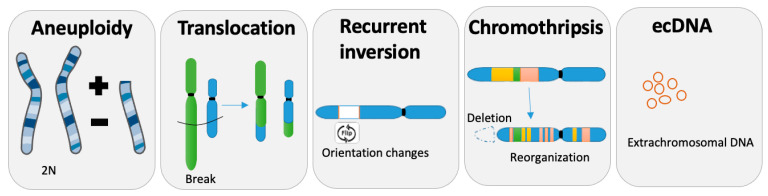
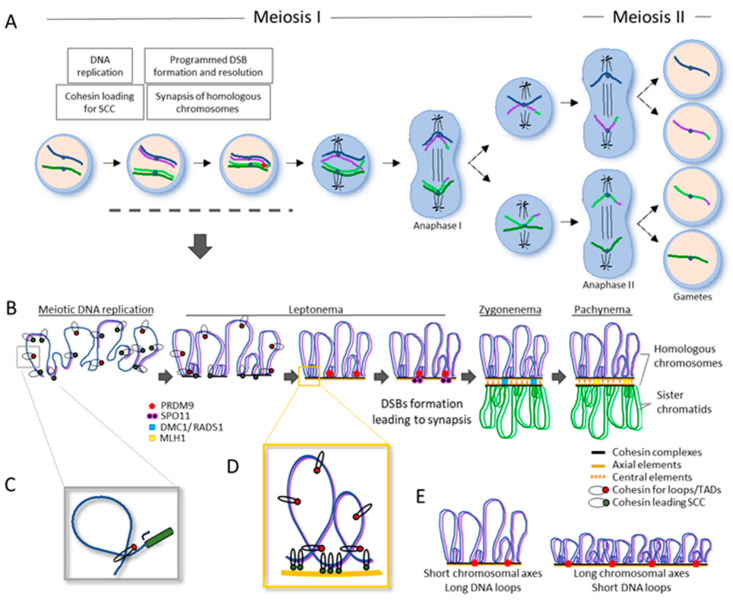
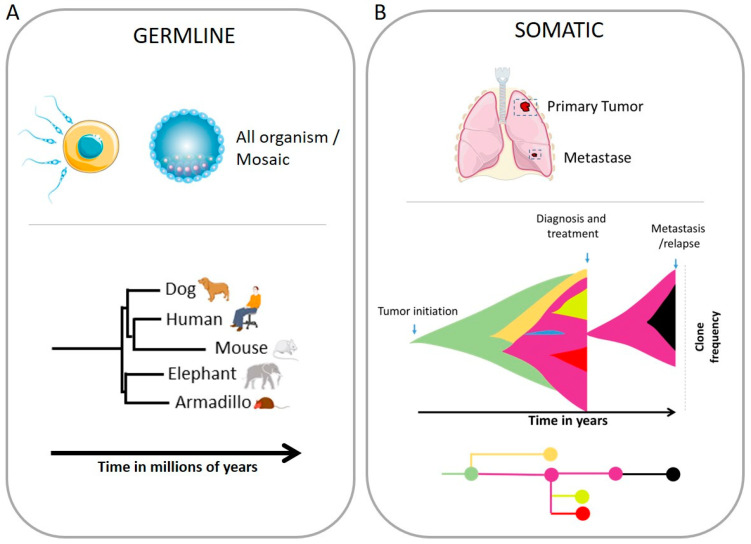
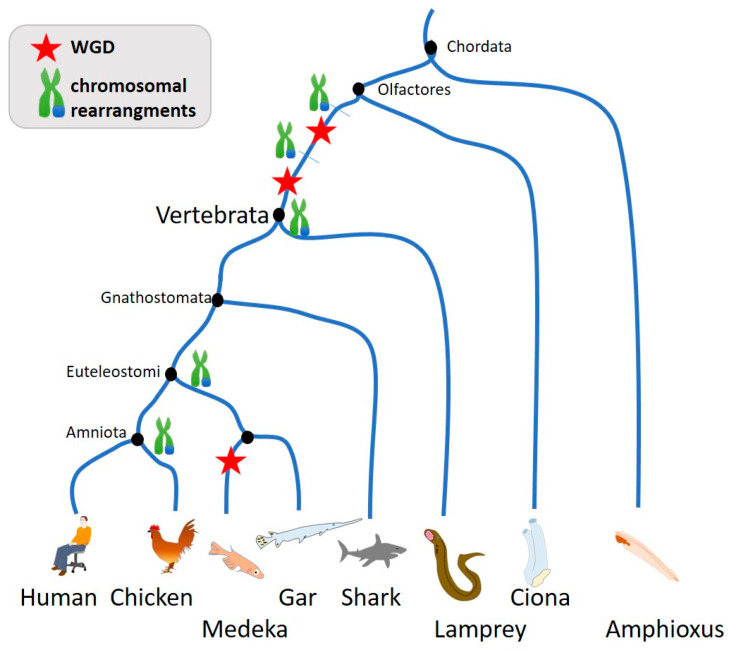
The integrity of the genome is crucial for the survival of all living organisms. However, genomes need to adapt to survive certain pressures, and for this purpose use several mechanisms to diversify. Chromosomal instability (CIN) is one of the main mechanisms leading to the creation of genomic heterogeneity by altering the number of chromosomes and changing their structures. In this review, we will discuss the different chromosomal patterns and changes observed in speciation, in evolutional biology as well as during tumor progression. By nature, the human genome shows an induction of diversity during gametogenesis but as well during tumorigenesis that can conclude in drastic changes such as the whole genome doubling to more discrete changes as the complex chromosomal rearrangement chromothripsis. More importantly, changes observed during speciation are strikingly similar to the genomic evolution observed during tumor progression and resistance to therapy. The different origins of CIN will be treated as the importance of double-strand breaks (DSBs) or the consequences of micronuclei. We will also explain the mechanisms behind the controlled DSBs, and recombination of homologous chromosomes observed during meiosis, to explain how errors lead to similar patterns observed during tumorigenesis. Then, we will also list several diseases associated with CIN, resulting in fertility issues, miscarriage, rare genetic diseases, and cancer. Understanding better chromosomal instability as a whole is primordial for the understanding of mechanisms leading to tumor progression.
基因组的完整性对于所有生物的生存至关重要。然而,基因组需要适应以在某些压力下生存,为此会利用多种机制实现多样化。染色体不稳定性(CIN)是通过改变染色体数量和结构导致基因组异质性产生的主要机制之一。在本综述中,我们将讨论在物种形成、进化生物学以及肿瘤进展过程中观察到的不同染色体模式和变化。从本质上讲,人类基因组在配子发生过程中以及肿瘤发生过程中都会表现出多样性的诱导,这可能导致剧烈变化,如全基因组加倍,也可能导致更离散的变化,如复杂的染色体重排——染色体碎裂。更重要的是,在物种形成过程中观察到的变化与在肿瘤进展和治疗耐药过程中观察到的基因组进化惊人地相似。CIN的不同起源将从双链断裂(DSB)的重要性或微核的后果方面进行探讨。我们还将解释减数分裂过程中观察到的受控DSB和同源染色体重组背后的机制,以解释错误是如何导致在肿瘤发生过程中观察到的类似模式的。然后,我们还将列出几种与CIN相关的疾病,这些疾病会导致生育问题、流产、罕见遗传病和癌症。全面更好地理解染色体不稳定性对于理解导致肿瘤进展的机制至关重要。