Berman Rina, Spencer Haley, Boese Martin, Kim Sharon, Radford Kennett, Choi Kwang
Center for the Study of Traumatic Stress, Uniformed Services University, Bethesda, MD 20814, USA.
Program in Neuroscience, Uniformed Services University, Bethesda, MD 20814, USA.
Brain Sci. 2023 Apr 30;13(5):750. doi: 10.3390/brainsci13050750.
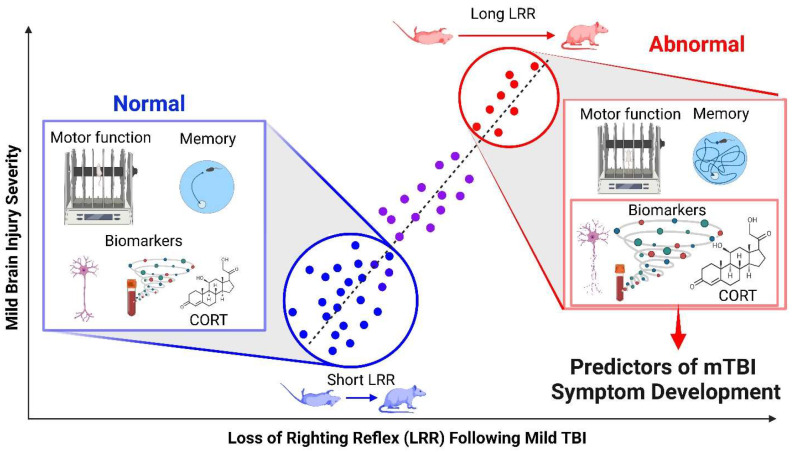
Identifying predictors for individuals vulnerable to the adverse effects of traumatic brain injury (TBI) remains an ongoing research pursuit. This is especially important for patients with mild TBI (mTBI), whose condition is often overlooked. TBI severity in humans is determined by several criteria, including the duration of loss of consciousness (LOC): LOC < 30 min for mTBI and LOC > 30 min for moderate-to-severe TBI. However, in experimental TBI models, there is no standard guideline for assessing the severity of TBI. One commonly used metric is the loss of righting reflex (LRR), a rodent analogue of LOC. However, LRR is highly variable across studies and rodents, making strict numeric cutoffs difficult to define. Instead, LRR may best be used as predictor of symptom development and severity. This review summarizes the current knowledge on the associations between LOC and outcomes after mTBI in humans and between LRR and outcomes after experimental TBI in rodents. In clinical literature, LOC following mTBI is associated with various adverse outcome measures, such as cognitive and memory deficits; psychiatric disorders; physical symptoms; and brain abnormalities associated with the aforementioned impairments. In preclinical studies, longer LRR following TBI is associated with greater motor and sensorimotor impairments; cognitive and memory impairments; peripheral and neuropathology; and physiologic abnormalities. Because of the similarities in associations, LRR in experimental TBI models may serve as a useful proxy for LOC to contribute to the ongoing development of evidence-based personalized treatment strategies for patients sustaining head trauma. Analysis of highly symptomatic rodents may shed light on the biological underpinnings of symptom development after rodent TBI, which may translate to therapeutic targets for mTBI in humans.
确定易受创伤性脑损伤(TBI)不良影响的个体预测因素仍是一项持续的研究工作。这对于轻度TBI(mTBI)患者尤为重要,他们的病情常常被忽视。人类TBI的严重程度由多个标准决定,包括意识丧失(LOC)的持续时间:mTBI的LOC<30分钟,中重度TBI的LOC>30分钟。然而,在实验性TBI模型中,尚无评估TBI严重程度的标准指南。一种常用的指标是翻正反射丧失(LRR),它是LOC在啮齿动物中的类似物。然而,LRR在不同研究和啮齿动物之间差异很大,难以定义严格的数值界限。相反,LRR最好用作症状发展和严重程度的预测指标。本综述总结了关于人类mTBI后LOC与结局之间以及啮齿动物实验性TBI后LRR与结局之间关联的现有知识。在临床文献中,mTBI后的LOC与各种不良结局指标相关,如认知和记忆缺陷、精神障碍、身体症状以及与上述损伤相关的脑异常。在临床前研究中,TBI后较长的LRR与更大的运动和感觉运动损伤、认知和记忆损伤、外周和神经病理学以及生理异常相关。由于关联的相似性,实验性TBI模型中的LRR可作为LOC的有用替代指标,有助于为头部创伤患者不断制定基于证据的个性化治疗策略。对高度有症状的啮齿动物进行分析可能会揭示啮齿动物TBI后症状发展的生物学基础,这可能转化为人类mTBI的治疗靶点。