Nugroho Hari Wahyu, Salimo Harsono, Hartono Hartono, Hakim Moh Abdul, Probandari Ari
Doctoral Program of Public Health, Faculty of Medicine, Universitas Sebelas Maret, Surakarta, Indonesia.
Department of Public Health, Faculty of Medicine, Universitas Sebelas Maret, Surakarta, Indonesia.
Front Nutr. 2023 May 11;10:1067626. doi: 10.3389/fnut.2023.1067626. eCollection 2023.
Working memory is critical in cognitive skills, especially among children. Children's ability to count and complete cognitive tasks are strongly associated with working memory abilities. Recent studies indicated that in addition to health factors, socioeconomic status also has a significant impact on children's working memory capacity. Despite these, evidence on the effects of socioeconomic status on working memory from developing countries yielded a somewhat puzzling picture.
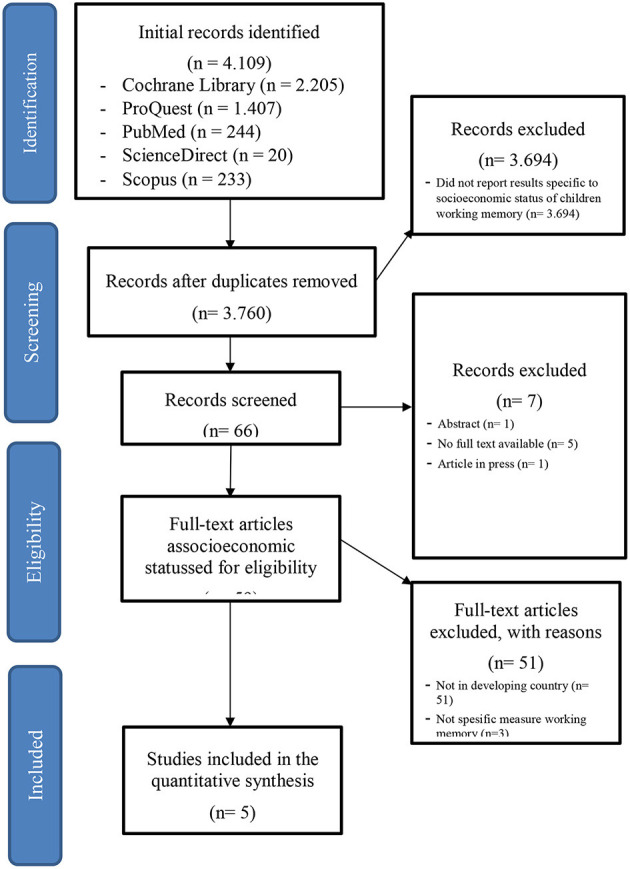
This systematic review and meta-analysis provide a comprehensive summary of the recent evidence concerning the socioeconomic status determinants of children's working memory in developing countries. We searched via Cochrane library, ScienceDirect, Scopus, PubMed, and ProQuest. The initial search terms were ["socioeconomic", "socio-economic", "socioeconomic status", "socio-economic status", "income", "poverty", "disadvantaged", "disparity"] AND ["working memory", "short term memory", "short-term memory", "cognitive", "achievement", "performance"] AND ["child", "school child"]. Odds ratio (for categorical outcome data) or standardized mean differences (for continuous data) and their 95% confidence intervals were calculated from the data generated.
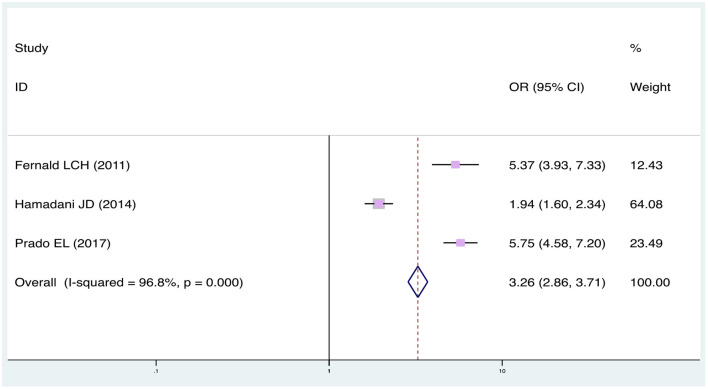
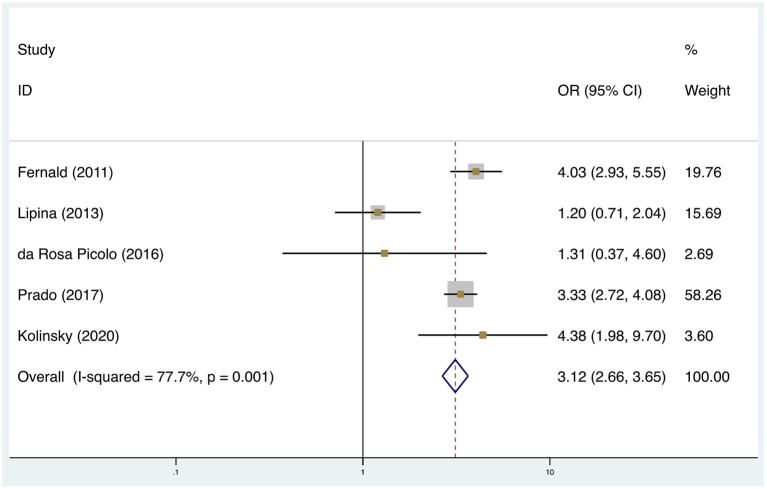
This meta-analysis included five studies from 4 developing countries with a total of 4,551 subjects. Poverty was associated with a lower working memory score (OR: 3.12; 95% CI: 2.66, 3.65; < 0.001). Another finding from 2 studies in this meta-analysis was that low mother education was associated with a lower score of working memory (OR: 3.26, 95% CI: 2.86, 3.71; < 0.001).
Poverty and low level of mothers' education were significant risk factors for lowering working memory among children in developing countries.
https://www.crd.york.ac.uk/prospero/, identifier: CRD42021270683.
工作记忆在认知技能中至关重要,尤其是在儿童中。儿童的计数能力和完成认知任务的能力与工作记忆能力密切相关。最近的研究表明,除健康因素外,社会经济地位也对儿童的工作记忆容量有重大影响。尽管如此,来自发展中国家的关于社会经济地位对工作记忆影响的证据却呈现出一幅有些令人困惑的图景。
本系统评价和荟萃分析全面总结了近期有关发展中国家儿童工作记忆的社会经济地位决定因素的证据。我们通过Cochrane图书馆、ScienceDirect、Scopus、PubMed和ProQuest进行搜索。最初的搜索词为["社会经济", "社会 - 经济", "社会经济地位", "社会 - 经济地位", "收入", "贫困", "弱势", "差距"] AND ["工作记忆", "短期记忆", "短期记忆", "认知", "成就", "表现"] AND ["儿童", "学童"]。根据生成的数据计算比值比(用于分类结果数据)或标准化均值差(用于连续数据)及其95%置信区间。
该荟萃分析纳入了来自4个发展中国家的5项研究,共4551名受试者。贫困与较低的工作记忆得分相关(比值比:3.12;95%置信区间:2.66, 3.65;P < 0.001)。该荟萃分析中2项研究的另一个发现是,母亲教育程度低与较低的工作记忆得分相关(比值比:3.26,95%置信区间:2.86, 3.71;P < 0.001)。
贫困和母亲教育水平低是发展中国家儿童工作记忆降低的重要危险因素。